Salo Ruth, Fassbender Catherine, Iosif Ana-Maria, Ursu Stefan, Leamon Martin H, Carter Cameron
Department of Psychiatry and Behavioral Sciences, University of California, Davis, 2230 Stockton Blvd, Sacramento, CA 95817, USA; Imaging Research Center, University of California, Davis, 4701 X Street, Sacramento, CA 95817, USA.
Psychiatry Res. 2013 Dec 15;210(2):529-35. doi: 10.1016/j.psychres.2013.06.030. Epub 2013 Jul 26.
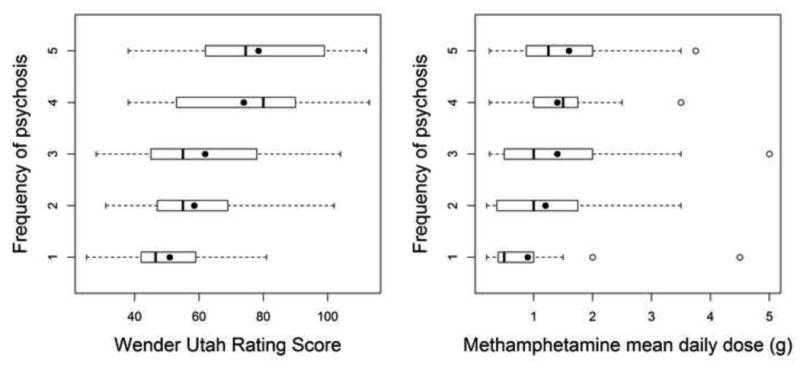
The goal of this study was to extend our previous research that reported a significant association between Attention Deficit Hyperactivity Disorder (ADHD)-relevant childhood behaviors and the frequency of methamphetamine (MA)-induced psychotic symptoms in an expanded sample. 190 participants who met DSM-IV criteria for MA dependence were administered the Methamphetamine Experience Questionnaire that assessed MA-induced psychosis. Data related to MA exposure, comorbid drug use, education, familial psychiatric history and assessments of ADHD-relevant childhood behaviors as measured by the Wender Utah Rating Scale (WURS) were collected. Although WURS scores did not differ between 145 MAP+ and 45 MAP- subjects, MAP+ subjects with higher WURS scores were significantly more likely to report more frequent psychosis. Although mean daily MA dosage did not differ between the MAP+ and MAP- subjects, MAP+ subjects who consumed larger doses of MA were significantly more likely to experience frequent psychosis. These data suggest that ADHD-relevant childhood behaviors may interact with MA exposure to reflect a neurobiological vulnerability related to the emergence of frequent MA-induced psychotic symptoms. These results may elucidate factors that contribute to the psychiatric sequelae of MA abuse.
本研究的目的是在一个扩大的样本中扩展我们之前的研究,该研究报告了与注意力缺陷多动障碍(ADHD)相关的儿童行为与甲基苯丙胺(MA)诱发的精神病症状频率之间存在显著关联。对190名符合DSM-IV甲基苯丙胺依赖标准的参与者进行了甲基苯丙胺体验问卷调查,以评估甲基苯丙胺诱发的精神病。收集了与甲基苯丙胺暴露、合并药物使用、教育程度、家族精神病史以及通过温德犹他评定量表(WURS)测量的与ADHD相关的儿童行为评估数据。尽管145名甲基苯丙胺阳性(MAP+)和45名甲基苯丙胺阴性(MAP-)受试者的WURS评分没有差异,但WURS评分较高的MAP+受试者报告更频繁精神病症状的可能性显著更高。尽管MAP+和MAP-受试者的平均每日甲基苯丙胺剂量没有差异,但服用较大剂量甲基苯丙胺的MAP+受试者出现频繁精神病症状的可能性显著更高。这些数据表明,与ADHD相关的儿童行为可能与甲基苯丙胺暴露相互作用,反映出与频繁的甲基苯丙胺诱发的精神病症状出现相关的神经生物学易感性。这些结果可能阐明导致甲基苯丙胺滥用精神后遗症的因素。