Authors' Affiliations: Department of Epidemiology, Columbia University Mailman School of Public Health and Departments of Medicine and Surgery, Columbia University College of Physicians and Surgeons, New York, New York.
Cancer Epidemiol Biomarkers Prev. 2013 Dec;22(12):2202-11. doi: 10.1158/1055-9965.EPI-13-0381. Epub 2013 Jul 29.
Observational studies have suggested that antioxidant nutrients may reduce cancer and overall mortality risks. However, most randomized trials have failed to show survival benefits. Examining nonlinear associations between antioxidant levels and health outcomes may help to explain these discrepant findings.
We evaluated all-cause, cancer, and cardiovascular mortality risks associated with quintiles (Q1-Q5) of serum antioxidant (vitamins C and E, β-carotene, and selenium) and vitamin A levels, in 16,008 adult participants of The Third National Health and Nutrition Examination Survey (NHANES III; 1988-1994).
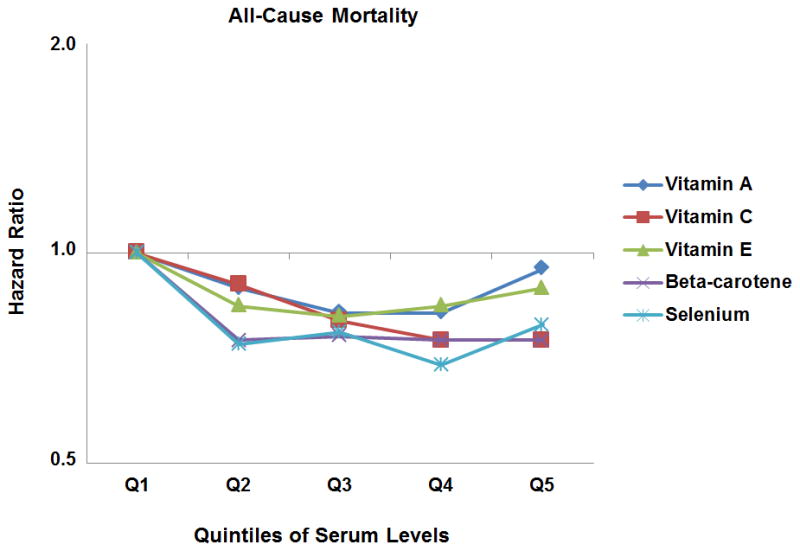
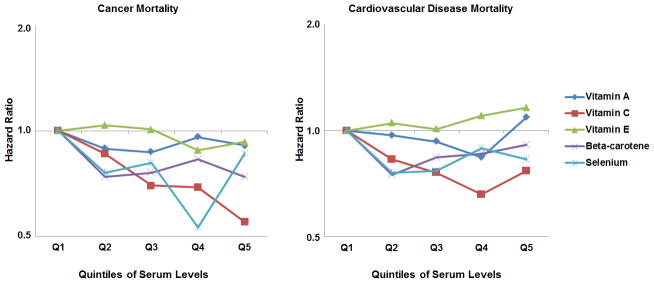
Over a median follow-up period of 14.2 years, there were 4,225 deaths, including 891 from cancer and 1,891 from cardiovascular disease. We observed a dose-response decrease in cancer and overall mortality risks with higher vitamin C levels. In contrast, for vitamin A, risk of cancer death decreased from Q1-Q2, with no further decline in risk at higher levels. For vitamin E, having levels in Q4 was associated with the lowest cancer mortality risk. Both vitamin A and E had U-shaped associations with all-cause mortality. Cancer mortality risks decreased from Q1-Q2 for β-carotene and from Q1-Q4 for selenium. However, for β-carotene and selenium, overall mortality risks decreased from Q1-Q2 but then did not change significantly with higher levels.
Antioxidant supplement use should be studied in the context of overall mortality and other competing mortality risks.
These data suggest the need for novel intervention studies where doses of these agents are individualized based on their serum levels, and possibly, markers of oxidative stress and systemic inflammatory response.
观察性研究表明,抗氧化营养素可能降低癌症和全因死亡率风险。然而,大多数随机试验未能显示生存获益。检验抗氧化剂水平与健康结果之间的非线性关联可能有助于解释这些不一致的发现。
我们评估了血清抗氧化剂(维生素 C 和 E、β-胡萝卜素和硒)和维生素 A 水平五分位数(Q1-Q5)与全因、癌症和心血管死亡率之间的相关性,纳入了 16008 名美国第三次国家健康和营养调查(NHANES III;1988-1994 年)参与者。
在中位数为 14.2 年的随访期间,发生了 4225 例死亡,包括 891 例癌症死亡和 1891 例心血管疾病死亡。我们观察到随着维生素 C 水平的升高,癌症和全因死亡率呈剂量反应性下降。相比之下,对于维生素 A,癌症死亡风险从 Q1-Q2 降低,在更高水平时风险没有进一步下降。对于维生素 E,Q4 水平与最低的癌症死亡率相关。维生素 A 和 E 与全因死亡率均呈 U 形关联。β-胡萝卜素的癌症死亡率风险从 Q1-Q2 降低,而硒的全因死亡率风险从 Q1-Q4 降低。然而,对于β-胡萝卜素和硒,全因死亡率风险从 Q1-Q2 降低,但在更高水平时没有显著变化。
应在全因死亡率和其他竞争死亡风险的背景下研究抗氧化补充剂的使用。
这些数据表明需要进行新的干预研究,根据血清水平以及可能的氧化应激和全身炎症反应标志物,个体化这些药物的剂量。