• 文献检索
  • 文档翻译
  • 深度研究
  • 学术资讯
  • Suppr Zotero 插件Zotero 插件
  • 邀请有礼
  • 套餐&价格
  • 历史记录
应用&插件
Suppr Zotero 插件Zotero 插件浏览器插件Mac 客户端Windows 客户端微信小程序
定价
高级版会员购买积分包购买API积分包
服务
文献检索文档翻译深度研究API 文档MCP 服务
关于我们
关于 Suppr公司介绍联系我们用户协议隐私条款
关注我们

Suppr 超能文献

核心技术专利:CN118964589B侵权必究
粤ICP备2023148730 号-1Suppr @ 2026

文献检索

告别复杂PubMed语法,用中文像聊天一样搜索,搜遍4000万医学文献。AI智能推荐,让科研检索更轻松。

立即免费搜索

文件翻译

保留排版,准确专业,支持PDF/Word/PPT等文件格式,支持 12+语言互译。

免费翻译文档

深度研究

AI帮你快速写综述,25分钟生成高质量综述,智能提取关键信息,辅助科研写作。

立即免费体验

相似文献

1
Lgr4 is a key regulator of prostate development and prostate stem cell differentiation.Lgr4 是前列腺发育和前列腺干细胞分化的关键调节因子。
Stem Cells. 2013 Nov;31(11):2492-505. doi: 10.1002/stem.1484.
2
Lgr4 regulates mammary gland development and stem cell activity through the pluripotency transcription factor Sox2.Lgr4 通过多能转录因子 Sox2 调节乳腺发育和干细胞活性。
Stem Cells. 2013 Sep;31(9):1921-31. doi: 10.1002/stem.1438.
3
Blockade of LGR4 inhibits proliferation and odonto/osteogenic differentiation of stem cells from apical papillae.阻断 LGR4 抑制根尖乳头干细胞的增殖和牙/骨向分化。
J Mol Histol. 2017 Dec;48(5-6):389-401. doi: 10.1007/s10735-017-9737-0. Epub 2017 Oct 6.
4
R-spondin 2-LGR4 system regulates growth, migration and invasion, epithelial-mesenchymal transition and stem-like properties of tongue squamous cell carcinoma via Wnt/β-catenin signaling.R-spondin 2-LGR4 系统通过 Wnt/β-catenin 信号通路调节舌鳞癌细胞的生长、迁移和侵袭、上皮-间充质转化和干细胞样特性。
EBioMedicine. 2019 Jun;44:275-288. doi: 10.1016/j.ebiom.2019.03.076. Epub 2019 May 13.
5
Loss of Lgr4 inhibits differentiation, migration and apoptosis, and promotes proliferation in bone mesenchymal stem cells.Lgr4 缺失抑制成骨间充质干细胞分化、迁移和凋亡,并促进其增殖。
J Cell Physiol. 2019 Jul;234(7):10855-10867. doi: 10.1002/jcp.27927. Epub 2018 Dec 7.
6
Leucine-rich repeat-containing G protein-coupled receptor 4 (Lgr4) is necessary for prostate cancer metastasis via epithelial-mesenchymal transition.富含亮氨酸重复序列的G蛋白偶联受体4(Lgr4)通过上皮-间质转化对前列腺癌转移至关重要。
J Biol Chem. 2017 Sep 15;292(37):15525-15537. doi: 10.1074/jbc.M116.771931. Epub 2017 Aug 2.
7
LGR4 modulates breast cancer initiation, metastasis, and cancer stem cells.LGR4 调节乳腺癌起始、转移和癌症干细胞。
FASEB J. 2018 May;32(5):2422-2437. doi: 10.1096/fj.201700897R. Epub 2017 Dec 21.
8
The Role of LGR4 (GPR48) in Normal and Cancer Processes.LGR4(GPR48)在正常和癌症过程中的作用。
Int J Mol Sci. 2021 Apr 29;22(9):4690. doi: 10.3390/ijms22094690.
9
Ablation of LGR4 signaling enhances radiation sensitivity of prostate cancer cells.LGR4 信号的消融增强了前列腺癌细胞的辐射敏感性。
Life Sci. 2021 Jan 15;265:118737. doi: 10.1016/j.lfs.2020.118737. Epub 2020 Nov 7.
10
Lgr4 promotes prostate tumorigenesis through the Jmjd2a/AR signaling pathway.Lgr4通过Jmjd2a/AR信号通路促进前列腺肿瘤发生。
Exp Cell Res. 2016 Nov 15;349(1):77-84. doi: 10.1016/j.yexcr.2016.09.023. Epub 2016 Oct 12.

引用本文的文献

1
Deficiency of neuronal LGR4 increases energy expenditure and inhibits food intake via hypothalamic leptin signaling.神经元LGR4的缺乏会增加能量消耗,并通过下丘脑瘦素信号传导抑制食物摄入。
EMBO Rep. 2025 Apr;26(8):2098-2120. doi: 10.1038/s44319-025-00398-5. Epub 2025 Mar 11.
2
Role of Leucine-Rich Repeat-Containing G-Protein-Coupled Receptors 4-6 (LGR4-6) in the Ovary and Other Female Reproductive Organs: A Literature Review.富含亮氨酸重复序列的G蛋白偶联受体4-6(LGR4-6)在卵巢及其他女性生殖器官中的作用:文献综述
Cell Transplant. 2025 Jan-Dec;34:9636897241303441. doi: 10.1177/09636897241303441.
3
LGR4 promotes proliferation and homing via activation of the NF‑κB signaling pathway in multiple myeloma.LGR4通过激活多发性骨髓瘤中的NF-κB信号通路促进细胞增殖和归巢。
Int J Oncol. 2025 Feb;66(2). doi: 10.3892/ijo.2025.5718. Epub 2025 Jan 3.
4
Sensory innervation in the prostate and a role for calcitonin gene-related peptide in prostatic epithelial proliferation.前列腺中的感觉神经支配以及降钙素基因相关肽在前列腺上皮增殖中的作用。
Front Mol Neurosci. 2024 Dec 18;17:1497735. doi: 10.3389/fnmol.2024.1497735. eCollection 2024.
5
Unravelling the Mysteries of the Sonic Hedgehog Pathway in Cancer Stem Cells: Activity, Crosstalk and Regulation.揭开癌症干细胞中 Sonic Hedgehog 信号通路的奥秘:活性、相互作用与调控
Curr Issues Mol Biol. 2024 May 29;46(6):5397-5419. doi: 10.3390/cimb46060323.
6
BMP9 induces osteogenic differentiation through up-regulating LGR4 via the mTORC1/Stat3 pathway in mesenchymal stem cells.骨形态发生蛋白9通过mTORC1/Stat3信号通路上调LGR4诱导间充质干细胞向成骨细胞分化。
Genes Dis. 2023 Sep 7;11(3):101075. doi: 10.1016/j.gendis.2023.101075. eCollection 2024 May.
7
YAP is required for prostate development, regeneration, and prostate stem cell function.YAP对于前列腺发育、再生及前列腺干细胞功能是必需的。
Cell Death Discov. 2023 Sep 9;9(1):339. doi: 10.1038/s41420-023-01637-1.
8
LGR4: A New Receptor Member in Endocrine and Metabolic Diseases.LGR4:内分泌和代谢疾病中的一种新型受体成员。
Endocr Rev. 2023 Jul 11;44(4):647-667. doi: 10.1210/endrev/bnad003.
9
Bioinformatics Analysis of in Colon Adenocarcinoma as Potential Diagnostic Biomarker, Therapeutic Target and Promoting Immune Cell Infiltration.结直肠腺癌中 的生物信息学分析及其作为潜在诊断生物标志物、治疗靶点和促进免疫细胞浸润的作用。
Biomolecules. 2022 Aug 6;12(8):1081. doi: 10.3390/biom12081081.
10
LGR4, a G Protein-Coupled Receptor With a Systemic Role: From Development to Metabolic Regulation.LGR4,一种具有全身作用的 G 蛋白偶联受体:从发育到代谢调节。
Front Endocrinol (Lausanne). 2022 May 30;13:867001. doi: 10.3389/fendo.2022.867001. eCollection 2022.

本文引用的文献

1
Lgr4 regulates mammary gland development and stem cell activity through the pluripotency transcription factor Sox2.Lgr4 通过多能转录因子 Sox2 调节乳腺发育和干细胞活性。
Stem Cells. 2013 Sep;31(9):1921-31. doi: 10.1002/stem.1438.
2
Nonsense mutation in the LGR4 gene is associated with several human diseases and other traits.无意义突变在 LGR4 基因中与几种人类疾病和其他特征有关。
Nature. 2013 May 23;497(7450):517-20. doi: 10.1038/nature12124. Epub 2013 May 5.
3
Lgr4/Gpr48 negatively regulates TLR2/4-associated pattern recognition and innate immunity by targeting CD14 expression.Lgr4/Gpr48 通过靶向 CD14 表达来负调控 TLR2/4 相关的模式识别和先天免疫。
J Biol Chem. 2013 May 24;288(21):15131-41. doi: 10.1074/jbc.M113.455535. Epub 2013 Apr 15.
4
Lgr4-mediated Wnt/β-catenin signaling in peritubular myoid cells is essential for spermatogenesis.Lgr4 介导的小管周肌样细胞中的 Wnt/β-catenin 信号通路对于精子发生是必需的。
Development. 2013 Apr;140(8):1751-61. doi: 10.1242/dev.093641.
5
Lgr4 gene deficiency increases susceptibility and severity of dextran sodium sulfate-induced inflammatory bowel disease in mice.Lgr4 基因缺失增加了小鼠对葡聚糖硫酸钠诱导的炎症性肠病的易感性和严重程度。
J Biol Chem. 2013 Mar 29;288(13):8794-803; discussion 8804. doi: 10.1074/jbc.M112.436204. Epub 2013 Feb 7.
6
Notch and TGFβ form a reciprocal positive regulatory loop that suppresses murine prostate basal stem/progenitor cell activity.Notch 和 TGFβ 形成一个相互促进的正反馈调节环路,抑制了小鼠前列腺基底干细胞/祖细胞的活性。
Cell Stem Cell. 2012 Nov 2;11(5):676-88. doi: 10.1016/j.stem.2012.07.003.
7
Multipotent and unipotent progenitors contribute to prostate postnatal development.多能祖细胞和单能祖细胞共同促进前列腺的出生后发育。
Nat Cell Biol. 2012 Nov;14(11):1131-8. doi: 10.1038/ncb2600. Epub 2012 Oct 14.
8
Tumour suppressor RNF43 is a stem-cell E3 ligase that induces endocytosis of Wnt receptors.抑癌基因 RNF43 是一种干细胞 E3 连接酶,可诱导 Wnt 受体的内吞作用。
Nature. 2012 Aug 30;488(7413):665-9. doi: 10.1038/nature11308.
9
ZNRF3 promotes Wnt receptor turnover in an R-spondin-sensitive manner.ZNRF3 以 R 语言应答蛋白敏感的方式促进 Wnt 受体周转。
Nature. 2012 Apr 29;485(7397):195-200. doi: 10.1038/nature11019.
10
Adult murine prostate basal and luminal cells are self-sustained lineages that can both serve as targets for prostate cancer initiation.成年鼠前列腺基底细胞和腔细胞是自我维持的谱系,都可以作为前列腺癌起始的靶标。
Cancer Cell. 2012 Feb 14;21(2):253-65. doi: 10.1016/j.ccr.2012.01.005.

Lgr4 是前列腺发育和前列腺干细胞分化的关键调节因子。

Lgr4 is a key regulator of prostate development and prostate stem cell differentiation.

机构信息

Center for Cancer and Stem Cell Biology, Institute of Biosciences and Technology, TexasA&M University Health Science Center, Houston, Texas, USA.

出版信息

Stem Cells. 2013 Nov;31(11):2492-505. doi: 10.1002/stem.1484.

DOI:10.1002/stem.1484
PMID:23897697
原文链接:https://pmc.ncbi.nlm.nih.gov/articles/PMC3934101/
Abstract

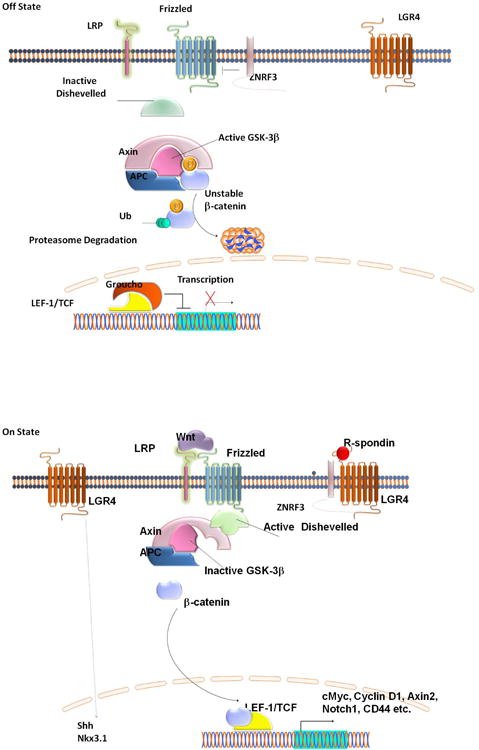
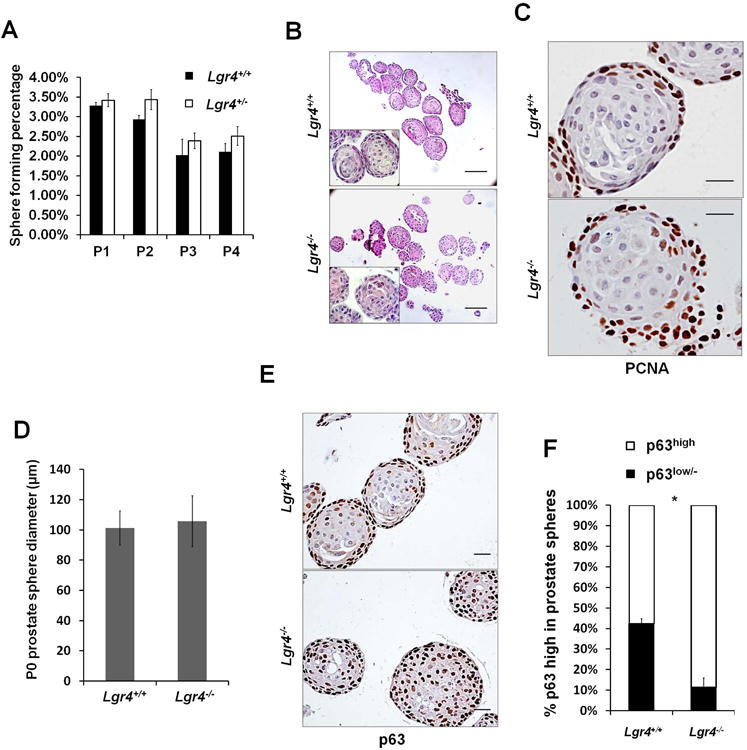
Mechanisms modulating prostate cell fate determination remain unexplored. The leucine-rich repeat containing G-protein-coupled receptors (Lgr) have been identified as important stem cell markers in various tissues. Here, we investigated the roles of Lgr4/Gpr48 in prostate stem cells (PSCs) and development. Lgr4 was ubiquitously expressed during early prostate development prior to lineage specification, with adult expression restricted to a few basal cells (principally Lin(-)Sca1(+)CD49f(+)). Lgr4(-/-) mice had compromised branching morphogenesis and delayed epithelial differentiation, leading to decreased prostate size and impaired luminal cell function. In vitro prostate sphere culture revealed that Lgr4(-/-) Lin(-)/Sca1(+)/CD49f(+) cells failed to generate p63(low) cells, indicating a differentiation deficiency. Furthermore, Lgr4 ablation arrested PSC differentiation of in vivo kidney capsule prostate grafts, suggesting that Lgr4 modulates PSC properties independent of hormonal and mesenchymal effects. Analysis of neonatal prostates and prostate spheres revealed a decrease in Wnt, Sonic Hedgehog, and Notch1 expression in Lgr4(-/-) cells. Lgr4 loss blocked differentiation of prostate sphere p63(hi) cells to p63(low). Treatment with exogenous Sonic Hedgehog partially restored the differentiation of p63(hi) cells in Lgr4(-/-) spheres. Taken together, our data revealed the roles of Lgr4 in early prostate development and in stem cell differentiation through regulation of the Wnt, Notch, and Sonic Hedgehog signaling pathways.

摘要

调控前列腺细胞命运决定的机制仍未被探索。富含亮氨酸重复序列的 G 蛋白偶联受体(Lgr)已被鉴定为多种组织中的重要干细胞标志物。在这里,我们研究了 Lgr4/Gpr48 在前列腺干细胞(PSCs)和发育中的作用。Lgr4 在早期前列腺发育过程中在谱系特化之前广泛表达,在成年后仅局限于少数基底细胞(主要是 Lin(-)Sca1(+)CD49f(+))表达。Lgr4(-/-) 小鼠的分支形态发生受损,上皮分化延迟,导致前列腺体积减小和管腔细胞功能受损。体外前列腺球体培养表明,Lgr4(-/-)Lin(-)/Sca1(+)/CD49f(+)细胞无法产生 p63(low)细胞,表明分化缺陷。此外,Lgr4 缺失阻断了体内肾包膜前列腺移植中 PSC 的分化,表明 Lgr4 调节 PSC 特性独立于激素和间质效应。对新生前列腺和前列腺球体的分析表明,Lgr4(-/-)细胞中 Wnt、Sonic Hedgehog 和 Notch1 的表达减少。Lgr4 的缺失阻断了前列腺球体 p63(hi)细胞向 p63(low)细胞的分化。外源性 Sonic Hedgehog 的处理部分恢复了 Lgr4(-/-)球体中 p63(hi)细胞的分化。总之,我们的数据揭示了 Lgr4 在早期前列腺发育和干细胞分化中的作用,通过调节 Wnt、Notch 和 Sonic Hedgehog 信号通路。

https://cdn.ncbi.nlm.nih.gov/pmc/blobs/efbf/3934101/0933d7a96d62/nihms511341f7.jpg
https://cdn.ncbi.nlm.nih.gov/pmc/blobs/efbf/3934101/ec3d3f123063/nihms511341f1.jpg
https://cdn.ncbi.nlm.nih.gov/pmc/blobs/efbf/3934101/b04327b2e6df/nihms511341f2.jpg
https://cdn.ncbi.nlm.nih.gov/pmc/blobs/efbf/3934101/c48a01887a3c/nihms511341f3.jpg
https://cdn.ncbi.nlm.nih.gov/pmc/blobs/efbf/3934101/7135183cf6e5/nihms511341f4.jpg
https://cdn.ncbi.nlm.nih.gov/pmc/blobs/efbf/3934101/e787b8e1b585/nihms511341f5.jpg
https://cdn.ncbi.nlm.nih.gov/pmc/blobs/efbf/3934101/34d84244faa2/nihms511341f6.jpg
https://cdn.ncbi.nlm.nih.gov/pmc/blobs/efbf/3934101/0933d7a96d62/nihms511341f7.jpg
https://cdn.ncbi.nlm.nih.gov/pmc/blobs/efbf/3934101/ec3d3f123063/nihms511341f1.jpg
https://cdn.ncbi.nlm.nih.gov/pmc/blobs/efbf/3934101/b04327b2e6df/nihms511341f2.jpg
https://cdn.ncbi.nlm.nih.gov/pmc/blobs/efbf/3934101/c48a01887a3c/nihms511341f3.jpg
https://cdn.ncbi.nlm.nih.gov/pmc/blobs/efbf/3934101/7135183cf6e5/nihms511341f4.jpg
https://cdn.ncbi.nlm.nih.gov/pmc/blobs/efbf/3934101/e787b8e1b585/nihms511341f5.jpg
https://cdn.ncbi.nlm.nih.gov/pmc/blobs/efbf/3934101/34d84244faa2/nihms511341f6.jpg
https://cdn.ncbi.nlm.nih.gov/pmc/blobs/efbf/3934101/0933d7a96d62/nihms511341f7.jpg