German Cancer Research Center (DKFZ), Tumor Virology, F010, Im Neuenheimer Feld 242, Heidelberg D-69120, Germany.
BMC Cancer. 2013 Jul 31;13:367. doi: 10.1186/1471-2407-13-367.
Investigating how the immune system functions during malignancies is crucial to developing novel therapeutic strategies. Natural killer (NK) cells, an important component of the innate immune system, play a vital role in immune defense against tumors and virus-infected cells. The poor survival rate in colon cancer makes it particularly important to develop novel therapeutic strategies. Oncolytic viruses, in addition to lysing tumor cells, may have the potential to augment antitumor immune responses. In the present study, we investigate the role of NK cells and how parvovirus H-1PV can modulate NK-cell mediated immune responses against colon carcinoma.
Human NK cells were isolated from the blood of healthy donors. The cytotoxicity and antibody-mediated inhibition of NK cells were measured in chromium release assays. Phenotypic assessment of colon cancer and dendritic cells was done by FACS. The statistical significance of the results was calculated with Student's t test (*p <0.05; **, p < 0.01; ***, p < 0.001).
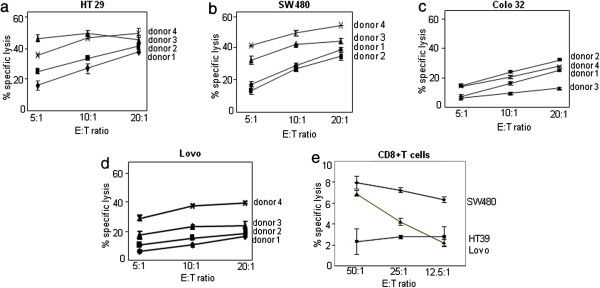
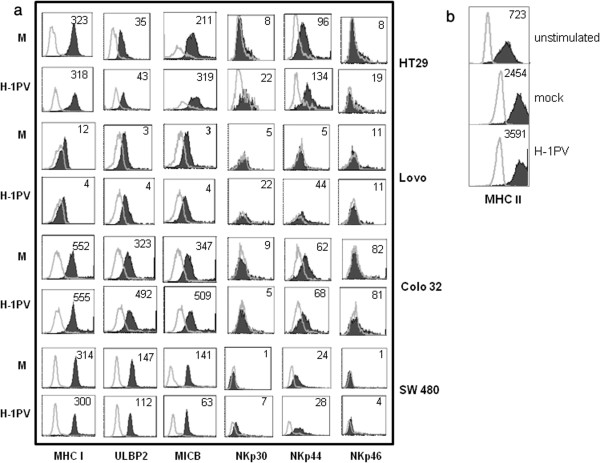
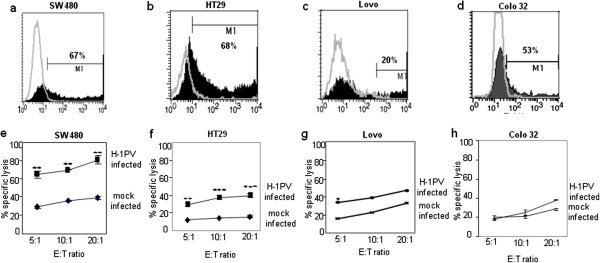
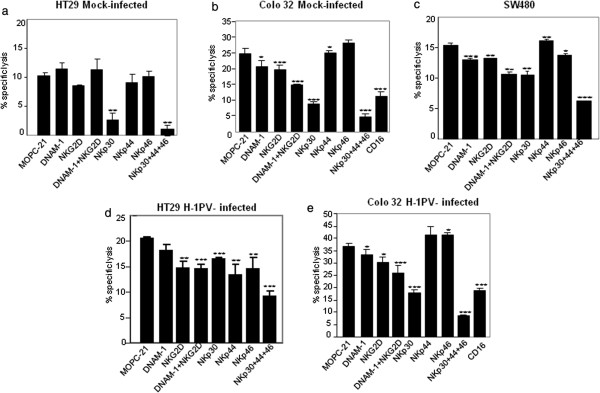
We show that IL-2-activated human NK cells can effectively kill colon carcinoma cells. Killing of colon carcinoma cells by NK cells was further enhanced upon infection of the former cells with parvovirus H-1PV. H-1PV has potent oncolytic activity against various tumors, yet its direct killing effect on colon carcinoma cells is limited. The cytotoxicity of NK cells towards colon carcinoma cells, both mock- and H-1PV-infected, was found to be mostly mediated by a combination of natural cytotoxicity receptors (NCRs), namely NKp30, 44, and 46. Colon carcinoma cells displayed low to moderate expression of NK cell ligands, and this expression was modulated upon H-1PV infection. Lysates of H-1PV-infected colon carcinoma cells were found to increase MHC class II expression on dendritic cells.
Altogether, these data suggest that IL-2-activated NK cells actively kill colon carcinoma cells and that this killing is mediated by several natural cytotoxicity receptors (NCRs) in combination. Additionally, in association with parvovirus H-1PV, IL-2-activated NK cells have the potential to boost immune responses against colon cancer.
研究免疫系统在恶性肿瘤中的功能对于开发新的治疗策略至关重要。自然杀伤 (NK) 细胞是先天免疫系统的重要组成部分,在免疫防御肿瘤和病毒感染细胞方面发挥着重要作用。结肠癌的生存率较低,因此特别需要开发新的治疗策略。溶瘤病毒除了裂解肿瘤细胞外,还有可能增强抗肿瘤免疫反应。在本研究中,我们研究了 NK 细胞的作用以及细小病毒 H-1PV 如何调节 NK 细胞介导的针对结肠癌的免疫反应。
从健康供体的血液中分离出人 NK 细胞。通过铬释放试验测量 NK 细胞的细胞毒性和抗体介导的抑制作用。通过流式细胞术评估结肠癌和树突状细胞的表型。使用学生 t 检验计算结果的统计学意义(p <0.05;,p <0.01;,p <0.001)。
我们表明,IL-2 激活的人 NK 细胞可以有效杀死结肠癌细胞。前者细胞感染细小病毒 H-1PV 后,NK 细胞对结肠癌细胞的杀伤作用进一步增强。H-1PV 对各种肿瘤具有强大的溶瘤活性,但对结肠癌细胞的直接杀伤作用有限。NK 细胞对结肠癌细胞(模拟和 H-1PV 感染)的细胞毒性主要由一系列自然细胞毒性受体 (NCR) 介导,即 NKp30、44 和 46。结肠癌细胞显示出低至中度的 NK 细胞配体表达,并且这种表达在 H-1PV 感染后被调节。发现 H-1PV 感染的结肠癌细胞的裂解物增加了树突状细胞上 MHC Ⅱ类的表达。
总之,这些数据表明,IL-2 激活的 NK 细胞主动杀死结肠癌细胞,并且这种杀伤是由几种自然细胞毒性受体 (NCR) 联合介导的。此外,与细小病毒 H-1PV 一起,IL-2 激活的 NK 细胞有可能增强针对结肠癌的免疫反应。