Moughrabi Samira, Evangelista Lorraine S, Habib Samer I, Kassabian Leo, Breen Elizabeth Crabb, Nyamathi Adeline, Irwin Michael
Department of Nursing, California State University, Northridge, CA, USA
Program of Nursing Science, University of California, Irvine, CA, USA.
Biol Res Nurs. 2014 Jul;16(3):295-302. doi: 10.1177/1099800413496454. Epub 2013 Jul 30.
Researchers have proposed biological (inflammation) and psychological (depression) factors as potential mechanisms for poorer outcomes and readmissions in heart failure (HF) patients. However, studies investigating the link between inflammation and depressive symptoms in these patients are few. We examined the relationships between levels of the inflammatory markers C-reactive protein (CRP), interleukin (IL)-6, and soluble tumor necrosis factor receptor 2 (sTNR2) and depressive symptoms in HF outpatients.
55 patients (74.5% men; 60% Whites; mean age 71.6 ± 11.3 years) with New York Heart Association Class II, III, or IV HF (49%, 47%, and 4%, respectively) and mean ejection fraction (EF) 29.9 ± 7.1% completed the Patient Health Questionnaire (PHQ)-9 as a measure of depressive symptoms. We also obtained height, weight, and CRP, IL-6, and sTNFR2 levels. We used multivariate regressions to assess the predictive value of PHQ-9 scores on each inflammatory marker.
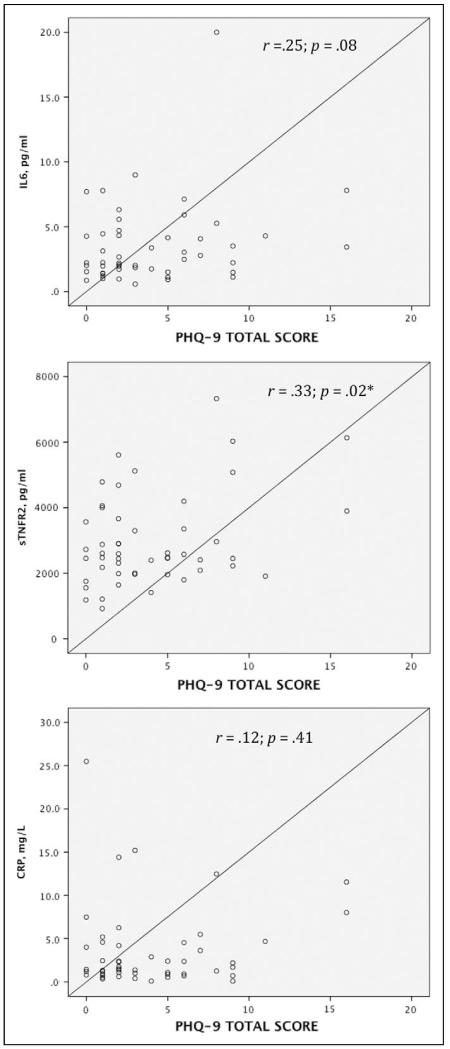
22 (40%) participants reported depressive symptoms (PHQ-9 score ≥ 5). After controlling for age, gender, body mass index, HF etiology, EF, and statin use, we found significant relationships between levels of both sTNFR2 (β = .35, p = .01) and IL-6 (β = .30, p = .04), but not CRP (β = -.96, p = .52), and depression scores.
Our findings add to a growing body of evidence supporting the proposition that heightened inflammation explains the effect depression has on HF. Health care providers should screen for depression in HF patients, as they may be at higher risk of augmented inflammation and poor outcomes.
研究人员提出生物学(炎症)和心理学(抑郁)因素是心力衰竭(HF)患者预后较差及再次入院的潜在机制。然而,针对这些患者炎症与抑郁症状之间联系的研究较少。我们研究了炎症标志物C反应蛋白(CRP)、白细胞介素(IL)-6和可溶性肿瘤坏死因子受体2(sTNR2)水平与HF门诊患者抑郁症状之间的关系。
55例纽约心脏病协会心功能II级、III级或IV级的HF患者(男性占74.5%;白人占60%;平均年龄71.6±11.3岁),其中心功能II级、III级和IV级的患者分别占49%、47%和4%,平均射血分数(EF)为29.9±7.1%,完成了患者健康问卷(PHQ)-9以评估抑郁症状。我们还获取了身高、体重以及CRP、IL-6和sTNFR2水平。我们使用多元回归来评估PHQ-9评分对每种炎症标志物的预测价值。
22名(40%)参与者报告有抑郁症状(PHQ-9评分≥5)。在控制了年龄、性别、体重指数、HF病因、EF和他汀类药物使用情况后,我们发现sTNFR2水平(β = 0.35,p = 0.01)和IL-6水平(β = 0.30,p = 0.04)与抑郁评分之间存在显著关系,但CRP水平与抑郁评分无显著关系(β = -0.96,p = 0.52)。
我们的研究结果进一步支持了越来越多的证据所支持的观点,即炎症加剧解释了抑郁对HF的影响。医疗保健提供者应筛查HF患者的抑郁情况,因为他们可能有炎症加剧和预后不良的更高风险。