Krueger Ricarda, Derno Michael, Goers Solvig, Metzler-Zebeli Barbara U, Nuernberg Gerd, Martens Karen, Pfuhl Ralf, Nebendahl Constanze, Zeyner Annette, Hammon Harald M, Metges Cornelia C
Institute of Nutritional Physiology 'Oskar Kellner', Leibniz Institute for Farm Animal Biology (FBN), 18196, Dummerstorf, Germany.
Eur J Nutr. 2014;53(2):583-97. doi: 10.1007/s00394-013-0567-x. Epub 2013 Aug 2.
A thrifty energy metabolism has been suggested in intrauterine growth restricted (IUGR) offspring. We characterized energy metabolism and substrate oxidation patterns in IUGR pigs in response to food restriction (FR) and refeeding (RFD).
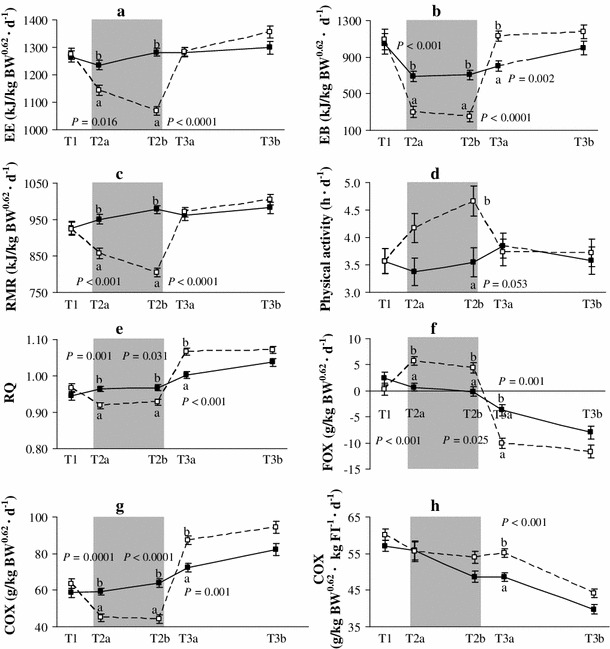
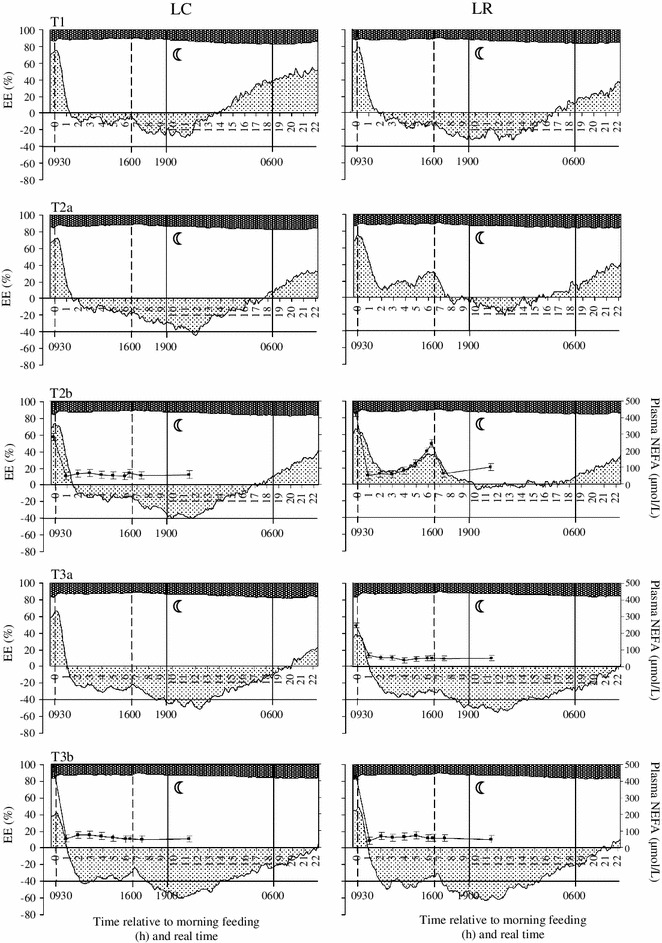
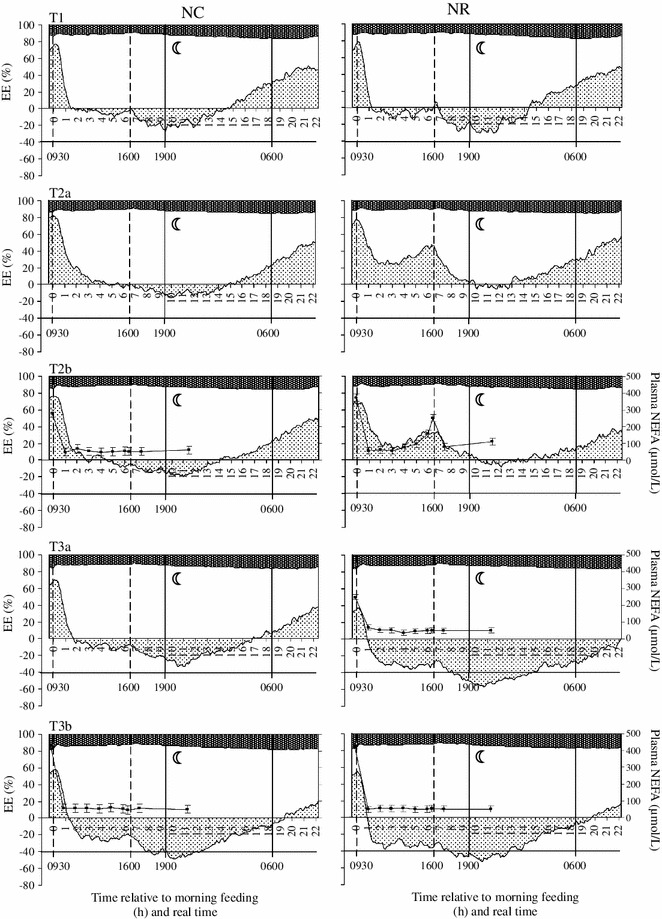
Female pigs with low (L; 1.1 kg; n = 20) or normal birth weight (N; 1.5 kg; n = 24) were fed ad libitum after weaning. Half of L and N pigs were food restricted (R; LR, NR) from days 80 to 100 (57% of ad libitum) and refeed from days 101 to 131, while the remaining pigs were fed ad libitum (control, C). Using indirect calorimetry, carbohydrate and fat oxidation (COX, FOX), energy expenditure (EE) and balance (EB), resting metabolic rate (RMR) [all related to kg body weight(0.62) (BW)] and RQ were determined at 4 days before (day 76) and after (day 83) beginning of FR, 4 days before (day 97) and after (day 104) end of FR and 25 days after beginning of RFD (day 125). Body fat and muscle weights were determined at day 131.
In spite of higher relative food intake (FI), BW was lower in L pigs. In L pigs, physical activity was lower at age 76 and 83 days compared to N pigs. IUGR did not affect EE or RMR, but resulted in higher COX and lower FOX, causing greater and earlier onset of fat deposition. During FR, EE and RMR of R pigs dropped below that of C pigs, and BW gain was delayed by 30% irrespective of birth weight. In response to FR, COX decreased and FOX increased. During FR, in LR pigs FOX was ~50% of that in NR pigs. After 4 days, but not 25 days of RFD, EB and fat synthesis were higher in pigs previously subjected to FR, indicating early catch-up fat. In R pigs, BW and the abdominal fat proportion were lower at 131 days.
Differences in food intake and substrate oxidation pattern, but not in EE and RMR, between L and N pigs were reflected in higher body fat proportions but lower body and muscle weights in L pigs. Refeeding following FR was initially associated with increased FI, a more positive EB and a more intense stimulation of fat synthesis which did not persist after 25 days of refeeding.
已有研究表明宫内生长受限(IUGR)后代存在节俭型能量代谢。我们对IUGR猪在食物限制(FR)和再喂养(RFD)情况下的能量代谢及底物氧化模式进行了特征描述。
将出生体重低(L;1.1千克;n = 20)或正常(N;1.5千克;n = 24)的雌性猪断奶后自由采食。L组和N组各一半的猪在80至100天进行食物限制(R;LR、NR),限制量为自由采食量的57%,并在101至131天进行再喂养,其余猪自由采食(对照,C)。使用间接测热法,在FR开始前4天(第76天)和开始后4天(第83天)、FR结束前4天(第97天)和结束后4天(第104天)以及RFD开始后25天(第125天)测定碳水化合物和脂肪氧化(COX、FOX)、能量消耗(EE)和平衡(EB)、静息代谢率(RMR)[均与体重(0.62)(BW)相关]以及呼吸商(RQ)。在第131天测定体脂和肌肉重量。
尽管L组猪的相对采食量(FI)较高,但其体重较低。与N组猪相比,L组猪在76日龄和83日龄时的身体活动较少。IUGR不影响EE或RMR,但会导致COX升高和FOX降低,从而使脂肪沉积增加且更早开始。在FR期间,R组猪的EE和RMR降至C组猪以下,且体重增加延迟30%,与出生体重无关。对FR的反应是,COX降低,FOX升高。在FR期间,LR组猪的FOX约为NR组猪的50%。RFD开始4天后而非25天后,先前经历FR的猪的EB和脂肪合成较高,表明存在早期追赶性脂肪。在R组猪中,131天时体重和腹部脂肪比例较低。
L组和N组猪在食物摄入量和底物氧化模式上存在差异,但在EE和RMR方面无差异,这反映在L组猪的体脂比例较高,但体重和肌肉重量较低。FR后的再喂养最初与FI增加、EB更正向以及脂肪合成刺激更强有关,但在再喂养25天后这种情况不再持续。