Faculty of Computer Sciences, Laboratory of Brain-Computer Interfaced, Institute for Knowledge Discovery, Graz University of Technology Graz, Austria.
Front Hum Neurosci. 2013 Jul 30;7:379. doi: 10.3389/fnhum.2013.00379. eCollection 2013.
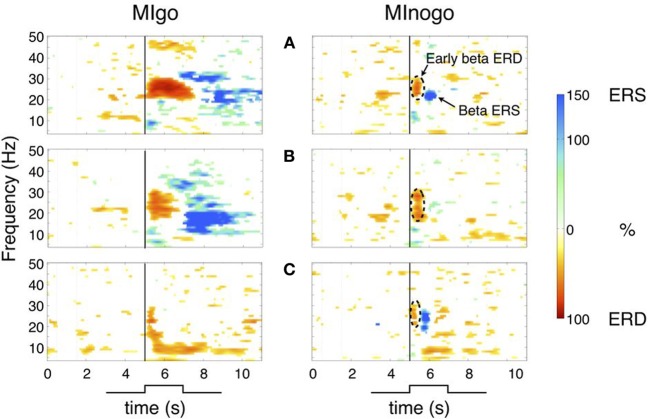
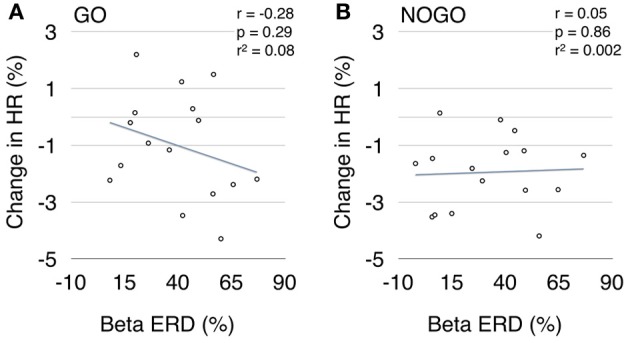
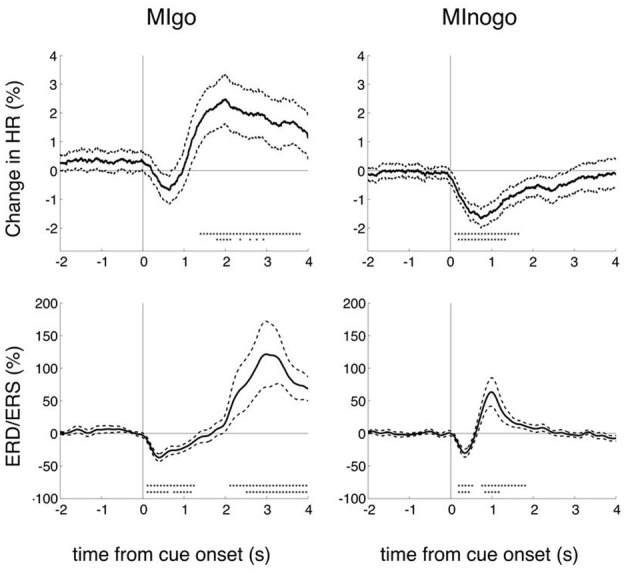
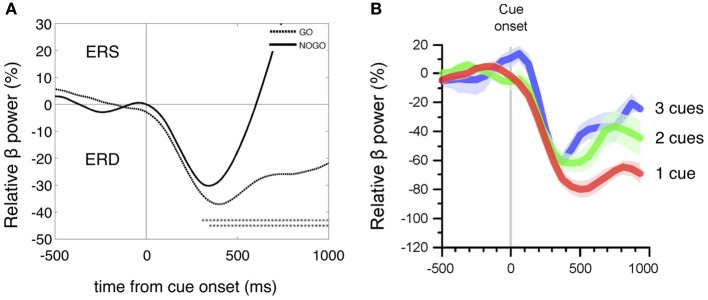
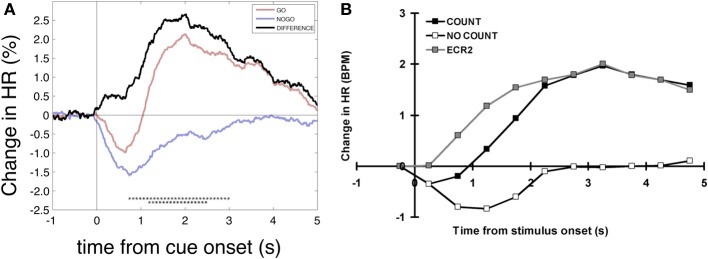
Cue-paced motor imagery (MI) is a frequently used mental strategy to realize a Brain-Computer Interface (BCI). Recently it has been reported that two MI tasks can be separated with a high accuracy within the first second after cue presentation onset. To investigate this phenomenon in detail we studied the dynamics of motor cortex beta oscillations in EEG and the changes in heart rate (HR) during visual cue-paced foot MI using a go (execution of imagery) vs. nogo (withholding of imagery) paradigm in 16 healthy subjects. Both execution and withholding of MI resulted in a brisk centrally localized beta event-related desynchronization (ERD) with a maximum at ~400 ms and a concomitant HR deceleration. We found that response patterns within the first second after stimulation differed between conditions. The ERD was significantly larger in go as compared to nogo. In contrast the HR deceleration was somewhat smaller and followed by an acceleration in go as compared to nogo. These findings suggest that the early beta ERD reflects visually induced preparatory activity in motor cortex networks. Both the early beta ERD and the HR deceleration are the result of automatic operating processes that are likely part of the orienting reflex (OR). Of interest, however, is that the preparatory cortical activity is strengthened and the HR modulated already within the first second after stimulation during the execution of MI. The subtraction of the HR time course of the nogo from the go condition revealed a slight HR acceleration in the first seconds most likely due to the increased mental effort associated with the imagery process.
线索引导的运动想象(MI)是一种常用的心理策略,可用于实现脑机接口(BCI)。最近有报道称,在线索呈现开始后的最初一秒内,可以以很高的准确率将两个 MI 任务分开。为了详细研究这一现象,我们使用视觉线索引导的脚踏 MI 的“go(执行想象)”与“nogo(抑制想象)”范式,研究了 EEG 中运动皮层β 振荡的动力学和心率(HR)的变化,该范式在 16 名健康受试者中进行。执行和抑制 MI 都会导致快速的中央局部β事件相关去同步(ERD),最大幅度在~400ms 左右,同时 HR 减速。我们发现,刺激后最初一秒内的反应模式在不同条件下有所不同。与 nogo 相比,go 时的 ERD 明显更大。相比之下,nogo 时 HR 减速较小,随后 go 时 HR 加速。这些发现表明,早期的β ERD 反映了视觉诱导的运动皮层网络中的预备活动。早期的β ERD 和 HR 减速都是自动操作过程的结果,这些过程可能是定向反射(OR)的一部分。有趣的是,在执行 MI 的最初一秒内,预备性皮质活动增强,HR 也被调制。从 go 条件减去 nogo 的 HR 时间历程,揭示了在最初几秒钟内 HR 略有加速,这很可能是由于与想象过程相关的精神努力增加所致。