Department of Psychology, University of California Los Angeles , Los Angeles, CA , USA.
Front Psychiatry. 2013 Jul 29;4:75. doi: 10.3389/fpsyt.2013.00075. eCollection 2013.
Alcohol dependence is a complex psychological disorder whose phenomenology changes as the disorder progresses. Neuroscience has provided a variety of theories and evidence for the development, maintenance, and severity of addiction; however, clinically, it has been difficult to evaluate alcohol use disorder (AUD) severity.
This study seeks to evaluate and validate a data-driven approach to capturing alcohol severity in a community sample.
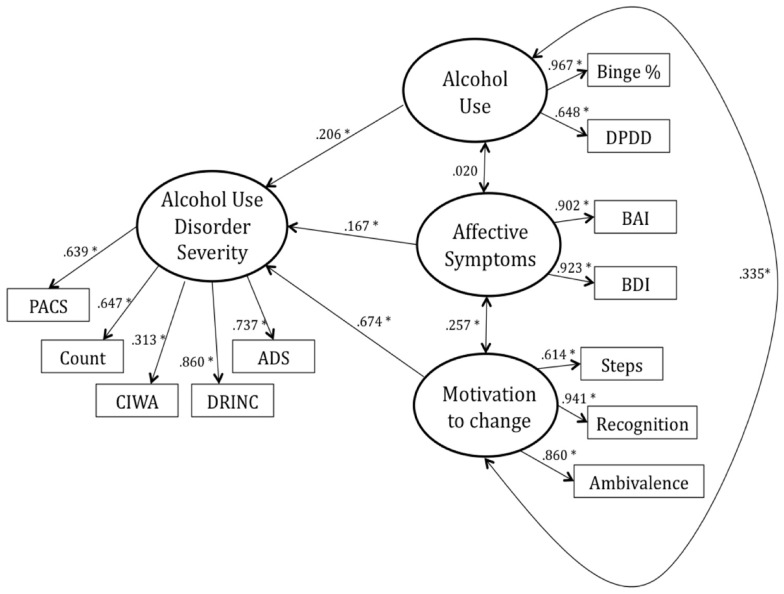
Participants were non-treatment seeking problem drinkers (n = 283). A structural equation modeling approach was used to (a) verify the latent factor structure of the indices of AUD severity; and (b) test the relationship between the AUD severity factor and measures of alcohol use, affective symptoms, and motivation to change drinking.
The model was found to fit well, with all chosen indices of AUD severity loading significantly and positively onto the severity factor. In addition, the paths from the alcohol use, motivation, and affective factors accounted for 68% of the variance in AUD severity. Greater AUD severity was associated with greater alcohol use, increased affective symptoms, and higher motivation to change.
Unlike the categorical diagnostic criteria, the AUD severity factor is comprised of multiple quantitative dimensions of impairment observed across the progression of the disorder. The AUD severity factor was validated by testing it in relation to other outcomes such as alcohol use, affective symptoms, and motivation for change. Clinically, this approach to AUD severity can be used to inform treatment planning and ultimately to improve outcomes.
酒精依赖是一种复杂的心理障碍,其表现随着疾病的进展而变化。神经科学为成瘾的发展、维持和严重程度提供了多种理论和证据;然而,临床上很难评估酒精使用障碍(AUD)的严重程度。
本研究旨在评估和验证一种数据驱动的方法,以捕捉社区样本中的酒精严重程度。
参与者是非治疗性寻求问题饮酒者(n=283)。采用结构方程建模方法(a)验证 AUD 严重程度指标的潜在因子结构;(b)测试 AUD 严重程度因子与酒精使用、情感症状和改变饮酒动机测量之间的关系。
该模型拟合良好,所有选定的 AUD 严重程度指标均显著正向加载到严重程度因子上。此外,酒精使用、动机和情感因素的路径解释了 AUD 严重程度的 68%的方差。更高的 AUD 严重程度与更多的酒精使用、更多的情感症状和更高的改变饮酒动机相关。
与分类诊断标准不同,AUD 严重程度因子由疾病进展过程中观察到的多个定量损伤维度组成。通过将 AUD 严重程度因子与其他结果(如酒精使用、情感症状和改变的动机)进行测试来验证该因子。临床上,这种 AUD 严重程度的方法可用于为治疗计划提供信息,并最终改善结果。