Lee Mary R, Sankar Vignesh, Hammer Aaron, Kennedy William G, Barb Jennifer J, McQueen Philip G, Leggio Lorenzo
Section on Clinical Psychoneuroendocrinology and Neuropsychopharmacology, National Institute on Alcohol Abuse and Alcoholism, National Institute on Drug Abuse, National Institutes of Health, Bethesda, MD, USA.
Krasnow Institute for Advanced Study, George Mason University, Fairfax, VA, USA.
EClinicalMedicine. 2019 Jun 17;12:70-78. doi: 10.1016/j.eclinm.2019.05.008. eCollection 2019 Jul.
The authors used a decision tree classifier to reduce neuropsychological, behavioral and laboratory measures to a subset of measures that best predicted whether an individual with alcohol use disorder (AUD) seeks treatment.
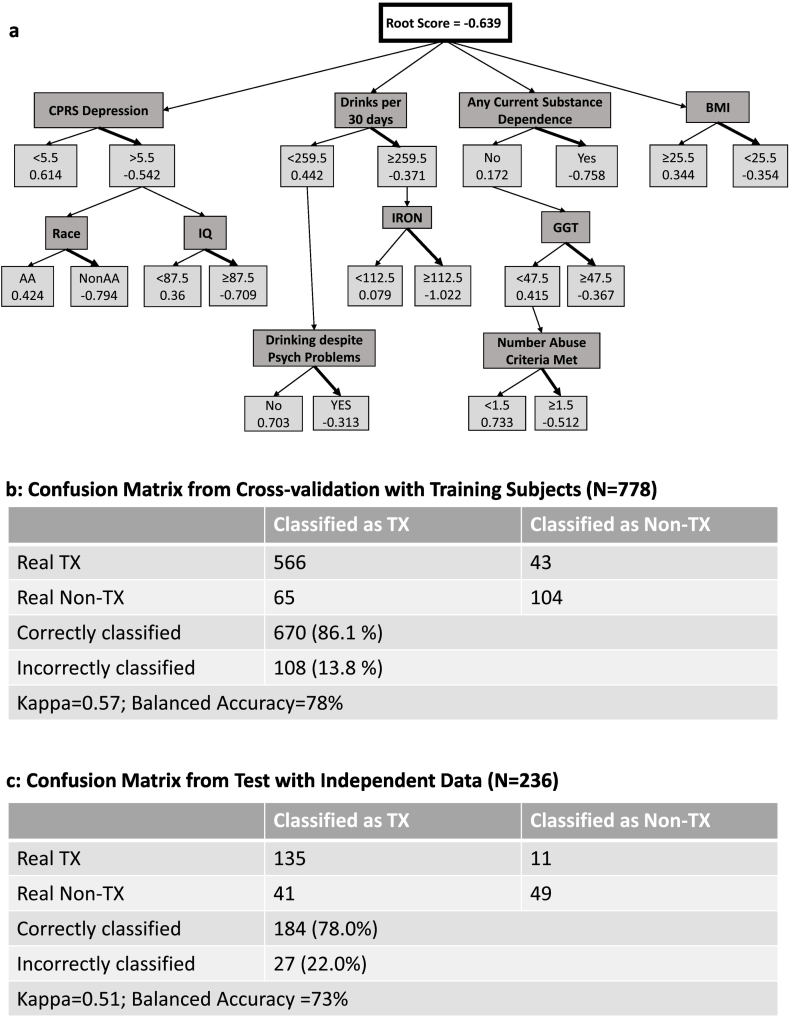
Clinical measures (N = 178) from 778 individuals with AUD were used to construct an alternating decision tree (ADT) with 10 measures that best classified individuals as treatment or not treatment-seeking for AUD. ADT's were validated by two methods: using cross-validation and an independent dataset (N = 236). For comparison, two other machine learning techniques were used as well as two linear models.
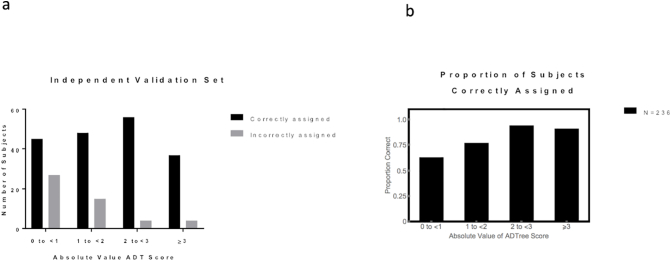
The 10 measures in the ADT classifier were drinking behavior, depression and drinking-related psychological problems, as well as substance dependence. With cross-validation, the ADT classified 86% of individuals correctly. The ADT classified 78% of the independent dataset correctly. Only the simple logistic model was similar in accuracy; however, this model needed more than twice as many measures as ADT to classify at comparable accuracy.
While there has been emphasis on understanding differences between those with AUD and controls, it is also important to understand, within those with AUD, the features associated with clinically important outcomes. Since the majority of individuals with AUD do not receive treatment, it is important to understand the clinical features associated with treatment utilization; the ADT reported here correctly classified the majority of individuals with AUD with 10 clinically relevant measures, misclassifying < 7% of treatment seekers, while misclassifying 38% of non-treatment seekers. These individual clinically relevant measures can serve, potentially, as separate targets for treatment.
Funding for this work was provided by the Intramural Research Programs of the National Institute on Alcohol Abuse and Alcoholism (NIAAA), National Institute on Drug Abuse (NIDA) and the Center for Information Technology (CIT).
Evidence Before This Study: Less than 10% of persons who meet lifetime criteria for Alcohol Use Disorder (AUD) receive treatment. As the etiology of AUD represents a complex interaction between neurobiological, social, environmental and psychological factors, low treatment utilization likely stems from barriers on multiple levels. Given this issue, it is important from both a research and clinical standpoint to determine what characteristics are associated with treatment utilization in addition to merely asking individuals if they wish to enter treatment. At the level of clinical research, if there are phenotypic differences between treatment and nontreatment-seekers that directly influence outcomes of early-phase studies, these phenotypic differences are a potential confound in assessing the utility of an experimental treatment for AUD. At the level of clinical practice, distinguishing between treatment- and nontreatment-seekers may help facilitate a targeted treatment approach. Previous efforts to understand the differences between these populations of individuals with AUD leveraged the multidimensional data collected in clinical research settings for AUD that are not well suited to traditional regression methods.Added Value of This Study: Alternating decision trees are well suited to deep-phenotyping data collected in clinical research settings as this approach handles nonparametric, skewed, and missing data whose relationships are nonlinear. This approach has proved to be superior in some cases to conventional clinical methods to solve diagnostic problems in medicine. We used a decision tree classifier to understand treatment- and non-treatment seeking group differences. The decision tree classifier approach chose a subset of factors arranged in an alternating decision tree that best predicts a given outcome. Assuming that the input measures are clinically relevant, the alternating decision tree that is generated has clinical value. Unlike other machine learning approaches, in addition to its predictive value, the nodes in the tree and their arrangement in a hierarchy have clinical utility. With the "if-then" logic of the tree, the clinician can learn what features become important and which recede in importance as the logic of the tree is followed. The decision tree classifier approach reduced 178 characterization measures (both categorical and continuous) in multiple domains to a decision tree comprised of 10 measures that together best classified subjects by treatment seeking status (yes/no).Implications After All the Available Evidence: We leveraged a large data set comprised of 178 clinical measures and using the decision tree approach, we have reduced these to a subset of 10 measures that accurately classified individuals with alcohol dependence by treatment utilization. From this analysis, drinking behavior variables and depression measures are strong treatment seeking predictors. Having identified a cluster of factors that predicts treatment seeking, we can assess the influence of these factors directly on the clinical study outcome measures themselves. In clinical practice these factors can be separate targets for treatment. In clinical research, the group differences my directly influence research outcomes for treatment of AUD.
作者使用决策树分类器,将神经心理学、行为学和实验室测量指标精简为一组能最佳预测酒精使用障碍(AUD)个体是否寻求治疗的指标子集。
采用来自778名AUD个体的临床测量指标(N = 178)构建交替决策树(ADT),其中10项指标能最佳地将个体分类为寻求AUD治疗或不寻求治疗。ADT通过两种方法进行验证:交叉验证和独立数据集(N = 236)。作为比较,还使用了另外两种机器学习技术以及两种线性模型。
ADT分类器中的10项指标为饮酒行为、抑郁和与饮酒相关的心理问题以及物质依赖。通过交叉验证,ADT正确分类了86%的个体。ADT正确分类了独立数据集中78%的个体。只有简单逻辑模型在准确性上与之相似;然而,该模型需要的指标数量是ADT的两倍多才能达到可比的分类准确性。
虽然一直强调理解AUD患者与对照组之间的差异,但在AUD患者群体中,了解与临床重要结局相关的特征也很重要。由于大多数AUD个体未接受治疗,了解与治疗利用相关的临床特征很重要;此处报告的ADT通过10项临床相关指标正确分类了大多数AUD个体,将寻求治疗者的误分类率<7%,而非寻求治疗者的误分类率为38%。这些个体临床相关指标有可能作为单独的治疗靶点。
本研究的资金由美国国立酒精滥用与酒精中毒研究所(NIAAA)、国立药物滥用研究所(NIDA)和信息技术中心(CIT)的内部研究项目提供。
本研究之前的证据:符合酒精使用障碍(AUD)终身标准的人群中,接受治疗的不到10%。由于AUD的病因代表了神经生物学、社会、环境和心理因素之间的复杂相互作用,低治疗利用率可能源于多个层面的障碍。鉴于此问题,从研究和临床角度来看,除了简单询问个体是否希望接受治疗外,确定与治疗利用相关的特征也很重要。在临床研究层面,如果治疗寻求者与非治疗寻求者之间存在直接影响早期研究结果的表型差异,那么这些表型差异在评估AUD实验性治疗的效用时可能是一个潜在的混杂因素。在临床实践层面,区分治疗寻求者和非治疗寻求者可能有助于促进有针对性的治疗方法。之前试图理解这些AUD个体群体之间差异的努力利用了在AUD临床研究环境中收集的多维数据,这些数据不太适合传统回归方法。
交替决策树非常适合处理临床研究环境中收集的深度表型数据,因为这种方法可以处理非参数、偏态和缺失的数据,其关系是非线性的。在某些情况下,这种方法已被证明优于传统临床方法,可解决医学中的诊断问题。我们使用决策树分类器来理解治疗寻求组与非治疗寻求组之间的差异。决策树分类器方法选择了一组排列在交替决策树中的因素,这些因素能最佳地预测给定结果。假设输入指标具有临床相关性,生成的交替决策树具有临床价值。与其他机器学习方法不同,除了其预测价值外,树中的节点及其层次排列具有临床效用。根据树的“如果……那么……”逻辑,临床医生可以了解随着遵循树的逻辑,哪些特征变得重要,哪些特征的重要性降低。决策树分类器方法将多个领域中的178项特征测量指标(包括分类和连续指标)精简为一个由10项指标组成的决策树,这些指标共同根据治疗寻求状态(是/否)对受试者进行最佳分类。
我们利用了一个由178项临床指标组成的大数据集,并使用决策树方法将其精简为一个由10项指标组成的子集,这些指标通过治疗利用情况准确地对酒精依赖个体进行了分类。通过该分析,饮酒行为变量和抑郁测量指标是寻求治疗的有力预测因素。确定了一组预测治疗寻求的因素后,我们可以直接评估这些因素对临床研究结局指标本身的影响。在临床实践中,这些因素可以作为单独的治疗靶点。在临床研究中,这些组间差异可能直接影响AUD治疗的研究结果。