Département de Médecine Nucléaire et Radiobiologie, Faculté de Médecine, Université de Sherbrooke, Sherbrooke, QC, Canada.
Int J Radiat Oncol Biol Phys. 2013 Nov 15;87(4):847-53. doi: 10.1016/j.ijrobp.2013.06.2037. Epub 2013 Aug 1.
To investigate the efficiencies of platinum chemotherapeutic drugs (Pt-drugs) in the sensitization of DNA to the direct effects of ionizing radiation and to determine the role of low-energy electrons (LEEs) in this process.
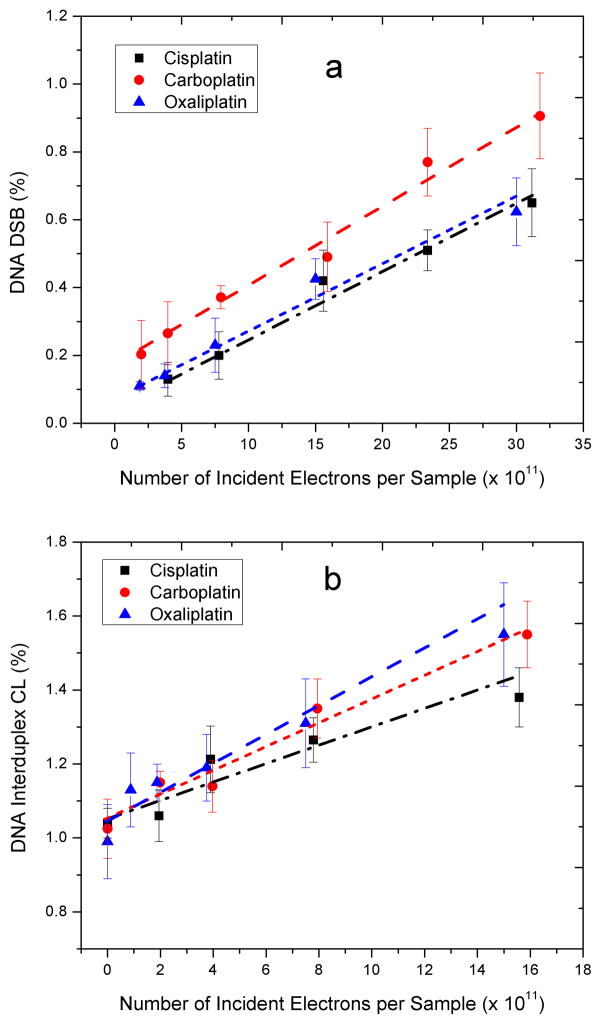
Complexes of supercoiled plasmid DNA covalently bound to either cisplatin, carboplatin, or oxaliplatin were prepared in different molar ratios. Solid films of DNA and DNA modified by Pt-drugs were irradiated with either 10-KeV or 10-eV electrons. Damages to DNA were quantified by gel electrophoresis, and the yields for damage formation were obtained from exposure-response curves.
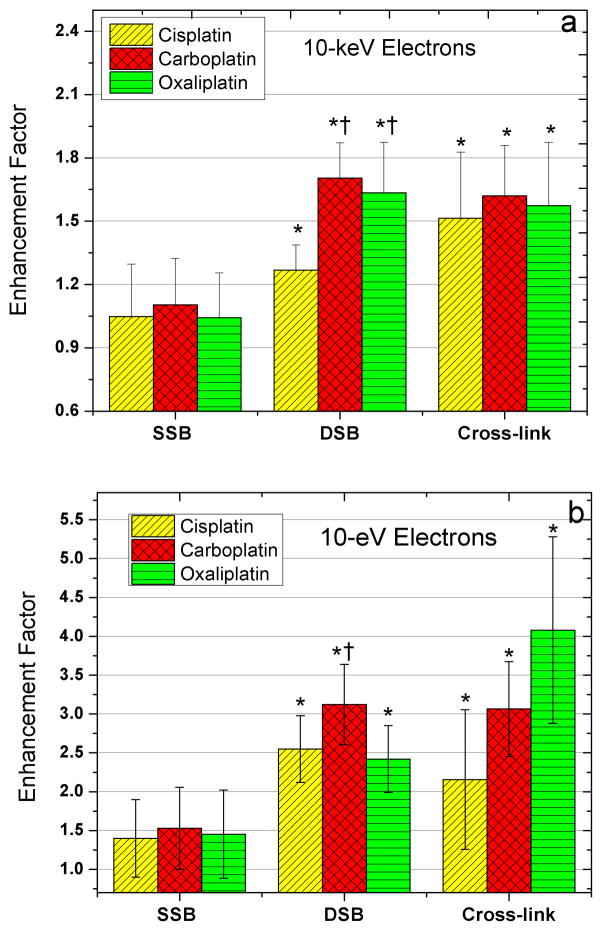
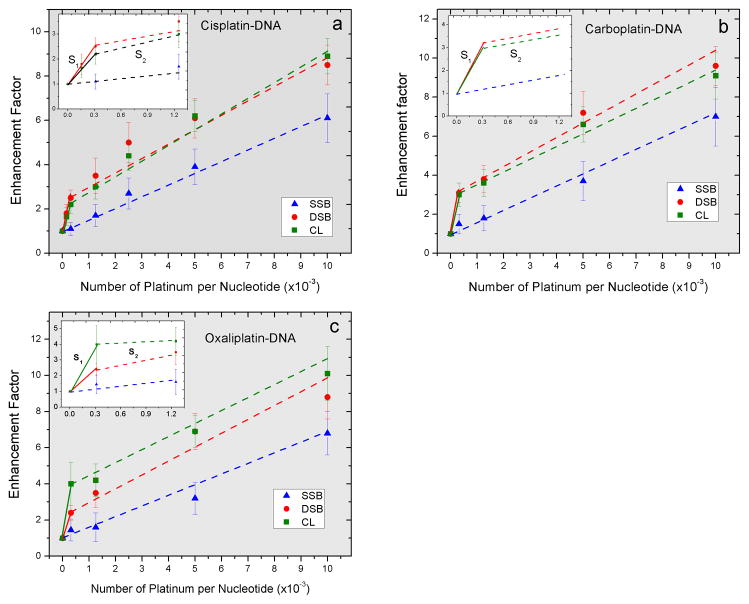
The presence of an average of 2 Pt-drug-DNA adducts (Pt-adducts) in 3199-bp plasmid DNA increases the probability of a double-strand break by factors of 3.1, 2.5, and 2.4 for carboplatin, cisplatin, and oxaliplatin, respectively. Electrons with energies of 10 eV and 10 KeV interact with Pt-adducts to preferentially enhance the formation of cluster lesions. The maximum increase in radiosensitivity per Pt-adduct is found at ratios up to 3.1×10(-4) Pt-adducts per nucleotide, which is equivalent to an average of 2 adducts per plasmid. Carboplatin and oxaliplatin show higher efficiencies than cisplatin in the radiosensitization of DNA. Because carboplatin and cisplatin give rise to identical reactive species that attach to DNA, carboplatin must be considered as a better radiosensitizer for equal numbers of Pt-adducts.
Platinum chemotherapeutic drugs preferentially enhance the formation of cluster damage to DNA induced by the direct effect of ionizing radiation, and LEEs are the main species responsible for such an enhancement via the formation of electron resonances.
研究铂类化疗药物(Pt-药物)在使 DNA 对电离辐射的直接作用敏感方面的效率,并确定低能电子(LEE)在该过程中的作用。
以不同摩尔比制备了与顺铂、卡铂或奥沙利铂共价结合的超螺旋质粒 DNA 复合物。用 10keV 或 10eV 电子辐照 DNA 及其经 Pt-药物修饰的固体薄膜。通过凝胶电泳定量测定 DNA 的损伤,从暴露-反应曲线获得损伤形成的产额。
在 3199bp 质粒 DNA 中存在平均 2 个 Pt-药物-DNA 加合物(Pt-加合物),可使卡铂、顺铂和奥沙利铂的双链断裂概率分别增加 3.1、2.5 和 2.4 倍。能量为 10eV 和 10keV 的电子与 Pt-加合物相互作用,优先增强簇状损伤的形成。每 Pt-加合物的放射增敏效果最大值出现在比例高达 3.1×10(-4)Pt-加合物/核苷酸时,相当于每个质粒平均有 2 个加合物。卡铂和奥沙利铂在 DNA 的放射增敏作用中比顺铂更有效。由于卡铂和顺铂产生相同的附着在 DNA 上的反应性物质,因此必须认为卡铂是同等 Pt-加合物数量下更好的放射增敏剂。
铂类化疗药物优先增强电离辐射直接作用诱导的 DNA 簇状损伤的形成,而 LEE 是通过形成电子共振来增强这种损伤的主要物质。