State Key Laboratory of Photocatalysis on Energy and Environment, Fuzhou University, Fuzhou 350116, China.
Département de Médecine Nucléaire et Radiobiologie et Centre de Recherche Clinique, Faculté de Médecine, Université de Sherbrooke, Sherbrooke, QC J1H 5N4, Canada.
Int J Mol Sci. 2021 Jul 23;22(15):7879. doi: 10.3390/ijms22157879.
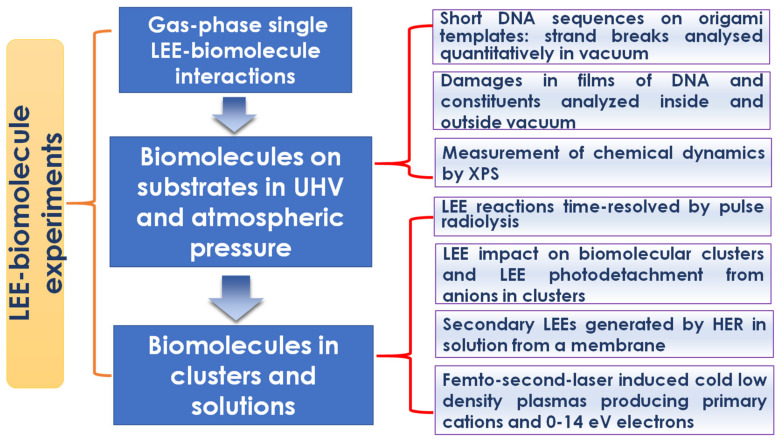
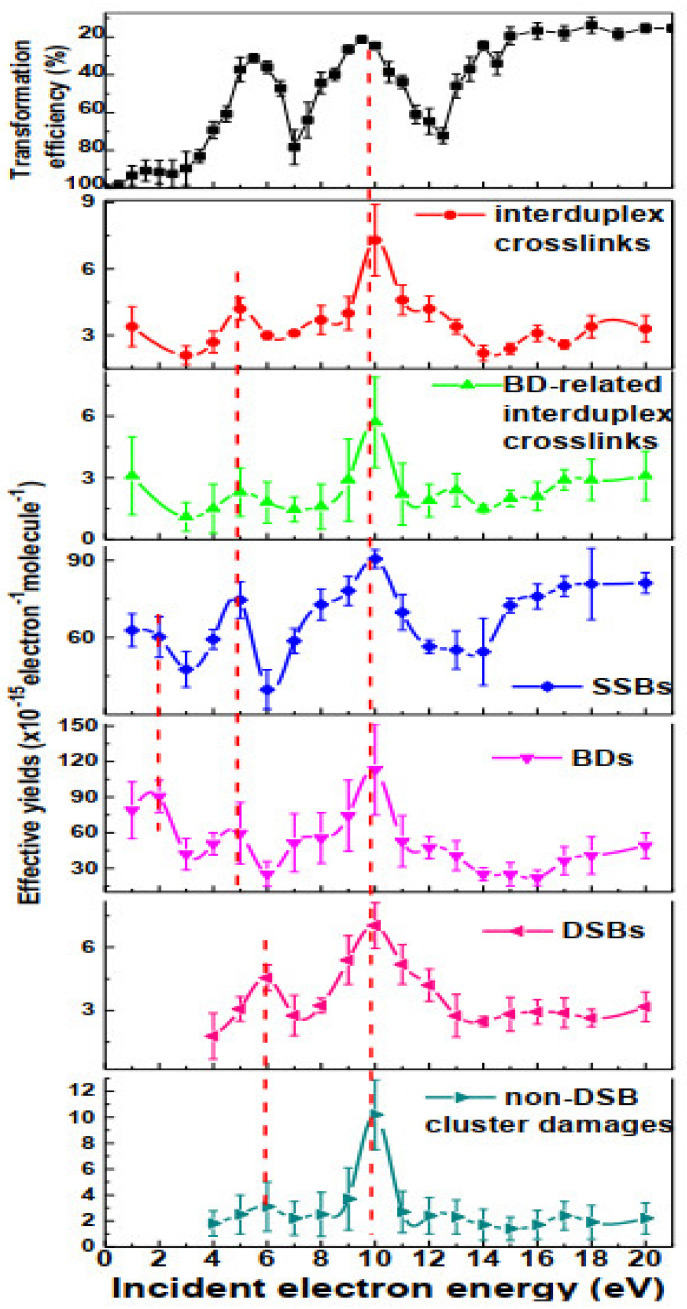
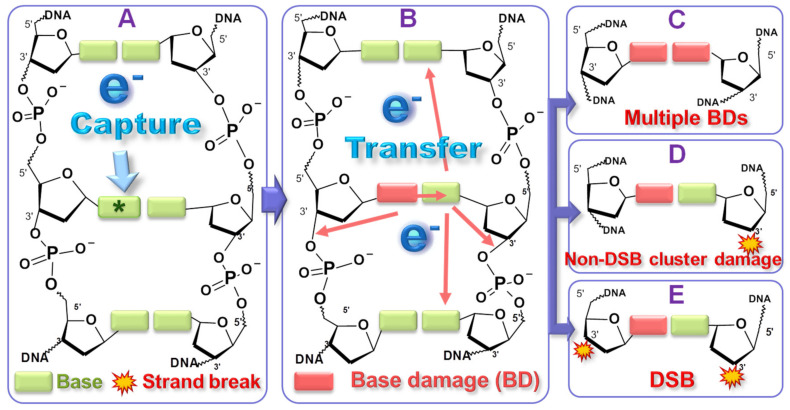
The complex physical and chemical reactions between the large number of low-energy (0-30 eV) electrons (LEEs) released by high energy radiation interacting with genetic material can lead to the formation of various DNA lesions such as crosslinks, single strand breaks, base modifications, and cleavage, as well as double strand breaks and other cluster damages. When crosslinks and cluster damages cannot be repaired by the cell, they can cause genetic loss of information, mutations, apoptosis, and promote genomic instability. Through the efforts of many research groups in the past two decades, the study of the interaction between LEEs and DNA under different experimental conditions has unveiled some of the main mechanisms responsible for these damages. In the present review, we focus on experimental investigations in the condensed phase that range from fundamental DNA constituents to oligonucleotides, synthetic duplex DNA, and bacterial (i.e., plasmid) DNA. These targets were irradiated either with LEEs from a monoenergetic-electron or photoelectron source, as sub-monolayer, monolayer, or multilayer films and within clusters or water solutions. Each type of experiment is briefly described, and the observed DNA damages are reported, along with the proposed mechanisms. Defining the role of LEEs within the sequence of events leading to radiobiological lesions contributes to our understanding of the action of radiation on living organisms, over a wide range of initial radiation energies. Applications of the interaction of LEEs with DNA to radiotherapy are briefly summarized.
高能辐射与遗传物质相互作用释放出大量低能(0-30 eV)电子(LEEs),这些电子之间复杂的物理和化学反应会导致各种 DNA 损伤的形成,如交联、单链断裂、碱基修饰和断裂,以及双链断裂和其他簇损伤。当交联和簇损伤不能被细胞修复时,它们会导致遗传信息丢失、突变、细胞凋亡,并促进基因组不稳定。通过过去二十年来许多研究小组的努力,对不同实验条件下 LEEs 与 DNA 之间相互作用的研究揭示了导致这些损伤的一些主要机制。在本综述中,我们重点介绍了凝聚相中的实验研究,范围从基本的 DNA 成分到寡核苷酸、合成的双链 DNA 和细菌(即质粒)DNA。这些靶标要么用单能电子或光电子源辐照,要么用亚单层、单层或多层薄膜辐照,要么用簇或水溶液辐照。简要描述了每种类型的实验,并报告了观察到的 DNA 损伤以及提出的机制。确定 LEEs 在导致放射生物学损伤的事件序列中的作用有助于我们理解辐射对生物体的作用,涵盖了广泛的初始辐射能量范围。简要总结了 LEEs 与 DNA 的相互作用在放射治疗中的应用。