Department of Cell, Developmental, and Integrative Biology, University of Alabama at Birmingham, Birmingham, Alabama, USA.
Obesity (Silver Spring). 2013 Jun;21(6):1223-5. doi: 10.1002/oby.20199.
To assess the relationship between body mass index (BMI) and adiposity as well as the influence of injury level on this relationship in 24 women with spinal cord injury (SCI) and 23 able-bodied (AB) women with similar age, race, and BMI.
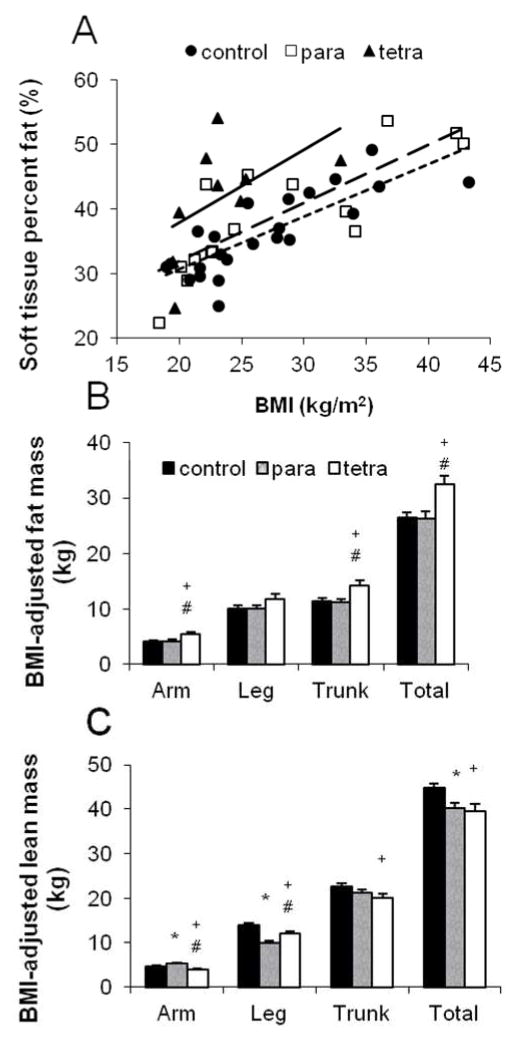
Body composition was measured by dual energy X-ray absorptiometry (DXA). Analysis of covariance was performed to compare total and regional soft tissue percent fat (PF) measures between groups.
Women with SCI had a higher soft tissue PF than AB women at any given BMI. The BMI-adjusted soft tissue PF (mean ± SE) was (44.4 ± 1.8)%, (37.8 ± 1.3)%, and (35.9 ± 1.1)% for tetraplegic, paraplegic, and AB women, respectively. The BMI explained about equal amounts of the variance in soft tissue PF among paraplegic and AB women (65%), but only 28% in tetraplegic women.
This study confirms a limited use of BMI in measuring adiposity in women with SCI, particularly among those with tetraplegia. Our observation of lower BMI cutoff points for defining obesity (28 kg/m(2) for paraplegia and 21 kg/m(2) for tetraplegia) needs further confirmation. The underweight/malnutrition issue also deserves the consideration while proposing the ideal weight and BMI range for persons with SCI.
评估 24 名脊髓损伤(SCI)女性和 23 名年龄、种族和 BMI 相似的健康女性(AB)的体重指数(BMI)与肥胖程度之间的关系,以及损伤水平对这种关系的影响。
采用双能 X 射线吸收法(DXA)测量身体成分。采用协方差分析比较两组之间的总软组织和局部软组织脂肪百分比(PF)。
任何给定 BMI 下,SCI 女性的软组织 PF 均高于 AB 女性。调整 BMI 后的软组织 PF(平均值±SE)分别为四肢瘫、截瘫和 AB 女性的(44.4±1.8)%、(37.8±1.3)%和(35.9±1.1)%。BMI 可以解释截瘫和 AB 女性软组织 PF 变异的相同比例(65%),但仅能解释四肢瘫女性的 28%。
本研究证实 BMI 在测量 SCI 女性肥胖程度方面的应用有限,尤其是在四肢瘫女性中。我们观察到截瘫女性肥胖的 BMI 切点较低(28kg/m2),四肢瘫女性肥胖的 BMI 切点较低(21kg/m2),需要进一步确认。在为 SCI 患者提出理想体重和 BMI 范围时,也应考虑低体重/营养不良问题。