Center for Infectious Disease Dynamics, Pennsylvania State University, University Park, PA, USA.
Malar J. 2013 Aug 2;12:269. doi: 10.1186/1475-2875-12-269.
Air travel has expanded at an unprecedented rate and continues to do so. Its effects have been seen on malaria in rates of imported cases, local outbreaks in non-endemic areas and the global spread of drug resistance. With elimination and global eradication back on the agenda, changing levels and compositions of imported malaria in malaria-free countries, and the threat of artemisinin resistance spreading from Southeast Asia, there is a need to better understand how the modern flow of air passengers connects each Plasmodium falciparum- and Plasmodium vivax-endemic region to the rest of the world.
Recently constructed global P. falciparum and P.vivax malaria risk maps, along with data on flight schedules and modelled passenger flows across the air network, were combined to describe and quantify global malaria connectivity through air travel. Network analysis approaches were then utilized to describe and quantify the patterns that exist in passenger flows weighted by malaria prevalence. Finally, the connectivity within and to the Southeast Asia region where the threat of imported artemisinin resistance arising is highest, was examined to highlight risk routes for its spread.
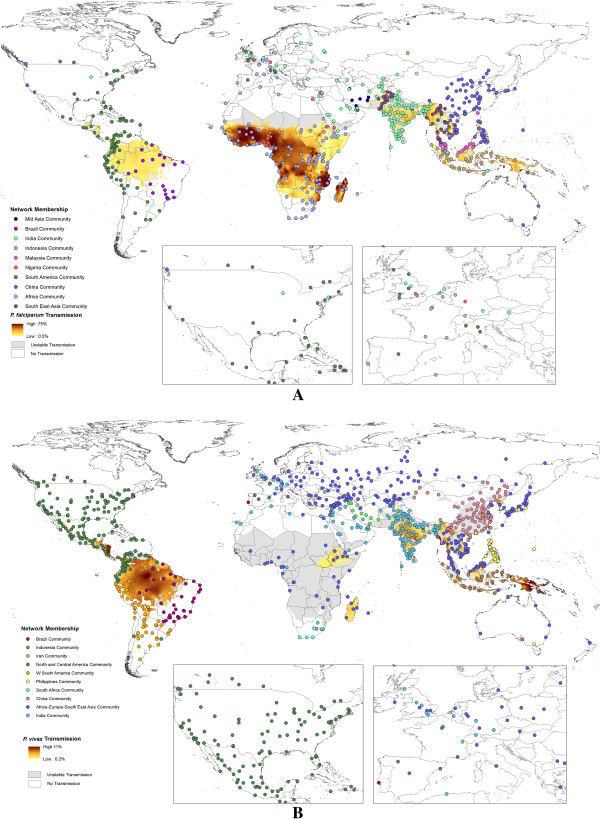
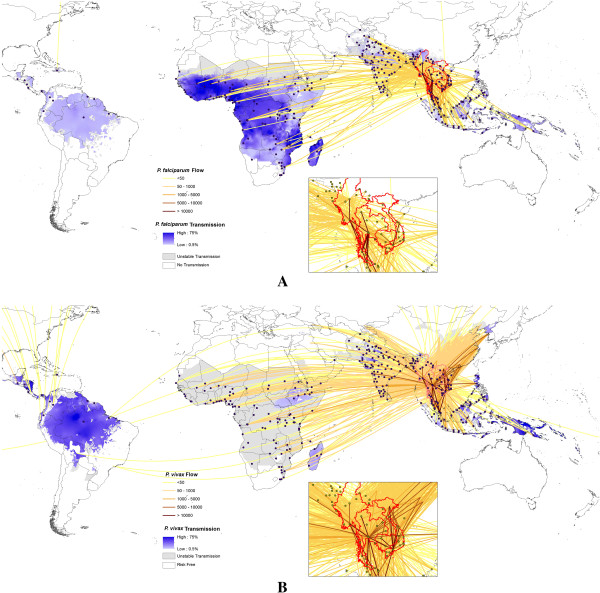
The analyses demonstrate the substantial connectivity that now exists between and from malaria-endemic regions through air travel. While the air network provides connections to previously isolated malarious regions, it is clear that great variations exist, with significant regional communities of airports connected by higher rates of flow standing out. The structures of these communities are often not geographically coherent, with historical, economic and cultural ties evident, and variations between P. falciparum and P. vivax clear. Moreover, results highlight how well connected the malaria-endemic areas of Africa are now to Southeast Asia, illustrating the many possible routes that artemisinin-resistant strains could take.
The continuing growth in air travel is playing an important role in the global epidemiology of malaria, with the endemic world becoming increasingly connected to both malaria-free areas and other endemic regions. The research presented here provides an initial effort to quantify and analyse the connectivity that exists across the malaria-endemic world through air travel, and provide a basic assessment of the risks it results in for movement of infections.
航空旅行以前所未有的速度扩张,并仍在继续。其影响已在输入病例的疟疾发病率、非流行地区的局部暴发以及耐药性的全球传播中显现。随着消除和全球根除工作重新提上日程,无疟疾国家输入性疟疾的水平和构成发生变化,以及青蒿素耐药性从东南亚蔓延的威胁,我们需要更好地了解现代航空旅客流动如何将每个恶性疟原虫和间日疟原虫流行地区与世界其他地区联系起来。
最近构建的全球恶性疟原虫和间日疟原虫疟疾风险图,以及航班时刻表和经模型化的旅客流动数据,被结合起来用于通过航空旅行描述和量化全球疟疾的连通性。然后利用网络分析方法来描述和量化按疟疾流行率加权的旅客流动中存在的模式。最后,还检查了东南亚地区(输入性青蒿素耐药性威胁最高的地区)内部和向该地区的连通性,以突出其传播的风险途径。
分析表明,通过航空旅行,现在疟疾流行地区之间以及从疟疾流行地区到其他地区的连通性大大增强。虽然航空网络为以前孤立的疟疾地区提供了连接,但很明显,存在着很大的差异,具有更高流动率的重要区域机场社区引人注目。这些社区的结构往往在地理上不连贯,存在着明显的历史、经济和文化联系,恶性疟原虫和间日疟原虫的情况也很明显。此外,结果突出表明非洲的疟疾流行地区现在与东南亚的连通性有多好,说明了青蒿素耐药株可能采取的许多可能途径。
航空旅行的持续增长在疟疾的全球流行病学中发挥着重要作用,使世界流行地区与无疟疾地区和其他流行地区更加紧密地联系在一起。这里提出的研究提供了一种初步的努力,用于通过航空旅行量化和分析存在于整个疟疾流行世界的连通性,并对由此导致的传染病传播风险进行基本评估。