State Key Laboratory of Pollution Control and Resource Reuse, School of the Environment, Nanjing University, Xianlin Campus, Nanjing 210023, China.
Environ Health. 2013 Aug 3;12:61. doi: 10.1186/1476-069X-12-61.
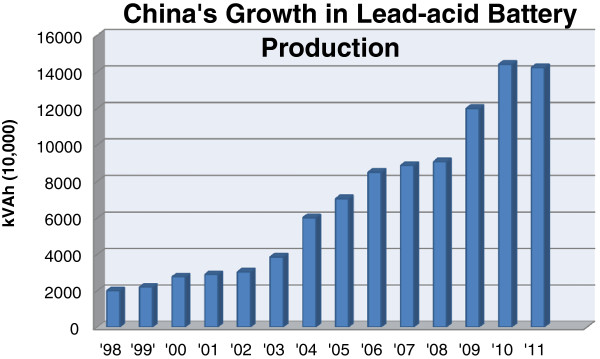
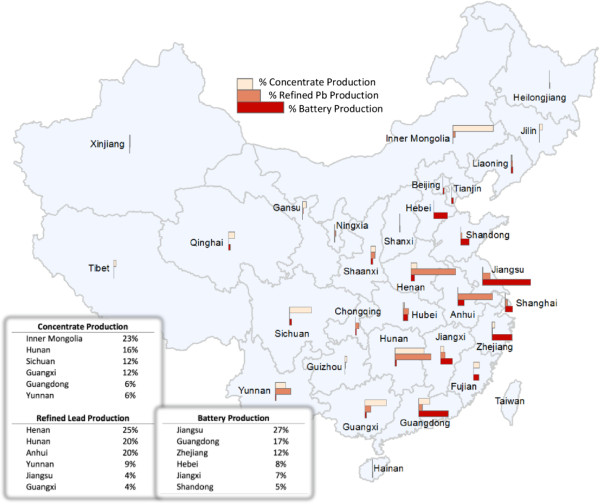
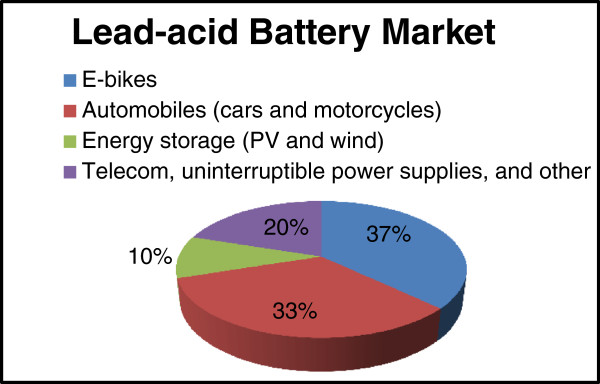
Despite China's leaded gasoline phase out in 2000, the continued high rates of lead poisoning found in children's blood lead levels reflect the need for identifying and controlling other sources of lead pollution. From 2001 to 2007, 24% of children in China studied (N = 94,778) were lead poisoned with levels exceeding 100 μg/L. These levels stand well above the global average of 16%. These trends reveal that China still faces significant public health challenges, with millions of children currently at risk of lead poisoning. The unprecedented growth of China's lead-acid battery industry from the electric bike, automotive, and photovoltaic industries may explain these persistently high levels, as China remains the world's leading producer, refiner, and consumer of both lead and lead-acid batteries.This review assesses the role of China's rising lead-acid battery industry on lead pollution and exposure. It starts with a synthesis of biological mechanisms of lead exposure followed by an analysis of the key technologies driving the rapid growth of this industry. It then details the four main stages of lead battery production, explaining how each stage results in significant lead loss and pollution. A province-level accounting of each of these industrial operations is also included. Next, reviews of the literature describe how this industry may have contributed to mass lead poisonings throughout China. Finally, the paper closes with a discussion of new policies that address the lead-acid battery industry and identifies policy frameworks to mitigate exposure.This paper is the first to integrate the market factors, production processes, and health impacts of China's growing lead-acid battery industry to illustrate its vast public health consequences. The implications of this review are two-fold: it validates calls for a nationwide assessment of lead exposure pathways and levels in China as well as for a more comprehensive investigation into the health impacts of the lead-acid battery industry. The continuous growth of this industry signals the urgent need for effective regulatory action to protect the health and lives of China's future generations.
尽管中国在 2000 年就已经淘汰了含铅汽油,但儿童血铅水平中持续高比例的铅中毒率反映出需要识别和控制其他铅污染来源。2001 年至 2007 年,中国研究的 24%的儿童(N=94778)血铅含量超过 100μg/L,属于铅中毒。这些水平远远高于全球 16%的平均水平。这些趋势表明,中国仍然面临着重大的公共卫生挑战,数以百万计的儿童目前面临铅中毒的风险。中国的铅酸电池行业从电动自行车、汽车和光伏产业中以前所未有的速度增长,这可能是导致这些持续高水平的原因,因为中国仍然是世界领先的铅和铅酸电池的生产国、精炼国和消费国。
本综述评估了中国不断增长的铅酸电池行业对铅污染和暴露的作用。它首先综合了铅暴露的生物学机制,然后分析了推动该行业快速增长的关键技术。接着详细介绍了铅电池生产的四个主要阶段,解释了每个阶段如何导致大量的铅损失和污染。还包括对每个工业操作的省级核算。接下来,对文献的综述描述了该行业如何可能导致中国各地的大规模铅中毒。最后,本文以讨论解决铅酸电池行业的新政策结束,并确定了减轻暴露的政策框架。
本文首次将中国不断增长的铅酸电池行业的市场因素、生产过程和健康影响整合在一起,说明了其对广泛的公共卫生的影响。本文的意义有两方面:它验证了对中国铅暴露途径和水平进行全国评估以及对铅酸电池行业健康影响进行更全面调查的呼吁。该行业的持续增长表明,迫切需要采取有效的监管行动,以保护中国子孙后代的健康和生命。