Division of Infection Medicine, Lund University, S-221 84 Lund, Sweden.
J Neuroinflammation. 2013 Aug 6;10:100. doi: 10.1186/1742-2094-10-100.
Cerebral intraventricular hemorrhage (IVH) is a major cause of severe neurodevelopmental impairment in preterm infants. To date, no therapy is available that prevents infants from developing serious neurological disability following IVH. Thus, to develop treatment strategies for IVH, it is essential to characterize the initial sequence of molecular events that leads to brain damage. In this study, we investigated extracellular hemoglobin (Hb) as a causal initiator of inflammation in preterm IVH.
Using a preterm rabbit pup model, we investigated the molecular mechanisms and events following IVH. We also characterized the concentrations of cell-free Hb metabolites and pro-inflammatory mediators in the cerebrospinal fluid (CSF) of preterm human infants and rabbit pups. Finally, Hb metabolites were evaluated as causal initiators of inflammation in primary rabbit astrocyte cell cultures.
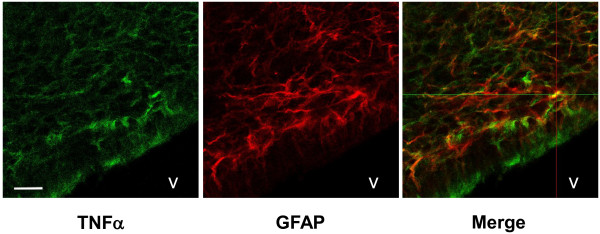
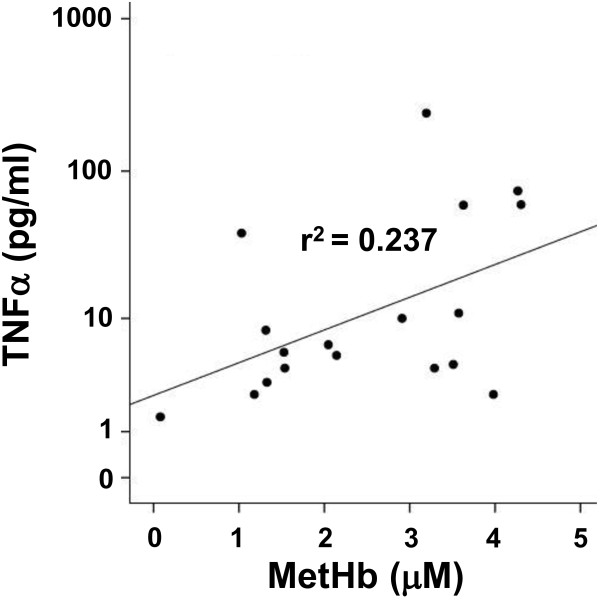
Following IVH in preterm rabbit pups, the intraventricular CSF concentration of cell-free methemoglobin (metHb) increased from 24 to 72 hours and was strongly correlated with the concentration of TNFα at 72 hours (r2 = 0.896, P <0.001). Also, the mRNA expression of TNFα, IL-1β, and Toll-like receptor-4 and TNFα protein levels were significantly increased in periventricular tissue at 72 hours, which was accompanied by extensive astrocyte activation (that is, glial fibrillary acidic protein (GFAP)staining). Furthermore, exposure of primary rabbit astrocyte cell cultures to metHb caused a dose-dependent increase in TNFα mRNA and protein levels, which was not observed following exposure to oxyhemoglobin (oxyHb) or hemin. Finally, a positive correlation (r2 = 0.237, P <0.03) between metHb and TNFα concentrations was observed in the CSF of preterm human infants following IVH.
Following preterm IVH, increased metHb formation in the intraventricular space induces expression of pro-inflammatory cytokines. Thus, the formation of metHb might be a crucial initial event in the development of brain damage following preterm IVH. Accordingly, removal, scavenging, or neutralization of Hb could present a therapeutic opportunity and plausible approach to decreasing the damage in the immature brain following preterm IVH.
脑室内出血(IVH)是早产儿发生严重神经发育障碍的主要原因。迄今为止,尚无任何治疗方法可防止 IVH 后婴儿出现严重神经功能障碍。因此,为了制定 IVH 的治疗策略,必须对导致脑损伤的初始分子事件序列进行特征描述。在这项研究中,我们研究了细胞外血红蛋白(Hb)作为早产儿 IVH 炎症的潜在起始因子。
使用早产兔模型,我们研究了 IVH 后的分子机制和事件。我们还描述了早产儿和兔幼仔的脑脊液(CSF)中游离 Hb 代谢产物和促炎介质的浓度。最后,我们评估了 Hb 代谢产物是否为原发性兔星形胶质细胞培养物炎症的起始因子。
在早产兔幼仔 IVH 后,脑室内 CSF 中游离高铁血红蛋白(metHb)的浓度从 24 小时增加到 72 小时,与 72 小时 TNFα 的浓度呈强相关性(r2=0.896,P<0.001)。此外,在 72 小时时,室周组织中 TNFα、IL-1β、Toll 样受体-4 的 mRNA 表达和 TNFα 蛋白水平显著增加,同时伴有广泛的星形胶质细胞激活(即胶质纤维酸性蛋白(GFAP)染色)。此外,暴露于 metHb 的原代兔星形胶质细胞培养物中,TNFα 的 mRNA 和蛋白水平呈剂量依赖性增加,而暴露于氧合血红蛋白(oxyHb)或血红素时则没有观察到这种增加。最后,在早产儿 IVH 后,CSF 中观察到 metHb 与 TNFα 浓度之间存在正相关(r2=0.237,P<0.03)。
在早产儿 IVH 后,脑室内空间中 metHb 的形成增加诱导了促炎细胞因子的表达。因此,metHb 的形成可能是早产儿 IVH 后脑损伤发展的关键初始事件。因此,去除、清除或中和 Hb 可能是一种有治疗前景的方法,可以减少早产儿 IVH 后不成熟大脑的损伤。