Programme for Physiology and Neurobiology, Department of Biosciences, University of Oslo, 0316 Oslo, Norway.
Comp Biochem Physiol A Mol Integr Physiol. 2013 Nov;166(3):482-9. doi: 10.1016/j.cbpa.2013.07.025. Epub 2013 Jul 31.
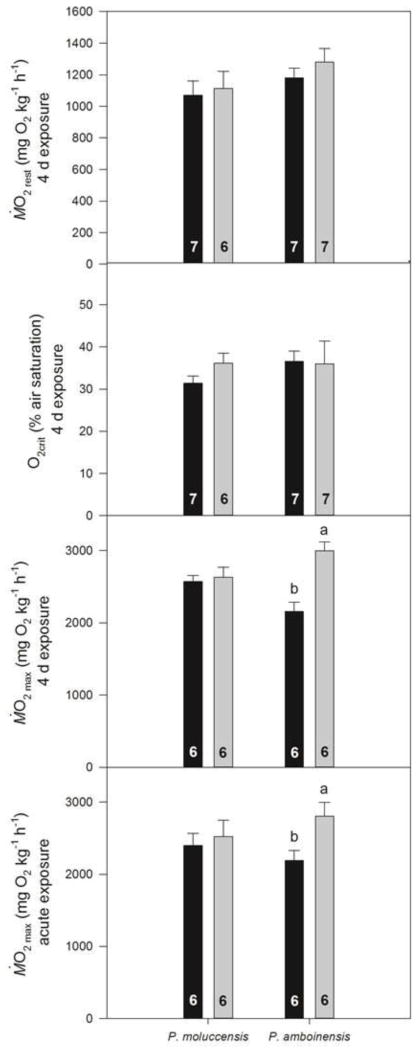
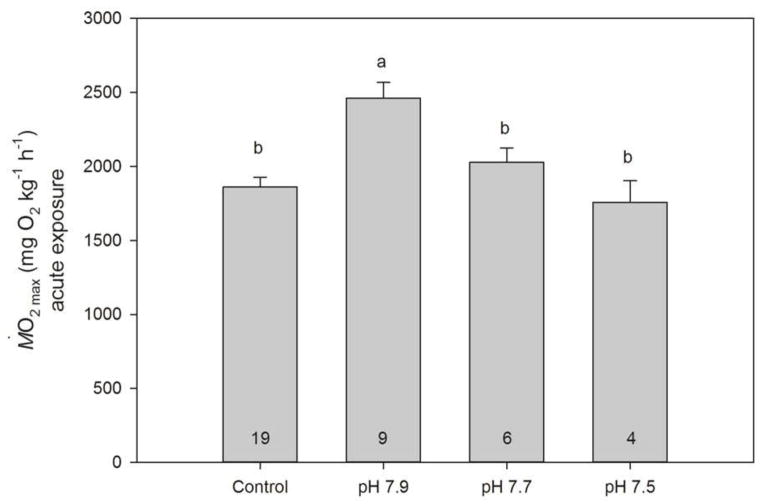
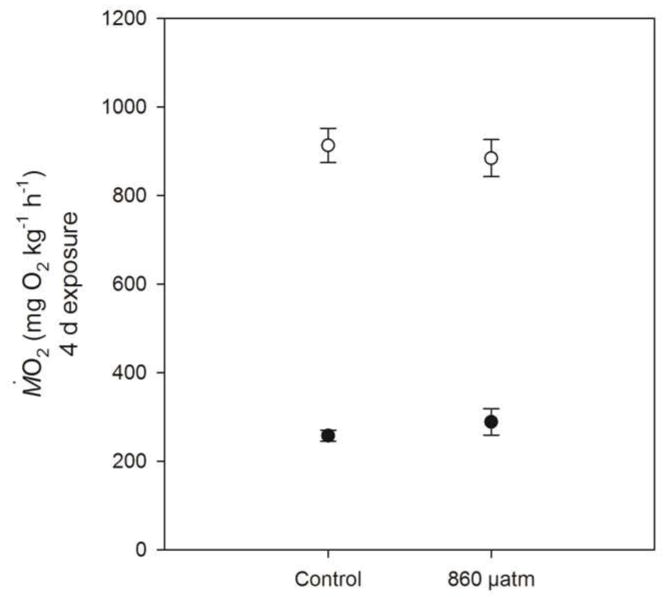
Ocean surface CO2 levels are increasing in line with rising atmospheric CO2 and could exceed 900μatm by year 2100, with extremes above 2000μatm in some coastal habitats. The imminent increase in ocean pCO2 is predicted to have negative consequences for marine fishes, including reduced aerobic performance, but variability among species could be expected. Understanding interspecific responses to ocean acidification is important for predicting the consequences of ocean acidification on communities and ecosystems. In the present study, the effects of exposure to near-future seawater CO2 (860μatm) on resting (M˙ O2rest) and maximum (M˙O2max) oxygen consumption rates were determined for three tropical coral reef fish species interlinked through predator-prey relationships: juvenile Pomacentrus moluccensis and Pomacentrus amboinensis, and one of their predators: adult Pseudochromis fuscus. Contrary to predictions, one of the prey species, P. amboinensis, displayed a 28-39% increase in M˙O2max after both an acute and four-day exposure to near-future CO2 seawater, while maintaining M˙O2rest. By contrast, the same treatment had no significant effects on M˙O2rest or M˙O2max of the other two species. However, acute exposure of P. amboinensis to 1400 and 2400μatm CO2 resulted in M˙O2max returning to control values. Overall, the findings suggest that: (1) the metabolic costs of living in a near-future CO2 seawater environment were insignificant for the species examined at rest; (2) the M˙O2max response of tropical reef species to near-future CO2 seawater can be dependent on the severity of external hypercapnia; and (3) near-future ocean pCO2 may not be detrimental to aerobic scope of all fish species and it may even augment aerobic scope of some species. The present results also highlight that close phylogenetic relatedness and living in the same environment, does not necessarily imply similar physiological responses to near-future CO2.
海洋表面二氧化碳水平与大气二氧化碳的上升相一致,到 2100 年可能会超过 900μatm,在一些沿海栖息地,二氧化碳浓度的极端值可能会超过 2000μatm。预计海洋二氧化碳分压的急剧增加将对海洋鱼类产生负面影响,包括有氧性能下降,但不同物种之间可能存在差异。了解物种间对海洋酸化的反应对于预测海洋酸化对群落和生态系统的影响非常重要。在本研究中,测定了三种与捕食者-猎物关系相互关联的热带珊瑚礁鱼类(幼年的 Pomacentrus moluccensis 和 Pomacentrus amboinensis 以及它们的一种捕食者:成年的 Pseudochromis fuscus)暴露在近未来海水 CO2(860μatm)下时的静息(M˙O2rest)和最大(M˙O2max)耗氧量的变化。与预测相反,其中一种猎物物种 Pomacentrus amboinensis 在急性和四天暴露于近未来 CO2 海水后,其 M˙O2max 增加了 28-39%,同时保持 M˙O2rest。相比之下,相同的处理对其他两种鱼类的 M˙O2rest 或 M˙O2max 没有显著影响。然而,急性暴露于 1400 和 2400μatm CO2 的 P.amboinensis 导致 M˙O2max 恢复到对照值。总体而言,研究结果表明:(1)在近未来 CO2 海水环境中生活的代谢成本对静息状态下的研究物种不重要;(2)热带珊瑚物种对近未来 CO2 海水的 M˙O2max 反应可能取决于外部碳酸过多的严重程度;(3)近未来海洋 pCO2 可能不会对所有鱼类物种的有氧范围造成不利影响,甚至可能增加某些物种的有氧范围。本研究结果还表明,亲缘关系密切且生活在同一环境中,并不一定意味着对近未来 CO2 具有相似的生理反应。