MRC Integrative Epidemiology Unit, University of Bristol, Oakfield House, Oakfield Grove, Bristol BS8 2BN, UK.
Hypertension. 2013 Sep;62(3):614-20. doi: 10.1161/HYPERTENSIONAHA.113.01513. Epub 2013 Aug 5.
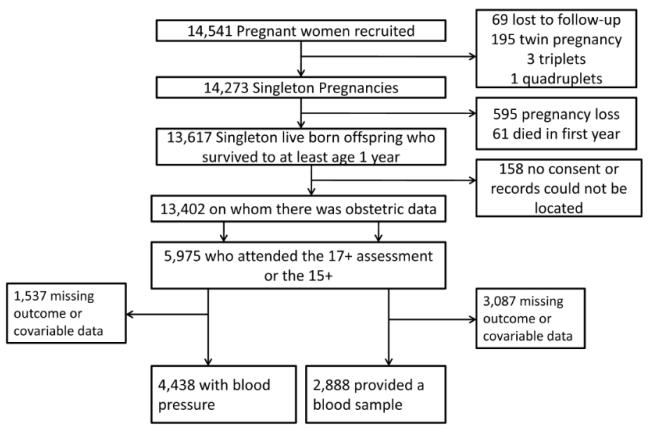
An accumulating body of evidence suggests that offspring of mothers with preeclampsia have higher blood pressure during childhood and young adulthood compared with women without preeclampsia. However, the evidence with regard to offspring glucose metabolism and lipids is more scant. We examined whether maternal hypertensive disorders of pregnancy (preeclampsia and gestational hypertension) are associated with a range of cardiometabolic health measures in adolescent offspring. We included data for mother-offspring pairs from a United Kingdom prospective birth cohort (the Avon Longitudinal Study of Parents and Children). Repeat antenatal clinic measures of blood pressure and proteinuria (median 14 and 11, respectively) were used to ascertain maternal preeclampsia (n=53) and gestational hypertension (n=431). Offspring had blood pressure (n=4438), and fasting lipids, insulin, and glucose (n=2888) measured at a mean age of 17 years. There was no strong evidence of differences in fasting insulin, glucose, or lipid concentrations. Systolic and diastolic blood pressures were higher in offspring of mothers with gestational hypertension (mean difference, 2.06 mm Hg; 95% confidence interval, 1.28-2.84 and 1.11 mm Hg; 95% confidence interval, 0.54-1.69, respectively) and preeclampsia (1.12 mm Hg; 95% confidence interval, -0.89-3.12 and 1.71 mm Hg; 95% confidence interval, 0.23-3.17, respectively) compared with offspring of mothers without hypertensive disorders of pregnancy, adjusting for potential confounders (age, sex, maternal age at delivery, household social class, prepregnancy body mass index, parity, and smoking in pregnancy). Results suggest a specific association between maternal hypertensive disorders of pregnancy and offspring blood pressure that may be driven by genetics or familial nongenetic risk factors particular to blood pressure.
越来越多的证据表明,与没有子痫前期的女性相比,患有子痫前期的母亲所生的子女在儿童期和青年期的血压更高。然而,关于后代葡萄糖代谢和脂质的证据则更为稀少。我们研究了母亲妊娠高血压疾病(子痫前期和妊娠期高血压)是否与青少年后代的一系列心血管代谢健康指标有关。我们纳入了来自英国前瞻性出生队列(阿冯纵向研究父母和儿童)的母婴对子的数据。重复的产前诊所血压和蛋白尿测量(中位数分别为 14 和 11)用于确定母亲的子痫前期(n=53)和妊娠期高血压(n=431)。在平均年龄为 17 岁时,对后代进行了血压(n=4438)以及空腹血脂、胰岛素和血糖(n=2888)的测量。空腹胰岛素、葡萄糖或脂质浓度没有明显差异。与无妊娠高血压疾病的母亲所生的子女相比,患有妊娠期高血压(平均差异 2.06mmHg;95%置信区间 1.28-2.84 和 1.11mmHg;95%置信区间 0.54-1.69)和子痫前期(1.12mmHg;95%置信区间 -0.89-3.12 和 1.71mmHg;95%置信区间 0.23-3.17)的子女的收缩压和舒张压均较高,调整了潜在的混杂因素(年龄、性别、分娩时母亲的年龄、家庭社会阶层、孕前体重指数、产次和孕期吸烟)。结果表明,母亲妊娠高血压疾病与后代血压之间存在特定的关联,这种关联可能是由遗传或特定于血压的家族非遗传危险因素引起的。