Department of General Practice, Katholieke Universiteit Leuven, Kapucijnenvoer 33 blok J, box 7001, 3000 Leuven, Belgium.
BMC Health Serv Res. 2013 Aug 6;13:296. doi: 10.1186/1472-6963-13-296.
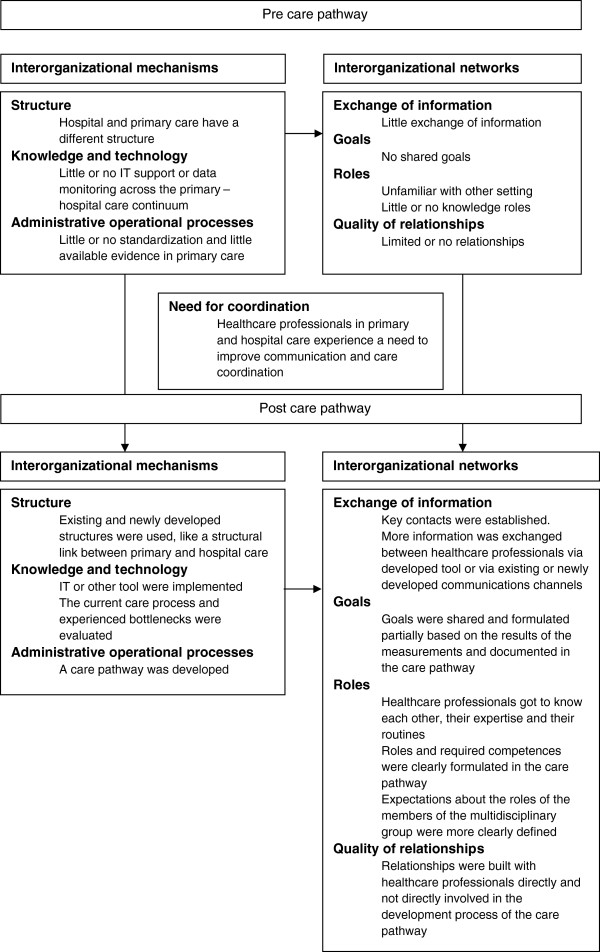
Care pathways are widely used in hospitals for a structured and detailed planning of the care process. There is a growing interest in extending care pathways into primary care to improve quality of care by increasing care coordination. Evidence is sparse about the relationship between care pathways and care coordination.The multi-level framework explores care coordination across organizations and states that (inter)organizational mechanisms have an effect on the relationships between healthcare professionals, resulting in quality and efficiency of care.The aim of this study was to assess the extent to which care pathways support or create elements of the multi-level framework necessary to improve care coordination across the primary-hospital care continuum.
This study is an in-depth analysis of five existing local community projects located in four different regions in Flanders (Belgium) to determine whether the available empirical evidence supported or refuted the theoretical expectations from the multi-level framework. Data were gathered using mixed methods, including structured face-to-face interviews, participant observations, documentation and a focus group. Multiple cases were analyzed performing a cross case synthesis to strengthen the results.
The development of a care pathway across the primary-hospital care continuum, supported by a step-by-step scenario, led to the use of existing and newly constructed structures, data monitoring and the development of information tools. The construction and use of these inter-organizational mechanisms had a positive effect on exchanging information, formulating and sharing goals, defining and knowing each other's roles, expectations and competences and building qualitative relationships.
Care pathways across the primary-hospital care continuum enhance the components of care coordination.
护理路径在医院中被广泛用于结构化和详细规划护理过程。人们越来越感兴趣的是将护理路径扩展到初级保健中,通过增加护理协调来提高护理质量。关于护理路径与护理协调之间的关系,证据有限。多水平框架跨越组织探讨了护理协调,并指出(组织间)机制对医疗保健专业人员之间的关系有影响,从而影响护理的质量和效率。本研究旨在评估护理路径在多大程度上支持或创造多水平框架中必要的要素,以改善整个初级医院护理连续体的护理协调。
本研究是对五个位于比利时四个不同地区的现有地方社区项目的深入分析,以确定现有经验证据是否支持或反驳多水平框架的理论预期。使用混合方法收集数据,包括结构化面对面访谈、参与式观察、文件记录和焦点小组。通过跨案例综合分析多个案例,以加强结果。
通过逐步情景支持的初级医院护理连续体的护理路径的发展,导致了现有和新构建的结构、数据监测和信息工具的开发的使用。这些组织间机制的构建和使用对信息交流、目标的制定和共享、角色、期望和能力的定义和了解以及建立定性关系产生了积极影响。
初级医院护理连续体上的护理路径增强了护理协调的组成部分。