Wu Danny T Y, Hanauer David A, Mei Qiaozhu, Clark Patricia M, An Lawrence C, Lei Jianbo, Proulx Joshua, Zeng-Treitler Qing, Zheng Kai
School of Information, University of Michigan, Ann Arbor, MI, USA.
Stud Health Technol Inform. 2013;192:647-51.
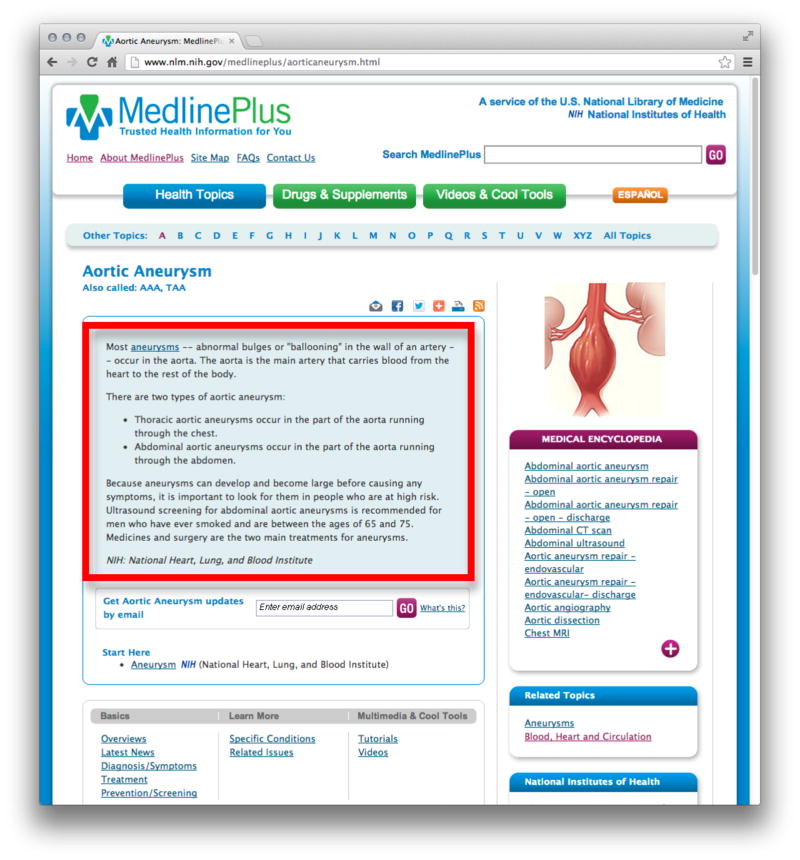
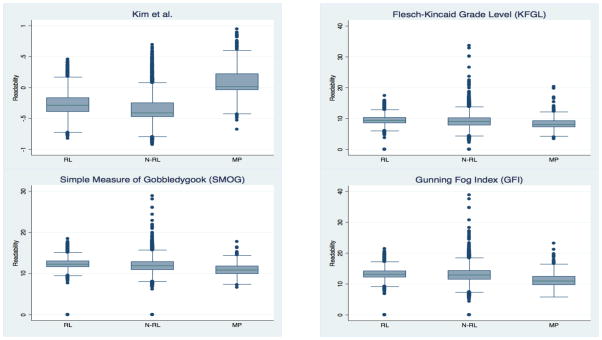
Medical documents provided to patients at the end of an episode of care, such as discharge summaries and referral letters, serve as an important vehicle to convey critical information to patients and families. Increasingly, healthcare institutions are also experimenting with granting patients direct electronic access to other types of clinical narratives that are not typically shared unless explicitly requested, such as progress notes. While these efforts have great potential to improve information transparency, their value can be severely diminished if patients are unable to read and thus unable to properly interpret the medical documents shared to them. In this study, we approached the problem by contrasting the 'readability' of two types of medical documents: referral letters vs. other genres of narrative clinician notes not explicitly intended for direct viewing by patients. To establish a baseline for comparison, we also computed readability scores of MedlinePlus articles - exemplars of fine patient education materials carefully crafted for lay audiences. We quantified document readability using four different measures. Differences in the results obtained through these measures are also discussed.
在诊疗结束时提供给患者的医疗文档,如出院小结和转诊信,是向患者及其家属传达关键信息的重要载体。越来越多的医疗机构也在尝试让患者直接通过电子方式获取其他类型的临床记录,这些记录通常不会主动分享,除非患者明确要求,比如病程记录。虽然这些举措在提高信息透明度方面有很大潜力,但如果患者无法阅读并正确解读提供给他们的医疗文档,其价值就会大打折扣。在本研究中,我们通过对比两类医疗文档的“可读性”来解决这个问题:转诊信与其他并非明确供患者直接查看的临床叙述性记录。为了建立比较基线,我们还计算了MedlinePlus文章的可读性得分,这些文章是为普通受众精心编写的优质患者教育材料的典范。我们使用四种不同的方法对文档可读性进行量化。同时也讨论了通过这些方法获得的结果差异。