Institute of psychology, University of Wroclaw, Wrocław, Poland.
PLoS One. 2013 Jul 29;8(7):e69203. doi: 10.1371/journal.pone.0069203. Print 2013.
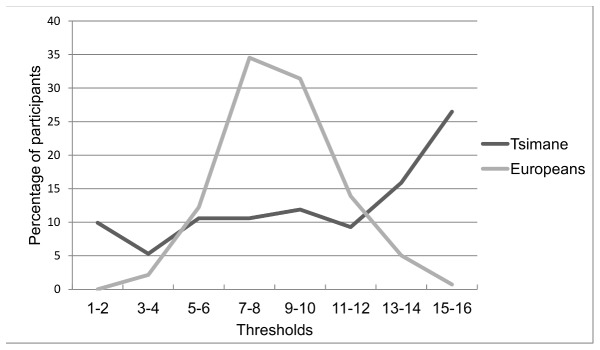
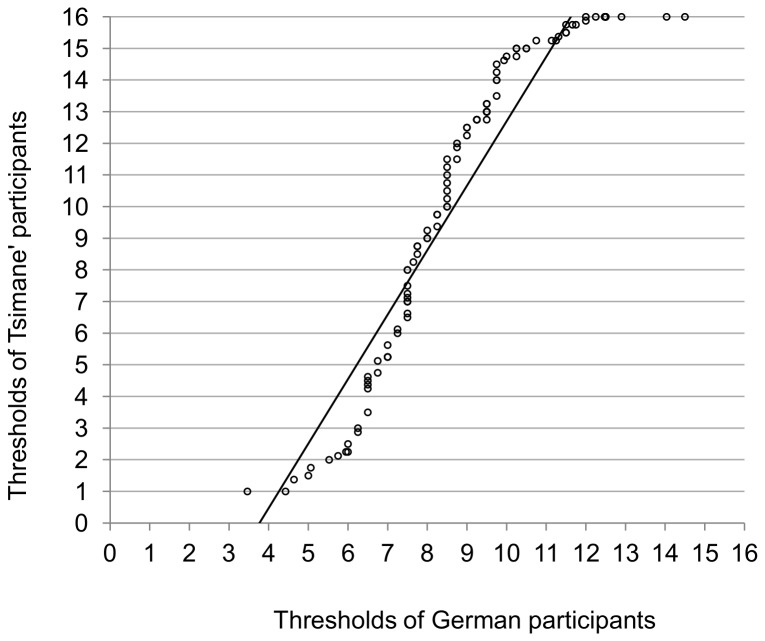
Olfactory sensitivity varies between individuals. However, data regarding cross-cultural and inter-group differences are scarce. We compared the thresholds of odor detection of the traditional society of Tsimane' (native Amazonians of the Bolivian rainforest; n = 151) and people living in Dresden (Germany; n = 286) using "Sniffin' Sticks" threshold subtest. Tsimane' detected n-butanol at significantly lower concentrations than the German subjects. The distribution of thresholds of the Tsimane' was very specific, with 25% of Tsimane' obtaining better results in the olfactory test than any member of the German group. These data suggest that differences in olfactory sensitivity seem to be especially salient between industrialized and non-industrialized populations inhabiting different environmental conditions. We hypothesize that the possible sources of such differences are: (i) the impact of pollution which impairs the olfactory abilities of people from industrialized countries; (ii) better training of olfaction because of the higher importance of smell in traditional populations; (iii) environmental pressures shaping olfactory abilities in these populations.
嗅觉敏感度因人而异。然而,关于跨文化和群体间差异的数据却很少。我们使用“嗅棒”阈值测试比较了传统的提斯曼人(居住在玻利维亚雨林的亚马逊原住民;n=151)和居住在德累斯顿(德国;n=286)的人群的气味检测阈值。提斯曼人检测到正丁醇的浓度明显低于德国受试者。提斯曼人的阈值分布非常特殊,有 25%的提斯曼人在嗅觉测试中的表现优于德国组的任何成员。这些数据表明,嗅觉敏感度的差异在居住在不同环境条件下的工业化和非工业化人群之间似乎尤为明显。我们假设造成这种差异的可能原因是:(i)污染的影响,这种污染损害了来自工业化国家人群的嗅觉能力;(ii)由于嗅觉在传统人群中的重要性更高,嗅觉训练更好;(iii)环境压力塑造了这些人群的嗅觉能力。