Department of Mechanical Engineering, Stanford University, Stanford, CA 94305, USA.
Nanoscale Res Lett. 2013 Aug 8;8(1):347. doi: 10.1186/1556-276X-8-347.
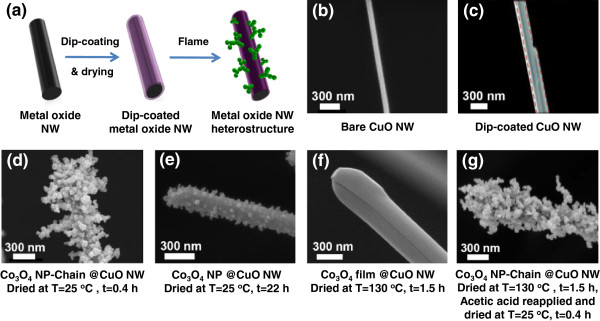
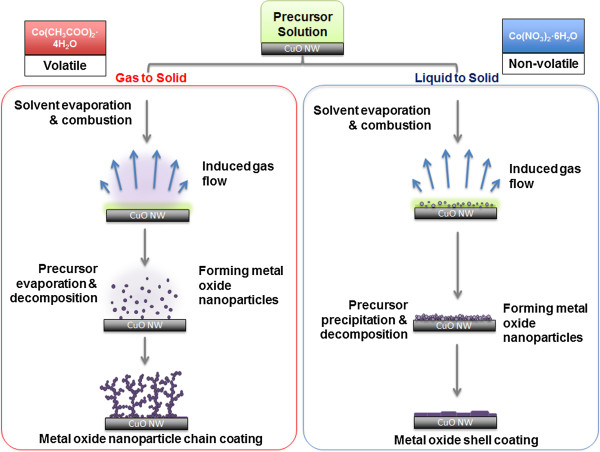
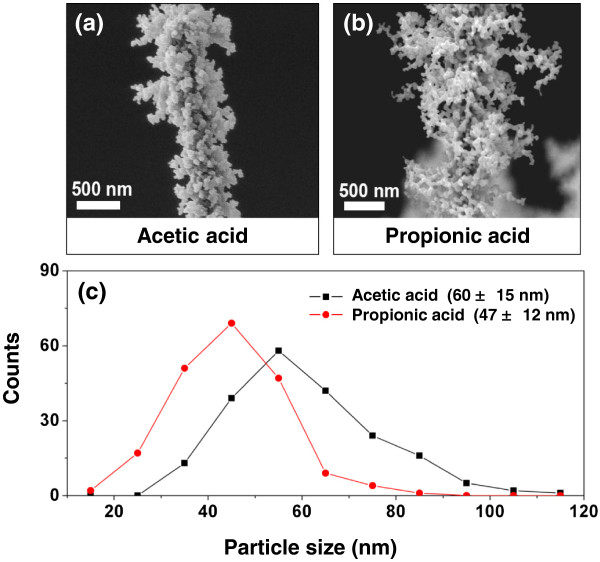
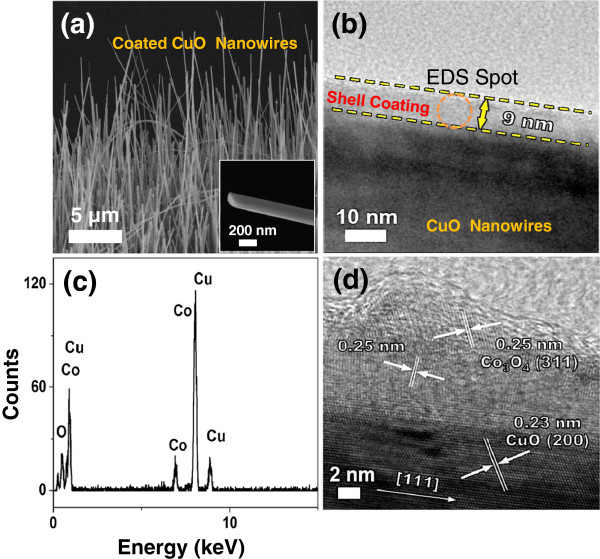
Heterostructured nanowires, such as core/shell nanowires and nanoparticle-decorated nanowires, are versatile building blocks for a wide range of applications because they integrate dissimilar materials at the nanometer scale to achieve unique functionalities. The sol-flame method is a new, rapid, low-cost, versatile, and scalable method for the synthesis of heterostructured nanowires, in which arrays of nanowires are decorated with other materials in the form of shells or chains of nanoparticles. In a typical sol-flame synthesis, nanowires are dip-coated with a solution containing precursors of the materials to be decorated, then dried in air, and subsequently heated in the post-flame region of a flame at high temperature (over 900°C) for only a few seconds. Here, we report the effects of the precursor solution on the final morphology of the heterostructured nanowire using Co3O4 decorated CuO nanowires as a model system. When a volatile cobalt salt precursor is used with sufficient residual solvent, both solvent and cobalt precursor evaporate during the flame annealing step, leading to the formation of Co3O4 nanoparticle chains by a gas-solid transition. The length of the nanoparticle chains is mainly controlled by the temperature of combustion of the solvent. On the other hand, when a non-volatile cobalt salt precursor is used, only the solvent evaporates and the cobalt salt is converted to nanoparticles by a liquid-solid transition, forming a conformal Co3O4 shell. This study facilitates the use of the sol-flame method for synthesizing heterostructured nanowires with controlled morphologies to satisfy the needs of diverse applications.
异质结构纳米线,如核/壳纳米线和纳米颗粒修饰的纳米线,是各种应用的多功能构建块,因为它们在纳米尺度上集成了不同的材料,以实现独特的功能。溶胶-火焰法是一种新的、快速的、低成本的、多功能的和可扩展的合成异质结构纳米线的方法,其中纳米线阵列以壳或纳米颗粒链的形式被其他材料修饰。在典型的溶胶-火焰合成中,纳米线先用含有要修饰的材料前体的溶液进行浸渍,然后在空气中干燥,随后在火焰的后焰区在高温(超过 900°C)下加热几秒钟。在这里,我们以 Co3O4 修饰的 CuO 纳米线为模型系统,报告了前体溶液对异质结构纳米线最终形态的影响。当使用挥发性钴盐前体并留有足够的残留溶剂时,在火焰退火步骤中,溶剂和钴前体都会蒸发,导致通过气-固转变形成 Co3O4 纳米颗粒链。纳米颗粒链的长度主要由溶剂的燃烧温度控制。另一方面,当使用非挥发性钴盐前体时,只有溶剂蒸发,钴盐通过液-固转变转化为纳米颗粒,形成共形的 Co3O4 壳。这项研究促进了溶胶-火焰法用于合成具有可控形态的异质结构纳米线,以满足各种应用的需求。