Department of Parasitology, College of Veterinary Medicine, Sichuan Agricultural University, Ya'an, China.
Parasit Vectors. 2013 Aug 8;6:233. doi: 10.1186/1756-3305-6-233.
Baylisascaris schroederi is one of the most common nematodes of the giant panda, and can cause severe baylisascarosis in both wild and captive giant pandas. Previous studies of the giant pandas indicated that this population is genetically distinct, implying the presence of a new subspecies. Based on the co-evolution between the parasite and the host, the aim of this study was to investigate the genetic differentiation in the B. schroederi population collected from giant pandas inhabiting different mountain ranges, and further to identify whether the evolution of this parasite correlates with the evolution of giant pandas.
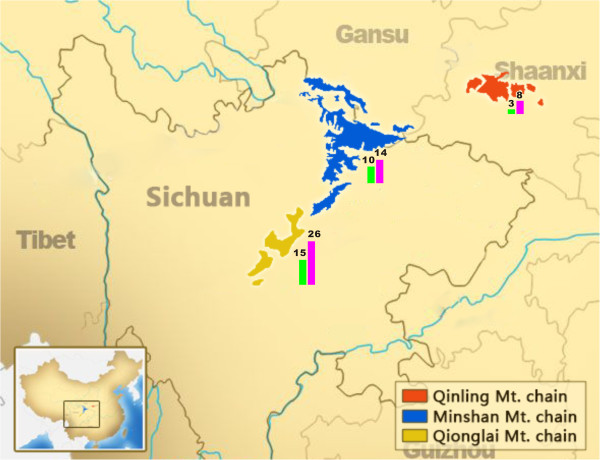
In this study, 48 B. schroederi were collected from 28 wild giant pandas inhabiting the Qinling, Minshan and Qionglai mountain ranges in China. The complete sequence of the mitochondrial cytochrome b (mtCytb) gene was amplified by PCR, and the corresponding population genetic diversity of the three mountain populations was determined. In addition, we discussed the evolutionary relationship between B. schroederi and its host giant panda.
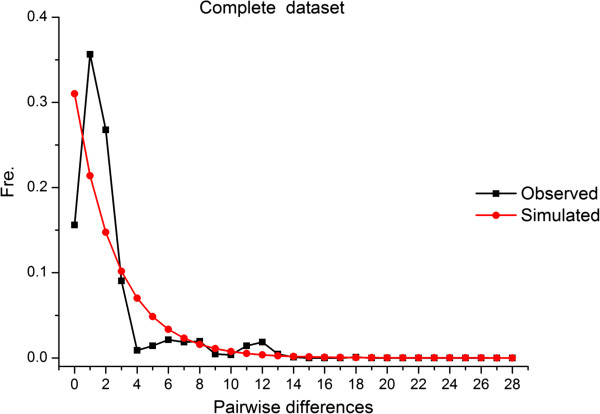
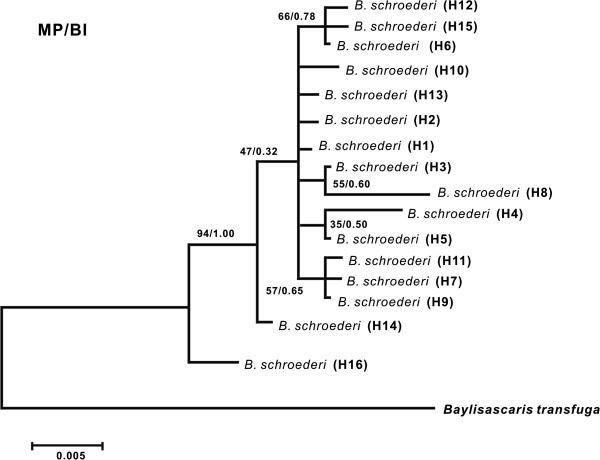
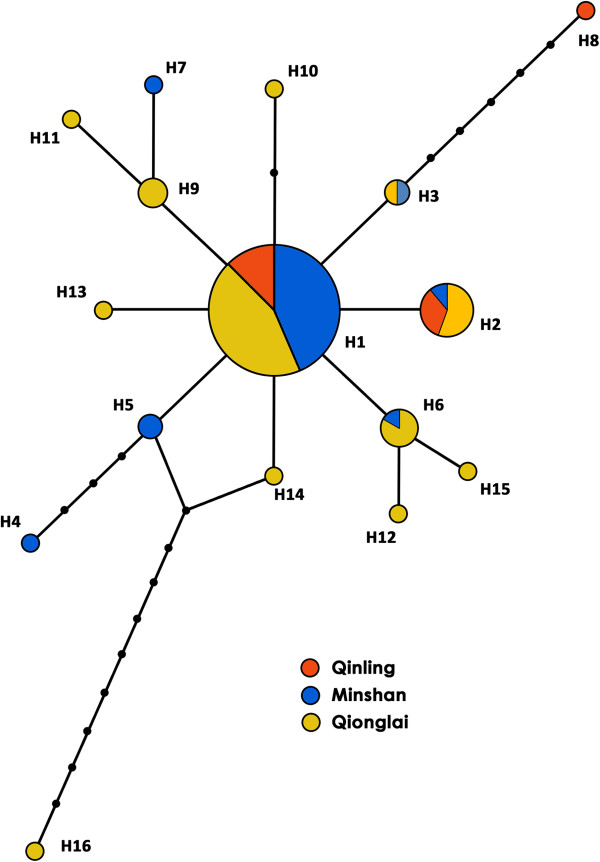
For the DNA dataset, insignificant Fst values and a significant, high level of gene flow were detected among the three mountain populations of B. schroederi, and high genetic variation within populations and a low genetic distance were observed. Both phylogenetic analyses and network mapping of the 16 haplotypes revealed a dispersed pattern and an absence of branches strictly corresponding to the three mountain range sampling sites. Neutrality tests and mismatch analysis indicated that B. schroederi experienced a population expansion in the past.
Taken together, the dispersed haplotype map, extremely high gene flow among the three populations of B. schroederi, low genetic structure and rapid evolutionary rate suggest that the B. schroederi populations did not follow a pattern of isolation by distance, indicating the existence of physical connections before these populations became geographically separated.
蛔虫是大熊猫最常见的线虫之一,在野生和圈养大熊猫中均可引起严重的蛔虫病。以前对大熊猫的研究表明,该种群在遗传上是独特的,暗示存在一个新的亚种。基于寄生虫和宿主之间的共同进化,本研究旨在调查来自栖息在不同山脉的大熊猫的蛔虫种群的遗传分化,并进一步确定这种寄生虫的进化是否与大熊猫的进化相关。
本研究从中国秦岭、岷山和邛崃山栖息的 28 只野生大熊猫中采集了 48 只蛔虫。通过 PCR 扩增线粒体细胞色素 b(mtCytb)基因的完整序列,确定了三个山地区种群的相应群体遗传多样性。此外,我们还讨论了蛔虫与其宿主大熊猫之间的进化关系。
对于 DNA 数据集,在三个山地区的蛔虫种群之间检测到了无意义的 Fst 值和显著的高水平基因流,并且在种群内观察到了高遗传变异和低遗传距离。16 个单倍型的系统发育分析和网络映射都显示出分散的模式,没有严格对应三个山脉采样点的分支。中性检验和错配分析表明,蛔虫在过去经历了种群扩张。
综上所述,分散的单倍型图谱、三个蛔虫种群之间极高的基因流、低遗传结构和快速的进化率表明,蛔虫种群并没有遵循距离隔离的模式,这表明在这些种群在地理上分离之前,存在物理联系。