Laboratory of Entomology and Agricultural Zoology, School of Agricultural Sciences, University of Thessaly, Phytokoy Street 38446 N. Ionia (Volos), Magnisias, Greece.
Proc Biol Sci. 2013 Aug 7;280(1768):20131466. doi: 10.1098/rspb.2013.1466. Print 2013 Oct 7.
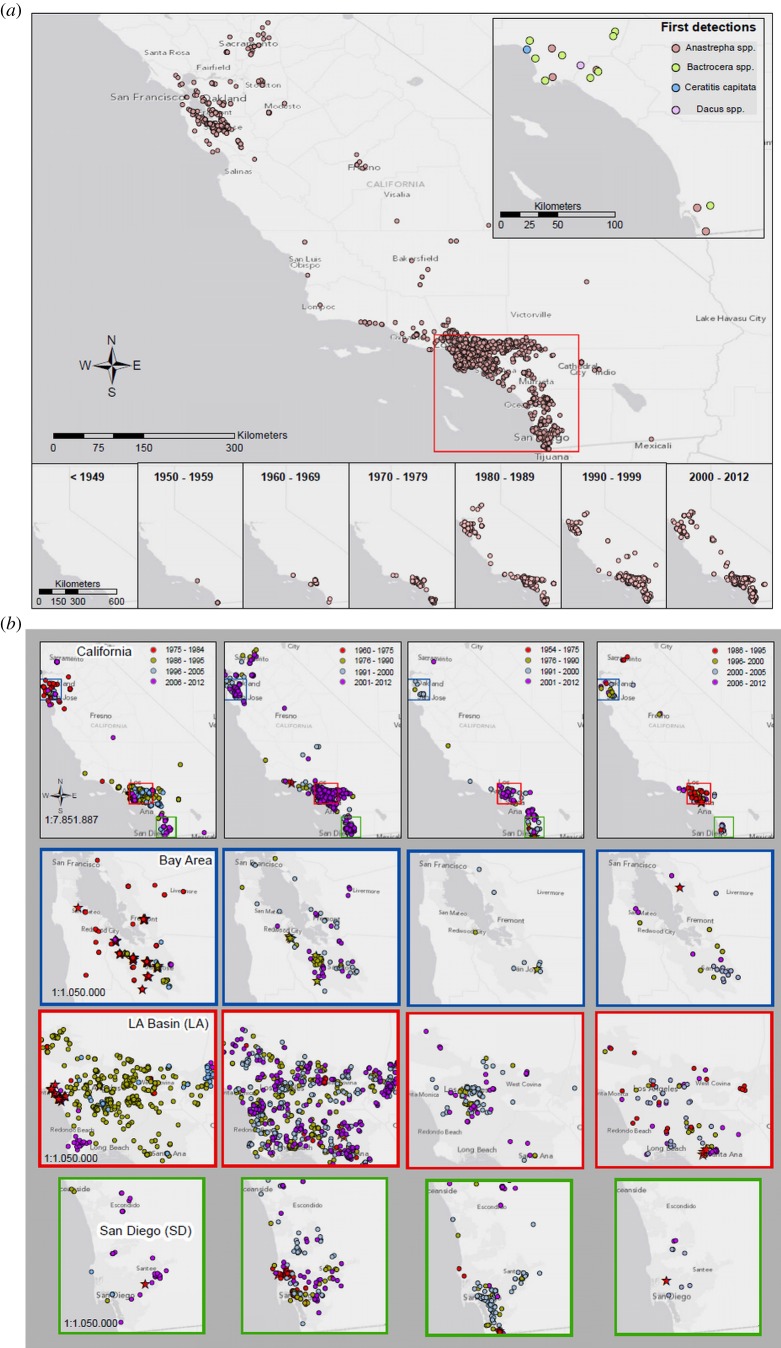
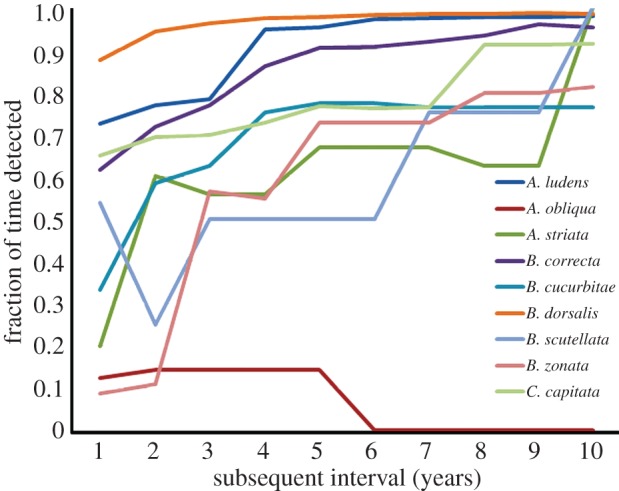
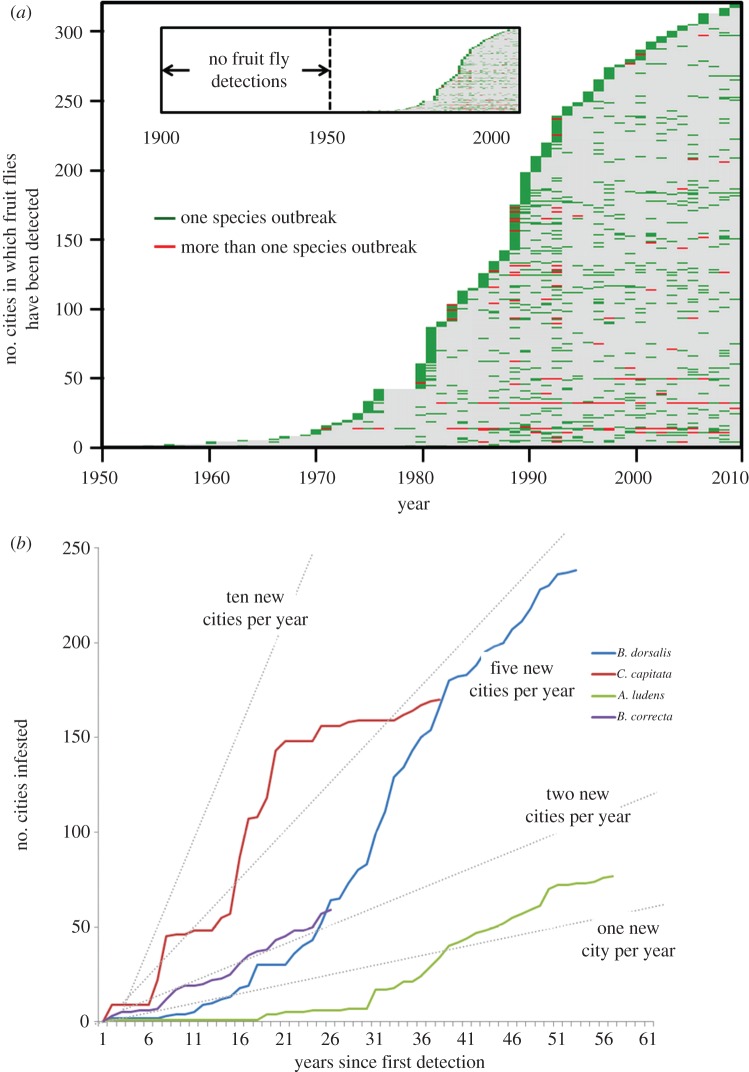
Since 1954, when the first tropical tephritid fruit fly was detected in California, a total of 17 species in four genera and 11 386 individuals (adults/larvae) have been detected in the state at more than 3348 locations in 330 cities. We conclude from spatial mapping analyses of historical capture patterns and modelling that, despite the 250+ emergency eradication projects that have been directed against these pests by state and federal agencies, a minimum of five and as many as nine or more tephritid species are established and widespread, including the Mediterranean, Mexican and oriental fruit flies, and possibly the peach, guava and melon fruit flies. We outline and discuss the evidence for our conclusions, with particular attention to the incremental, chronic and insidious nature of the invasion, which involves ultra-small, barely detectable populations. We finish by considering the implications of our results for invasion biology and for science-based invasion policy.
自 1954 年首次在加利福尼亚州发现第一只热带果实蝇以来,在该州 330 个城市的 3348 多个地点,已检测到四个属的 17 种、11386 只个体(成虫/幼虫)。通过对历史捕获模式的空间映射分析和建模,我们得出结论,尽管州和联邦机构针对这些害虫开展了 250 多个紧急根除项目,但仍有至少 5 种,最多 9 种或更多的果实蝇种已建立并广泛分布,包括地中海、墨西哥和东方果实蝇,以及可能还有桃、番石榴和瓜实蝇。我们概述并讨论了我们结论的证据,特别关注入侵的渐进性、慢性和隐伏性,其中涉及超小、几乎无法检测到的种群。最后,我们考虑了我们的研究结果对入侵生物学和基于科学的入侵政策的影响。