Department of Nutrition, Harvard School of Public Health, Boston, Massachusetts, USA; Channing Division of Network Medicine Brigham and Women's Hospital, Harvard Medical School, Boston, Massachusetts, USA.
Obesity (Silver Spring). 2014 May;22(5):E135-41. doi: 10.1002/oby.20592. Epub 2013 Sep 23.
Many confirmed genetic loci for obesity are expressed in regions of the brain that regulate energy intake and reward-seeking behavior. Whether these loci contribute to the development of specific eating behaviors has not been investigated. The relationship between a genetic susceptibility to obesity and cognitive restraint, uncontrolled and emotional eating was examined.
Eating behavior and body mass index (BMI) were determined by questionnaires for 1471 men and 2381 women from two US cohorts. Genotypes were extracted from genome-wide scans and a genetic-risk score (GRS) derived from 32 obesity-loci was calculated.
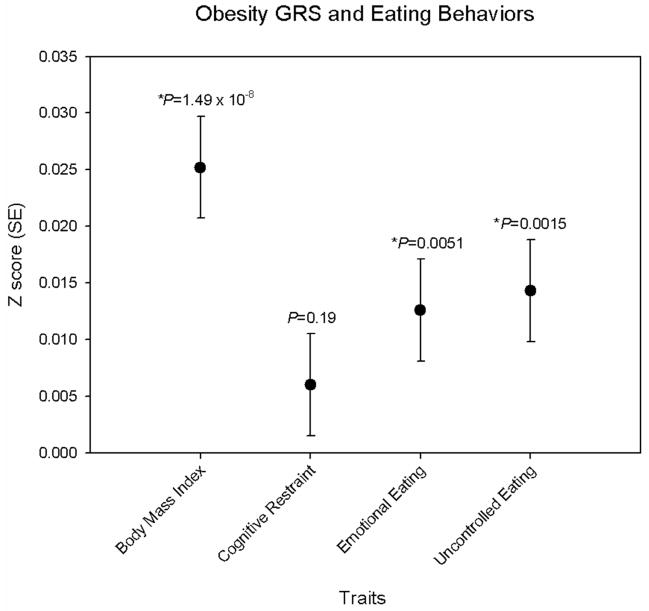
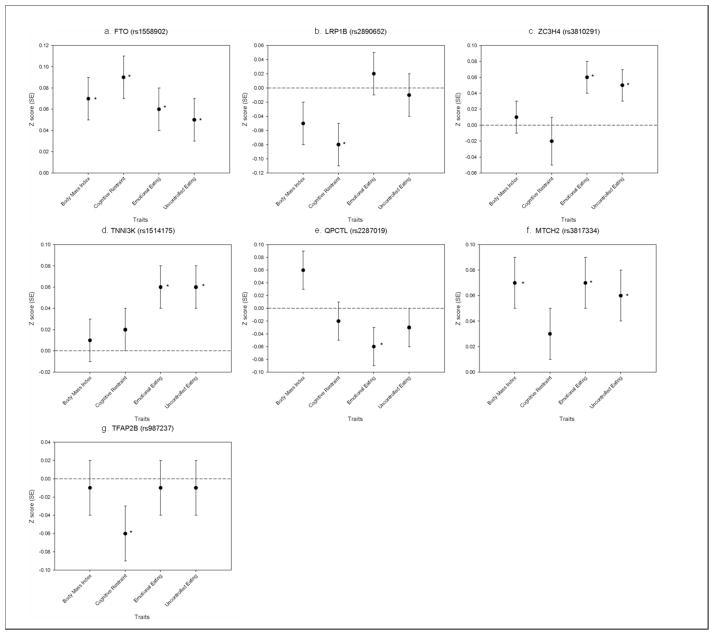
The GRS was positively associated with emotional and uncontrolled eating (P<0.002). In exploratory analysis, BMI-increasing variants of MTCH2, TNNI3K, and ZC3H4 were positively associated with emotional eating and those of TNNI3K and ZC3H4 were positively associated with uncontrolled eating. The BMI-increasing variant of FTO was positively and those of LRP1B and TFAP2B were inversely associated with cognitive restraint. These associations for single SNPs were independent of BMI but were not significant after multiple-testing correction.
An overall genetic susceptibility to obesity may also extend to eating behaviors. The link between specific loci and obesity may be mediated by eating behavior but larger studies are warranted to confirm these results.
许多已确认的肥胖相关遗传基因座在调节能量摄入和寻求奖励行为的大脑区域表达。这些基因座是否有助于特定进食行为的发展尚未得到研究。本研究旨在调查肥胖遗传易感性与认知约束、无法自控的进食和情绪性进食之间的关系。
对来自两个美国队列的 1471 名男性和 2381 名女性进行问卷调查,以确定其进食行为和体重指数(BMI)。从全基因组扫描中提取基因型,并计算出 32 个肥胖相关基因座的遗传风险评分(GRS)。
GRS 与情绪性进食和无法自控的进食呈正相关(P<0.002)。在探索性分析中,MTCH2、TNNI3K 和 ZC3H4 的 BMI 增加型变体与情绪性进食呈正相关,而 TNNI3K 和 ZC3H4 的 BMI 增加型变体与无法自控的进食呈正相关。FTO 的 BMI 增加型变体与认知约束呈正相关,而 LRP1B 和 TFAP2B 的 BMI 增加型变体与认知约束呈负相关。这些单核苷酸多态性的关联独立于 BMI,但经多次检验校正后无统计学意义。
肥胖的总体遗传易感性可能也延伸到了进食行为。特定基因座与肥胖之间的联系可能通过进食行为介导,但需要更大规模的研究来证实这些结果。