McLeod Bryce D, Southam-Gerow Michael A, Tully Carrie B, Rodríguez Adriana, Smith Meghan M
Department of Psychology, Virginia Commonwealth University.
Clin Psychol (New York). 2013 Mar;20(1):14-32. doi: 10.1111/cpsp.12020.
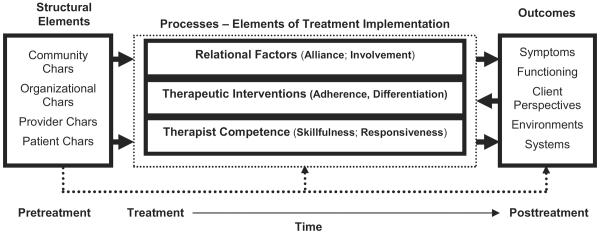
Measures of treatment integrity are needed to advance clinical research in general and are viewed as particularly relevant for dissemination and implementation research. Although some efforts to develop such measures are underway, a conceptual and methodological framework will help guide these efforts. The purpose of this article is to demonstrate how frameworks adapted from the psychosocial treatment, therapy process, healthcare, and business literatures can be used to address this gap. We propose that components of treatment integrity (i.e., adherence, differentiation, competence, alliance, client involvement) pulled from the treatment technology and process literatures can be used as quality indicators of treatment implementation and thereby guide quality improvement efforts in practice settings. Further, we discuss how treatment integrity indices can be used in feedback systems that utilize benchmarking to expedite the process of translating evidence-based practices to service settings.
一般而言,推进临床研究需要治疗完整性的衡量标准,并且这些标准被视为对传播与实施研究尤为重要。尽管目前正在努力制定此类衡量标准,但一个概念和方法框架将有助于指导这些工作。本文的目的是展示如何利用从心理社会治疗、治疗过程、医疗保健和商业文献中改编而来的框架来填补这一空白。我们建议,从治疗技术和过程文献中提取的治疗完整性组成部分(即依从性、差异性、能力、联盟、患者参与度)可作为治疗实施的质量指标,从而指导实践环境中的质量改进工作。此外,我们还讨论了治疗完整性指数如何用于反馈系统,该系统利用基准测试来加速将循证实践转化为服务环境的过程。