Immune Tolerance Laboratory, Medicine, University of New South Wales , Sydney, NSW , Australia.
Front Immunol. 2013 Aug 2;4:208. doi: 10.3389/fimmu.2013.00208. eCollection 2013.
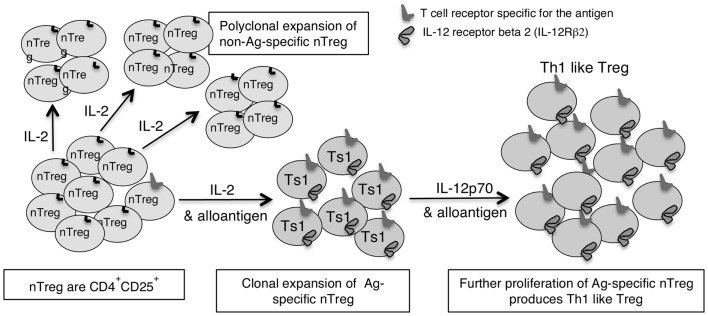
Antigen specific T regulatory cells (Treg) are often CD4(+)CD25(+)FoxP3(+) T cells, with a phenotype similar to natural Treg (nTreg). It is assumed that nTreg cannot develop into an antigen specific Treg as repeated culture with IL-2 and a specific antigen does not increase the capacity or potency of nTreg to promote immune tolerance or suppress in vitro. This has led to an assumption that antigen specific Treg mainly develop from CD4(+)CD25(-)FoxP3(-) T cells, by activation with antigen and TGF-β in the absence of inflammatory cytokines such as IL-6 and IL-1β. Our studies on antigen specific CD4(+)CD25(+) T cells from animals with tolerance to an allograft, identified that the antigen specific and Treg are dividing, and need continuous stimulation with specific antigen T cell derived cytokines. We identified that a variety of cytokines, especially IL-5 and IFN-γ but not IL-2 or IL-4 promoted survival of antigen specific CD4(+)CD25(+)FoxP3(+) Treg. To examine if nTreg could be activated to antigen specific Treg, we activated nTreg in culture with either IL-2 or IL-4. Within 3 days, antigen specific Treg are activated and there is induction of new cytokine receptors on these cells. Specifically nTreg activated by IL-2 and antigen express the interferon-γ receptor (IFNGR) and IL-12p70 (IL-12Rβ2) receptor but not the IL-5 receptor (IL-5Rα). These cells were responsive to IFN-γ or IL-12p70. nTreg activated by IL-4 and alloantigen express IL-5Rα not IFNGR or IL-12p70Rβ2 and become responsive to IL-5. These early activated antigen specific Treg, were respectively named Ts1 and Ts2 cells, as they depend on Th1 or Th2 responses. Further culture of Ts1 cells with IL-12p70 induced Th1-like Treg, expressing IFN-γ, and T-bet as well as FoxP3. Our studies suggest that activation of nTreg with Th1 or Th2 responses induced separate lineages of antigen specific Treg, that are dependent on late Th1 and Th2 cytokines, not the early cytokines IL-2 and IL-4.
抗原特异性调节性 T 细胞(Treg)通常为 CD4(+)CD25(+)FoxP3(+)T 细胞,表型类似于天然调节性 T 细胞(nTreg)。人们认为,nTreg 不能发育成抗原特异性 Treg,因为反复用 IL-2 和特定抗原培养并不能增加 nTreg 促进免疫耐受或体外抑制的能力或效力。这导致人们假设,抗原特异性 Treg 主要由 CD4(+)CD25(-)FoxP3(-)T 细胞发育而来,通过在缺乏 IL-6 和 IL-1β 等炎症细胞因子的情况下与抗原和 TGF-β 激活。我们对来自对同种异体移植物具有耐受性的动物的抗原特异性 CD4(+)CD25(+)T 细胞的研究表明,抗原特异性和 Treg 正在分裂,并且需要不断用特定抗原 T 细胞衍生的细胞因子刺激。我们发现,多种细胞因子,特别是 IL-5 和 IFN-γ,但不是 IL-2 或 IL-4,促进了抗原特异性 CD4(+)CD25(+)FoxP3(+)Treg 的存活。为了检查 nTreg 是否可以被激活为抗原特异性 Treg,我们用 IL-2 或 IL-4 在培养物中激活 nTreg。在 3 天内,抗原特异性 Treg 被激活,并且这些细胞上诱导了新的细胞因子受体。具体来说,由 IL-2 和抗原激活的 nTreg 表达干扰素-γ受体(IFNGR)和 IL-12p70(IL-12Rβ2)受体,但不表达 IL-5 受体(IL-5Rα)。这些细胞对 IFN-γ 或 IL-12p70 有反应。由 IL-4 和同种异体抗原激活的 nTreg 表达 IL-5Rα,而不表达 IFNGR 或 IL-12p70Rβ2,并且对 IL-5 有反应。这些早期激活的抗原特异性 Treg 分别命名为 Ts1 和 Ts2 细胞,因为它们依赖于 Th1 或 Th2 反应。进一步用 IL-12p70 培养 Ts1 细胞诱导产生 Th1 样 Treg,表达 IFN-γ、T-bet 和 FoxP3。我们的研究表明,用 Th1 或 Th2 反应激活 nTreg 诱导了抗原特异性 Treg 的不同谱系,这些谱系依赖于晚期 Th1 和 Th2 细胞因子,而不是早期细胞因子 IL-2 和 IL-4。