Qian Yu, Zhao Xin, Kan Jianquan
Department of Food Chemistry and Nutrition, Southwest University, Chongqing 400715; ; Department of Biological and Chemical Engineering, Chongqing University of Education, Chongqing 400067, P.R. China.
Exp Ther Med. 2013 Jul;6(1):228-232. doi: 10.3892/etm.2013.1096. Epub 2013 May 1.
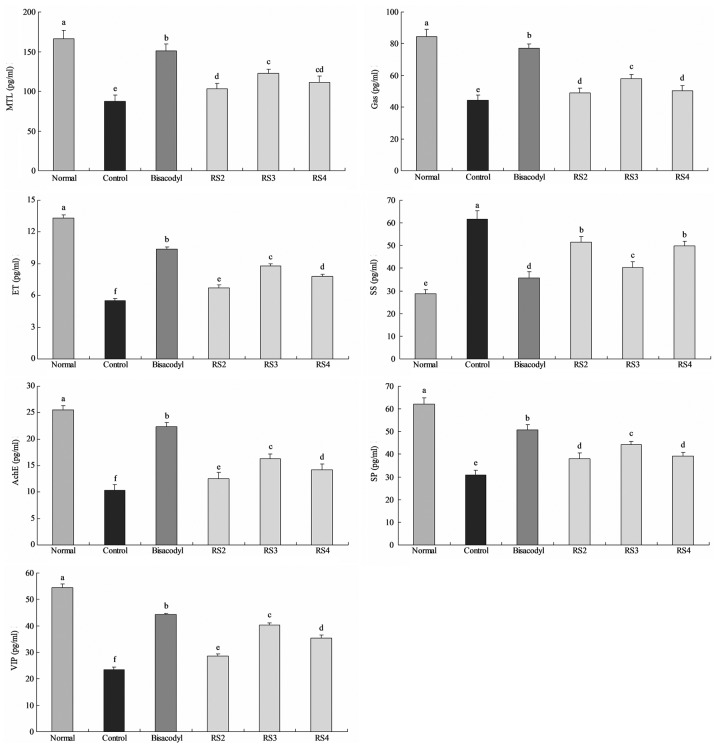
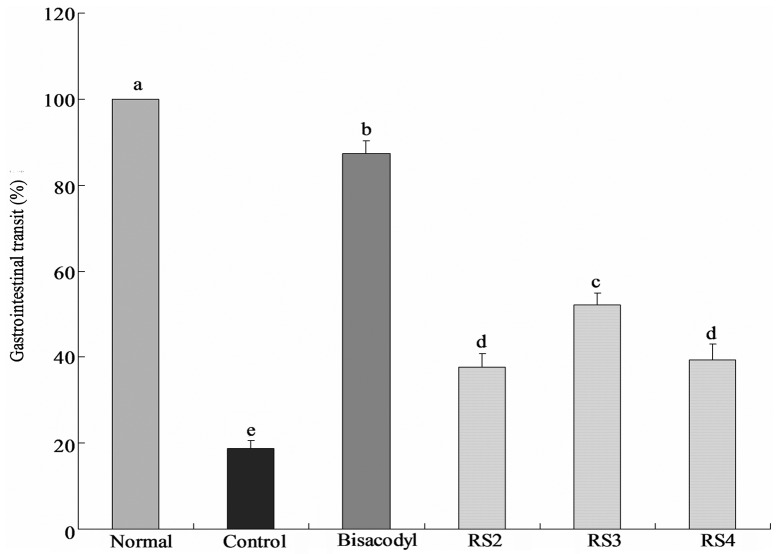
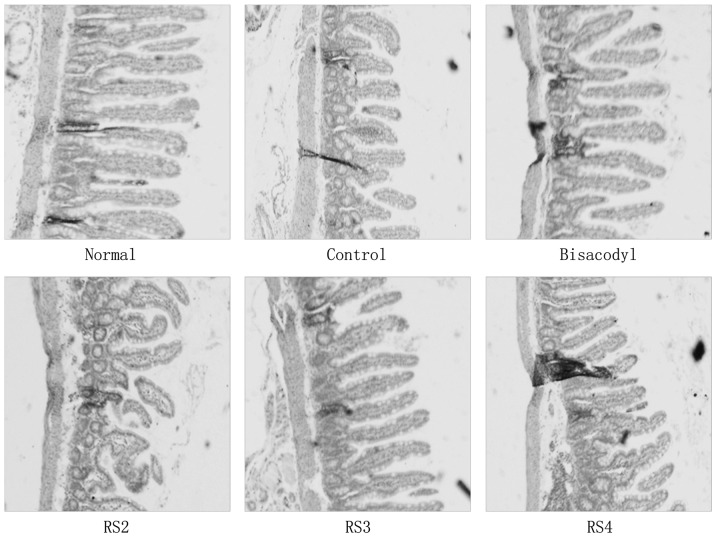
The aim of this study was to investigate the effects of resistant starch (RS) on activated carbon-induced constipation in ICR mice. ICR mice were fed on diet containing 15% RS of type RS2, RS3 or RS4 for 9 days. Gastrointestinal transit, defecation time and intestinal tissue histopathological sections, as well as motilin (MTL), gastrin (Gas), endothelin (ET), somatostatin (SS), acetylcholinesterase (AChE), substance P (SP) and vasoactive intestinal peptide (VIP) levels in serum were used to evaluate the preventive effects of RS on constipation. Bisacodyl, a laxative drug, was used as a positive control. The time to the first black stool defecation for normal, control, bisacodyl-treated (100 mg/kg, oral administration) and RS2-, RS3- and RS4-treated mice was 78, 208, 109, 181, 144 and 173 min, respectively. Following the consumption of RS2, RS3 and RS4 or the oral administration of bisacodyl (100 mg/kg), the gastrointestinal transit was reduced to 37.7, 52.1, 39.3 and 87.3%, respectively, of the transit in normal mice, respectively. Histopathological sections of intestinal tissue also underscored the protective effect of RS3. The serum levels of MTL, Gas, ET, AChE, SP and VIP were significantly increased and the serum levels of SS were reduced in the mice treated with RS compared with those in the untreated control mice (P<0.05). These results demonstrate that RS has preventive effects on mouse constipation and RS3 demonstrated the best functional activity.
本研究旨在探讨抗性淀粉(RS)对活性炭诱导的ICR小鼠便秘的影响。给ICR小鼠喂食含15% RS2、RS3或RS4型抗性淀粉的日粮9天。通过胃肠道转运、排便时间和肠道组织病理切片,以及血清中胃动素(MTL)、胃泌素(Gas)、内皮素(ET)、生长抑素(SS)、乙酰胆碱酯酶(AChE)、P物质(SP)和血管活性肠肽(VIP)水平来评估RS对便秘的预防作用。缓泻药比沙可啶用作阳性对照。正常、对照、比沙可啶处理(100 mg/kg,口服)以及RS2、RS3和RS4处理的小鼠首次排出黑色粪便的时间分别为78、208、109、181、144和173分钟。食用RS2、RS3和RS4或口服比沙可啶(100 mg/kg)后,胃肠道转运分别降至正常小鼠转运的37.7%、52.1%、39.3%和87.3%。肠道组织病理切片也强调了RS3的保护作用。与未处理的对照小鼠相比,RS处理的小鼠血清中MTL、Gas、ET、AChE、SP和VIP水平显著升高,血清SS水平降低(P<0.05)。这些结果表明,RS对小鼠便秘有预防作用,且RS3表现出最佳的功能活性。