Institute of Biochemistry and Molecular Medicine, Faculty of Medicine, University of Bern, Bern, Switzerland.
PLoS One. 2013 Jul 31;8(7):e70407. doi: 10.1371/journal.pone.0070407. Print 2013.
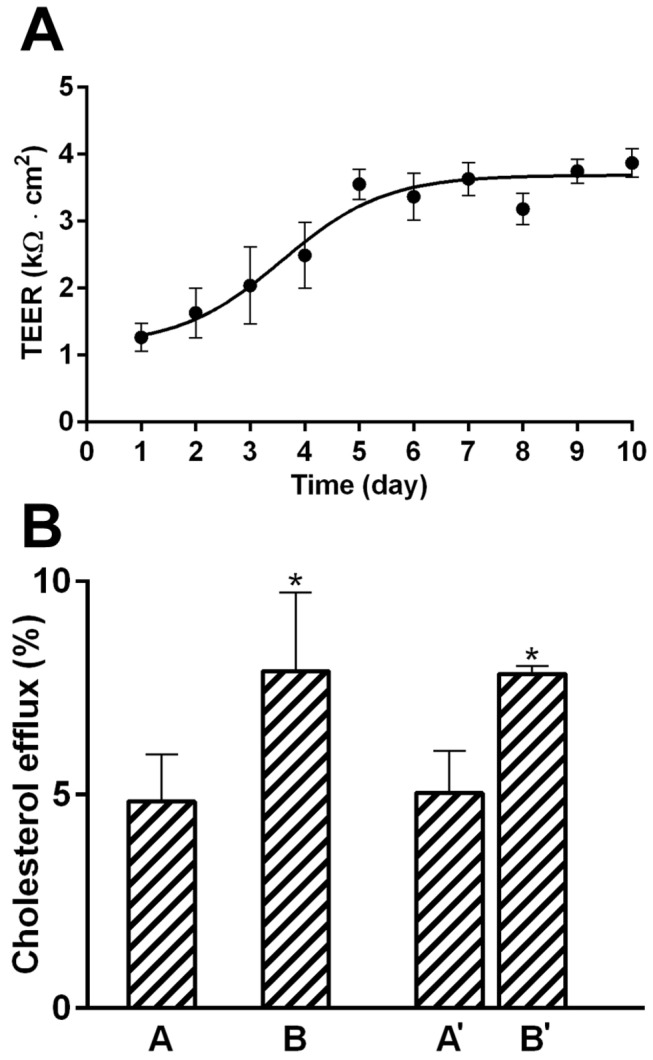
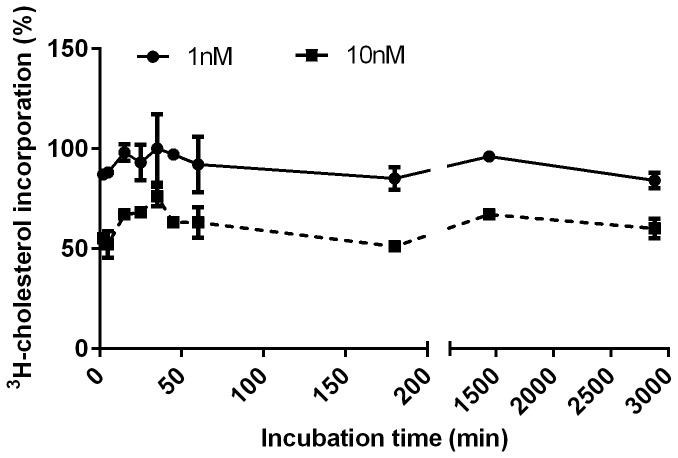
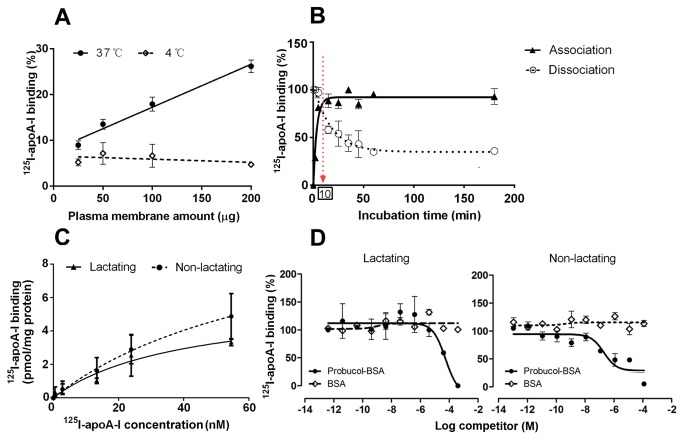
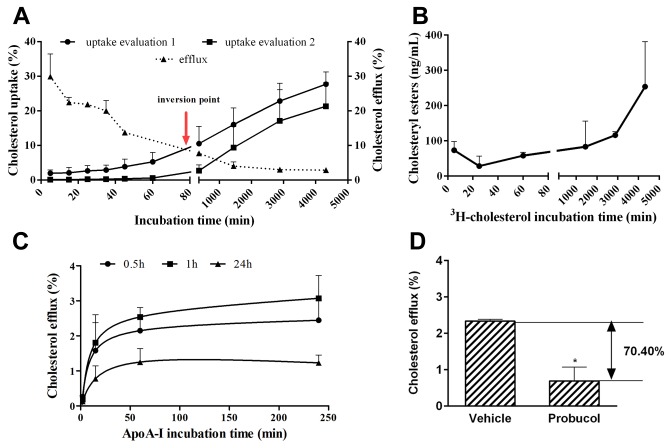
Cholesterol in milk is derived from the circulating blood through a complex transport process involving the mammary alveolar epithelium. Details of the mechanisms involved in this transfer are unclear. Apolipoprotein-AI (apoA-I) is an acceptor of cellular cholesterol effluxed by the ATP-binding cassette (ABC) transporter A1 (ABCA1). We aimed to 1) determine the binding characteristics of (125)I-apoA-I and (3)H-cholesterol to enriched plasma membrane vesicles (EPM) isolated from lactating and non-lactating bovine mammary glands (MG), 2) optimize the components of an in vitro model describing cellular (3)H-cholesterol efflux in primary bovine mammary epithelial cells (MeBo), and 3) assess the vectorial cholesterol transport in MeBo using Transwell(®) plates. The amounts of isolated EPM and the maximal binding capacity of (125)I-apoA-I to EPM differed depending on the MG's physiological state, while the kinetics of (3)H-cholesterol and (125)I-apoA-I binding were similar. (3)H-cholesterol incorporated maximally to EPM after 25±9 min. The time to achieve the half-maximum binding of (125)I-apoA-I at equilibrium was 3.3±0.6 min. The dissociation constant (KD) of (125)I-apoA-I ranged between 40-74 nmol/L. Cholesterol loading to EPM increased both cholesterol content and (125)I-apoA-I binding. The ABCA1 inhibitor Probucol displaced (125)I-apoA-I binding to EPM and reduced (3)H-cholesterol efflux in MeBo. Time-dependent (3)H-cholesterol uptake and efflux showed inverse patterns. The defined binding characteristics of cholesterol and apoA-I served to establish an efficient and significantly shorter cholesterol efflux protocol that had been used in MeBo. The application of this protocol in Transwell(®) plates with the upper chamber mimicking the apical (milk-facing) and the bottom chamber corresponding to the basolateral (blood-facing) side of cells showed that the degree of (3)H-cholesterol efflux in MeBo differed significantly between the apical and basolateral aspects. Our findings support the importance of the apoA-I/ABCA1 pathway in MG cholesterol transport and suggest its role in influencing milk composition and directing cholesterol back into the bloodstream.
牛奶中的胆固醇来源于通过涉及乳腺腺泡上皮的复杂转运过程从循环血液中获得。目前尚不清楚这种转移中涉及的机制细节。载脂蛋白 AI(apoA-I)是由 ATP 结合盒(ABC)转运蛋白 A1(ABCA1)外排的细胞胆固醇的受体。我们旨在 1)确定从泌乳和非泌乳牛乳腺(MG)中分离的富含质膜小泡(EPM)与(125)I-apoA-I 和(3)H-胆固醇的结合特性,2)优化描述原发性牛乳腺上皮细胞(MeBo)中细胞(3)H-胆固醇流出的体外模型的组成部分,以及 3)使用 Transwell(®)板评估 MeBo 中的载体胆固醇转运。分离的 EPM 的量和(125)I-apoA-I 对 EPM 的最大结合能力取决于 MG 的生理状态,而(3)H-胆固醇和(125)I-apoA-I 结合的动力学相似。(3)H-胆固醇最大程度地掺入 EPM 后 25±9 min。达到平衡时(125)I-apoA-I 半最大结合所需的时间为 3.3±0.6 min。(125)I-apoA-I 的解离常数(KD)在 40-74 nmol/L 之间。EPM 中的胆固醇负载增加了胆固醇含量和(125)I-apoA-I 结合。ABC 转运蛋白 A1 抑制剂 Probucol 置换了 EPM 上的(125)I-apoA-I 结合,并降低了 MeBo 中的(3)H-胆固醇流出。时间依赖性(3)H-胆固醇摄取和流出呈现相反的模式。胆固醇和 apoA-I 的明确结合特征可用于建立已在 MeBo 中使用的高效且明显更短的胆固醇流出方案。在 Transwell(®)板上应用该方案,其中上室模拟顶(乳面向),下室对应于细胞的基底外侧(血面向)侧,表明 MeBo 中的(3)H-胆固醇流出程度在顶侧和基底外侧之间存在显著差异。我们的研究结果支持 apoA-I/ABCA1 途径在 MG 胆固醇转运中的重要性,并表明其在影响乳成分和将胆固醇引导回血液中的作用。