Department of Biochemistry, School of Life Sciences, University of Hyderabad, Hyderabad, Andhra Pradesh, India.
PLoS One. 2013 Aug 1;8(8):e70250. doi: 10.1371/journal.pone.0070250. Print 2013.
Cytokines are the hallmark of immune response to different pathogens and often dictate the disease outcome. HIV infection and tuberculosis (TB) are more destructive when confronted together than either alone. Clinical data related to the immune status of HIV-TB patients before the initiation of any drug therapy is not well documented. This study aimed to collect the baseline information pertaining to the immune status of HIV-TB co-infected patients and correlate the same with CD4+T cell levels and viral loads at the time of diagnosis prior to any drug therapy.
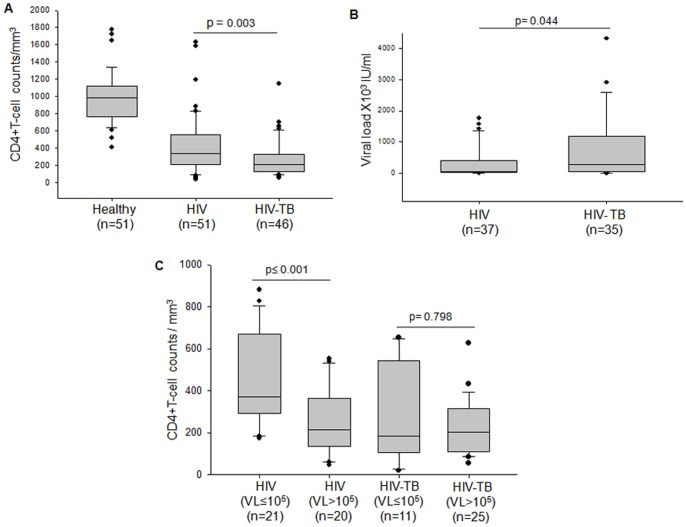
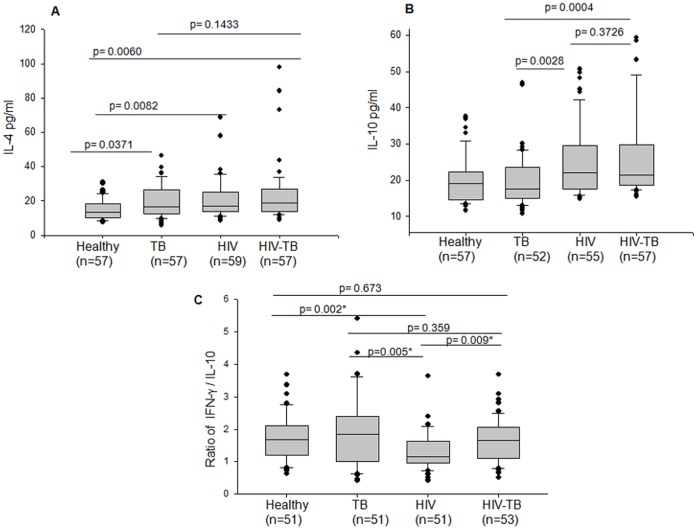
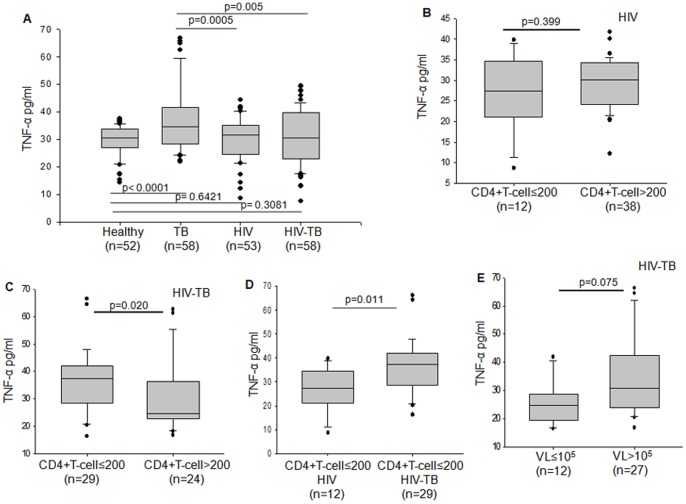
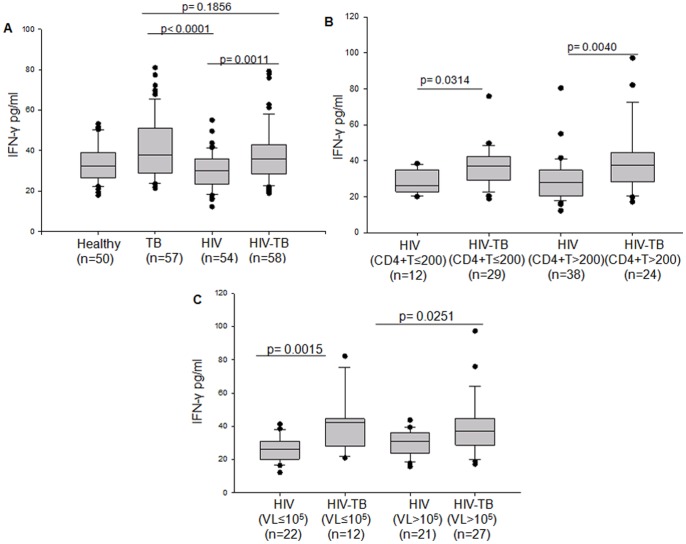
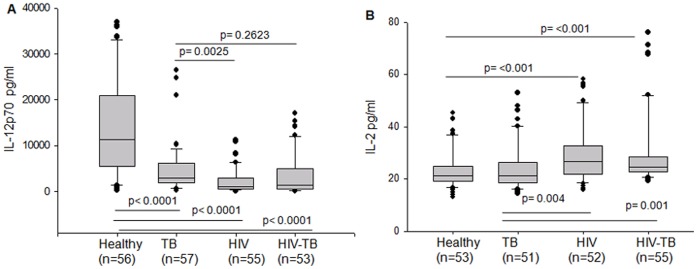
METHODOLOGY/PRINCIPAL FINDINGS: We analyzed the cytokines, CD4+T cell levels and viral loads to determine the immune environment in HIV-TB co-infection. The study involved four categories namely, Healthy controls (n=57), TB infected (n=57), HIV infected (n=59) and HIV-TB co-infected (n=57) patients. The multi-partite comparison and correlation between cytokines, CD4+T-cell levels and viral loads prior to drug therapy, showed an altered TH1 and TH2 response, as indicated by the cytokine profiles and skewed IFN-γ/IL-10 ratio. Inadequate CD4+T cell counts in HIV-TB patients did not correlate with high viral loads and vice-versa. When compared to HIV category, 34% of HIV-TB patients had concurrent high plasma levels of IL-4 and TNF-α at the time of diagnosis. TB relapse was observed in 5 of these HIV-TB co-infected patients who also displayed high IFN-γ/IL-10 ratio.
CONCLUSION/SIGNIFICANCE: With these studies, we infer (i) CD4+T-cell levels as baseline criteria to report the disease progression in terms of viral load in HIV-TB co-infected patients can be misleading and (ii) co-occurrence of high TNF-α and IL-4 levels along with a high ratio of IFN-γ/IL-10, prior to drug therapy, may increase the susceptibility of HIV-TB co-infected patients to hyper-inflammation and TB relapse.
细胞因子是针对不同病原体的免疫反应的标志,通常决定疾病的结果。当 HIV 感染和结核病 (TB) 同时发生时,其破坏性比单独发生时更大。在开始任何药物治疗之前,与 HIV-TB 患者免疫状态相关的临床数据记录并不完善。本研究旨在收集与 HIV-TB 合并感染患者免疫状态相关的基线信息,并将其与开始任何药物治疗之前诊断时的 CD4+T 细胞水平和病毒载量相关联。
方法/主要发现:我们分析了细胞因子、CD4+T 细胞水平和病毒载量,以确定 HIV-TB 合并感染中的免疫环境。该研究涉及四个类别,即健康对照者(n=57)、TB 感染者(n=57)、HIV 感染者(n=59)和 HIV-TB 合并感染者(n=57)患者。在开始药物治疗之前,对细胞因子、CD4+T 细胞水平和病毒载量进行多部分比较和相关性分析,结果表明,细胞因子谱和 IFN-γ/IL-10 比值的倾斜表明 TH1 和 TH2 反应发生改变。HIV-TB 患者的 CD4+T 细胞计数不足与高病毒载量不相关,反之亦然。与 HIV 类别相比,在诊断时,34%的 HIV-TB 患者同时具有高水平的 IL-4 和 TNF-α。在这些 HIV-TB 合并感染者中,有 5 人出现 TB 复发,并且还显示出高 IFN-γ/IL-10 比值。
结论/意义:通过这些研究,我们推断:(i)CD4+T 细胞水平作为报告 HIV-TB 合并感染患者病毒载量疾病进展的基线标准可能具有误导性;(ii)在开始药物治疗之前,高水平的 TNF-α 和 IL-4 以及 IFN-γ/IL-10 比值的同时发生,可能会增加 HIV-TB 合并感染患者发生过度炎症和 TB 复发的易感性。