Vector Control Division, Ministry of Health, Kampala, Uganda.
PLoS Negl Trop Dis. 2013 Jul 25;7(7):e2268. doi: 10.1371/journal.pntd.0002268. Print 2013.
In schistosomiasis control programmes using mass chemotherapy, epidemiological and morbidity aspects of the disease need to be studied so as to monitor the impact of treatment, and make recommendations accordingly. These aspects were examined in the community of Musoli village along Lake Victoria in Mayuge district, highly endemic for Schistosoma mansoni infection.
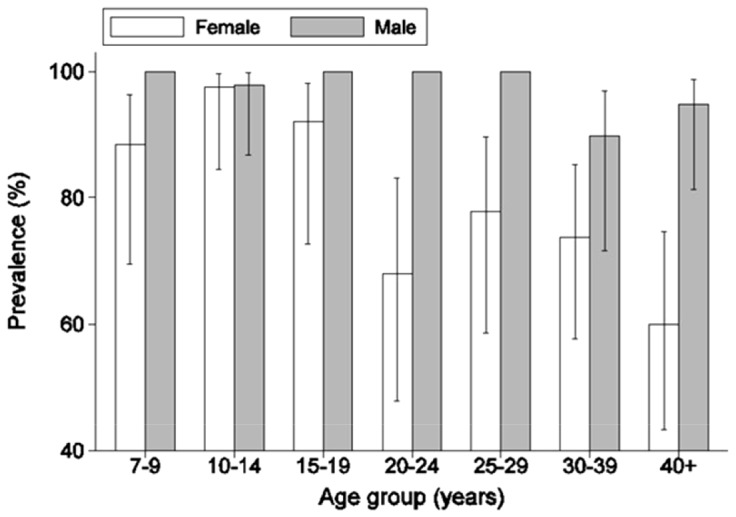
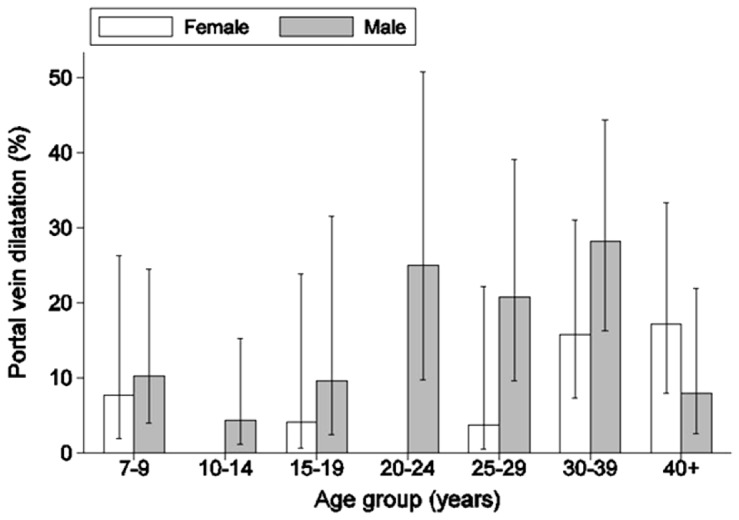
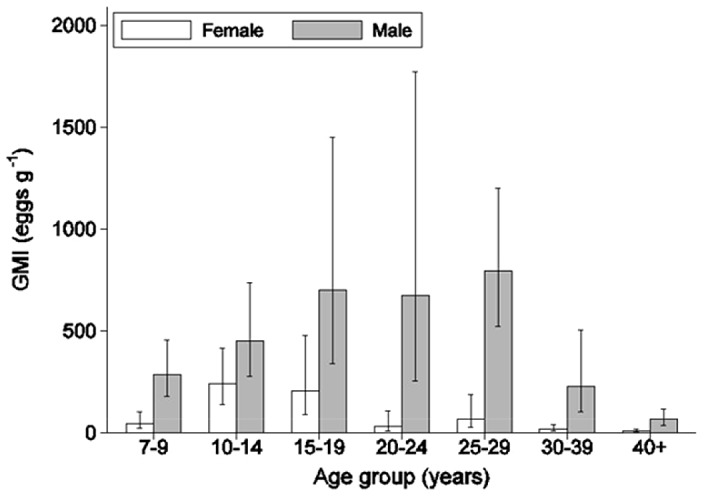
A cross sectional descriptive study was undertaken in a randomly selected sample of 217 females and 229 males, with a mean age of 26 years (SD ± 16, range 7-76 years). The prevalence of S. mansoni was 88.6% (95% CI: 85.6-91.5). The geometric mean intensity (GMI) of S. mansoni was 236.2 (95% CI: 198.5-460.9) eggs per gram (epg) faeces. Males had significantly higher GMI (370.2 epg) than females (132.6 epg) and age was also significantly associated with intensity of infection. Levels of water contact activities significantly influenced intensity of infection and the highest intensity of infection was found among people involved in fishing. However, organomegaly was not significantly associated with S. mansoni except for very heavy infection (>2000 epg). Liver image patterns C and D indicative of fibrosis were found in only 2.2% and 0.2%, respectively. S. mansoni intensity of infection was associated with portal vein dilation and abnormal spleen length. Anaemia was observed in 36.4% of the participants but it was not associated with S. mansoni infection intensity. Considering growth in children as one of the morbidity indicators of schistosomiasis, intensity of S. mansoni was significantly associated with stunting.
Although organ-related morbidity, with the exception of periportal fibrosis, and S. mansoni infections were highly prevalent, the two were only associated for individuals with very high infection intensities. These results contrast starkly with reports from Ugandan Lake Albert fishing communities in which periportal fibrosis is more prevalent.
在采用群体化疗的血吸虫病防治规划中,需要对疾病的流行病学和发病情况进行研究,以监测治疗效果,并提出相应的建议。本研究在马尤盖区维多利亚湖沿岸的 Musoli 村社区进行,该社区曼氏血吸虫感染高度流行。
本研究采用横断面描述性研究方法,对 217 名女性和 229 名男性进行了随机抽样,平均年龄为 26 岁(标准差±16,范围 7-76 岁)。曼氏血吸虫的流行率为 88.6%(95%置信区间:85.6-91.5)。曼氏血吸虫的几何平均强度(GMI)为 236.2(95%置信区间:198.5-460.9)每克粪便虫卵数(epg)。男性的 GMI(370.2 epg)显著高于女性(132.6 epg),年龄也与感染强度显著相关。不同的水体接触活动水平显著影响感染强度,其中渔民的感染强度最高。然而,除了重度感染(>2000 epg)外,肝肿大与曼氏血吸虫感染之间无显著相关性。仅分别有 2.2%和 0.2%的人出现提示纤维化的肝图像模式 C 和 D。门静脉扩张和脾脏长度异常与曼氏血吸虫感染强度相关。36.4%的参与者存在贫血,但与曼氏血吸虫感染强度无关。考虑到儿童生长是血吸虫病发病的一个指标,曼氏血吸虫的感染强度与发育迟缓显著相关。
尽管除了门脉周围纤维化之外,与器官相关的发病率和曼氏血吸虫感染都非常普遍,但这两者仅与感染强度非常高的个体相关。这些结果与来自乌干达维多利亚湖渔业社区的报告形成鲜明对比,在那里门脉周围纤维化更为普遍。