Unité de Formation et de Recherche Biosciences, Université Félix Houphouët-Boigny, Abidjan, Côte d'Ivoire.
Centre Suisse de Recherches Scientifiques en Côte d'Ivoire, Abidjan, Côte d'Ivoire.
PLoS Negl Trop Dis. 2023 Jul 17;17(7):e0011487. doi: 10.1371/journal.pntd.0011487. eCollection 2023 Jul.
Schistosomiasis and hookworm infection remain public health problems in large parts of sub-Saharan Africa. The epidemiology of schistosomiasis and hookworm was studied in seasonal transmission settings in the northern part of Côte d'Ivoire.
In August 2018, a cross-sectional study was conducted. Urine and stool samples were collected from 742 individuals aged 6-96 years in 16 localities from four departments in northern Côte d'Ivoire. Urine samples were examined by a filtration method for quantification of Schistosoma haematobium eggs. Stool samples were subjected to duplicate Kato-Katz thick smears and eggs of Schistosoma mansoni and soil-transmitted helminths (STHs) were counted. Additionally, a questionnaire was administered to determine demographic characteristics and to identify risk factors of schistosomiasis and STHs. Malacologic surveys were carried out at water points that are contacted by humans and animals.
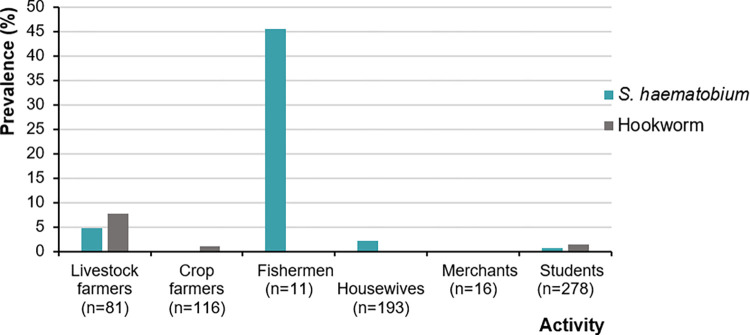
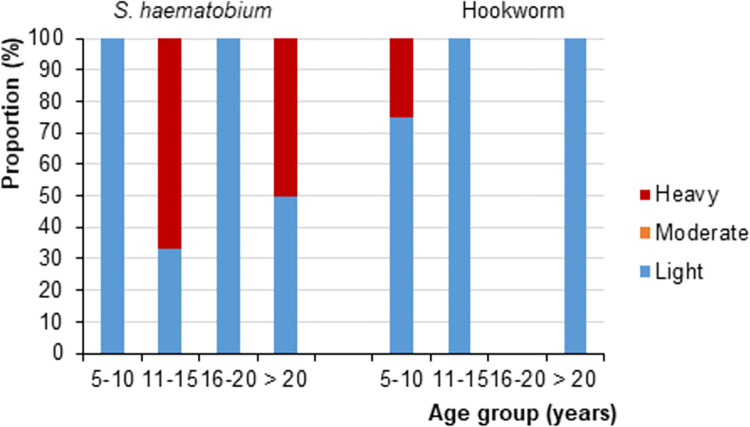
The prevalence of schistosomiasis was very low. Only two cases of S. mansoni were found (0.3%, 95% confidence interval [CI]: 0.1-1.0%). The distribution of S. haematobium was focal, with cases found only in two departments; Ferkessédougou (5.4%, 95% CI: 2.5-9.9%) and Ouangolodougou (2.7%, 95% CI: 0.9-6.3%). Hookworm was the only STH species observed with a prevalence of 1.5% (95% CI: 0.8-2.8%). A higher risk of S. haematobium infection was observed in males compared to females, but the difference was not statistically significant (2.3% versus 1.3%, odds ratio [OR]: 1.5, 95% CI: 0.8-2.7). Participants aged 16-20 years showed the highest prevalence of S. haematobium. A total of 111 human- and animal-water contact points were identified at 47 water sources. Three potential intermediate host snails of schistosomes were collected; namely, Bulinus forskalii (n = 761), Bulinus truncatus (n = 205), and Biomphalaria pfeifferi (n = 1). Yet, only one specimen of Bu. truncatus was found to be shedding schistosome cercariae.
CONCLUSIONS/SIGNIFICANCE: This study confirms very low transmission of schistosomiasis and hookworm in northern Côte d'Ivoire. The establishment and rigorous implementation of integrated surveillance-response systems could lead to the elimination of schistosomiasis and hookworm in this part of Côte d'Ivoire.
在撒哈拉以南非洲的大部分地区,血吸虫病和钩虫感染仍然是公共卫生问题。本研究在科特迪瓦北部的季节性传播环境中研究了血吸虫病和钩虫的流行病学。
2018 年 8 月,进行了一项横断面研究。从科特迪瓦北部四个省的 16 个地点的 742 名 6-96 岁的个体中采集尿液和粪便样本。尿液样本通过过滤法进行定量检测,以检测曼氏血吸虫卵。粪便样本进行两次加藤厚涂片,并对曼氏血吸虫和土壤传播性蠕虫(STH)卵进行计数。此外,还进行了问卷调查,以确定血吸虫病和 STH 的危险因素。在与人畜接触的水源点进行贝类学调查。
血吸虫病的患病率非常低。仅发现两例曼氏血吸虫病例(0.3%,95%置信区间[CI]:0.1-1.0%)。曼氏血吸虫的分布呈局灶性,仅在两个部门发现病例;费尔凯塞杜古(5.4%,95%CI:2.5-9.9%)和瓦翁戈洛杜古(2.7%,95%CI:0.9-6.3%)。钩虫是唯一观察到的 STH 物种,患病率为 1.5%(95%CI:0.8-2.8%)。与女性相比,男性感染曼氏血吸虫的风险更高,但差异无统计学意义(2.3%比 1.3%,比值比[OR]:1.5,95%CI:0.8-2.7)。16-20 岁的参与者感染曼氏血吸虫的患病率最高。在 47 个水源中共发现 111 个人畜接触点。共收集了三种潜在的血吸虫中间宿主蜗牛;即巴氏血吸虫(n = 761)、 truncatus 血吸虫(n = 205)和 pfeifferi 血吸虫(n = 1)。然而,只发现了一个 truncatus 血吸虫样本释放血吸虫尾蚴。
结论/意义:本研究证实科特迪瓦北部的血吸虫病和钩虫传播率非常低。建立和严格实施综合监测-应对系统可以导致该地区消除血吸虫病和钩虫。