Cancer Institute, Key Laboratory of Cancer Prevention and Intervention, National Ministry of Education, Provincial Key Laboratory of Molecular Biology in Medical Sciences, The Second Affiliated Hospital, Zhejiang University School of Medicine, Hangzhou, China.
PLoS One. 2013 Aug 5;8(8):e70958. doi: 10.1371/journal.pone.0070958. Print 2013.
Many studies have reported the prognostic predictive value of CD166 as a cancer stem cell marker in cancers of the digestive system; however, its predictive value remains controversial. Here, we investigate the correlation between CD166 positivity in digestive system cancers and clinicopathological features using meta-analysis.
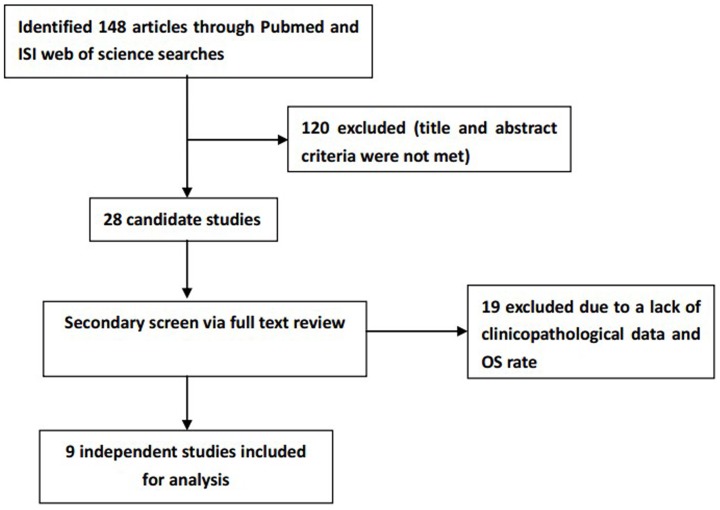
A comprehensive search in PubMed and ISI Web of Science through March of 2013 was performed. Only articles containing CD166 antigen immunohistochemical staining in cancers of the digestive system were included,including pancreatic cancer, esophageal cancer, gastric cancer and colorectal cancer. Data comparing 3- and 5-year overall survival along with other clinicopathological features were collected.
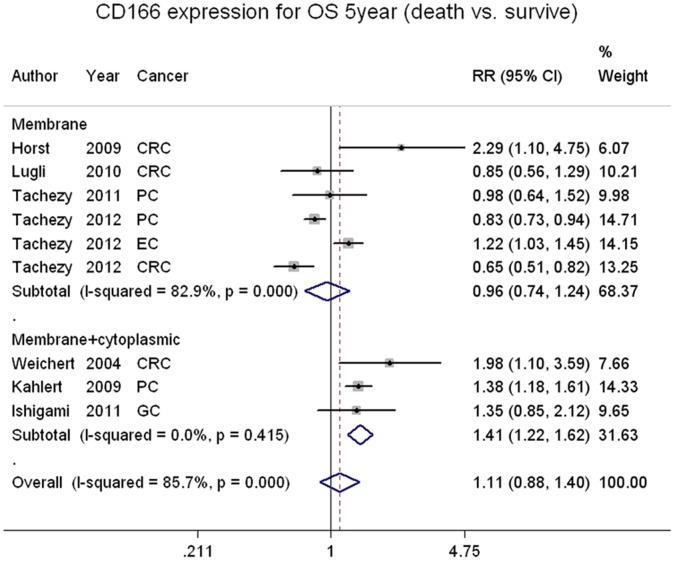
Nine studies with 2553 patients who met the inclusion criteria were included for the analysis. The median rate of CD166 immunohistochemical staining expression was 56% (25.4%-76.3%). In colorectal cancer specifically, the results of a fixed-effects model indicated that CD166-positive expression was an independent marker associated with a smaller tumor burden (T category; RR = 0.93, 95%, CI: 0.88-0.98) but worse spread to nearby lymph nodes (N category; RR = 1.17, 95% CI: 1.05-1.30). The 5-year overall survival rate was showed relationship with cytoplasmic positive staining of CD166 (RR = 1.47 95% 1.21-1.79), but no significant association was found in the pool or any other stratified analysis with 3- or 5- year overall survival rate.
Based on the published studies, different cellular location of CD166 has distinct prognostic value and cytoplasmic positive expression is associated with worse prognosis outcome. Besides, our results also find CD166 expression indicate advanced T category and N-positive status in colorectal cancer specifically.
许多研究报道了 CD166 作为癌症干细胞标志物在消化系统癌症中的预后预测价值;然而,其预测价值仍存在争议。在这里,我们使用荟萃分析研究消化系统癌症中 CD166 阳性与临床病理特征的相关性。
通过 2013 年 3 月之前的 PubMed 和 ISI Web of Science 进行全面搜索。仅包括消化系统癌症中含有 CD166 抗原免疫组织化学染色的文章,包括胰腺癌、食管癌、胃癌和结直肠癌。收集了比较 3 年和 5 年总生存率以及其他临床病理特征的数据。
共有 9 项研究纳入了符合纳入标准的 2553 名患者进行分析。CD166 免疫组化染色表达的中位数为 56%(25.4%-76.3%)。特别是在结直肠癌中,固定效应模型的结果表明,CD166 阳性表达是与肿瘤负荷较小(T 分期;RR=0.93,95%CI:0.88-0.98)但附近淋巴结转移(N 分期;RR=1.17,95%CI:1.05-1.30)更差相关的独立标志物。5 年总生存率与 CD166 细胞质阳性表达呈相关性(RR=1.47 95%1.21-1.79),但在任何其他分层分析中,与 3 年或 5 年总生存率均无显著相关性。
基于已发表的研究,CD166 的不同细胞位置具有不同的预后价值,细胞质阳性表达与较差的预后结果相关。此外,我们的研究结果还发现,CD166 表达提示结直肠癌中 T 分期和 N 阳性状态更晚期。