Insitute of Chemical Sciences and Engineering, École Polytechnique Fédérale de Lausanne, Lausanne, Switzerland.
Sci Rep. 2013;3:2446. doi: 10.1038/srep02446.
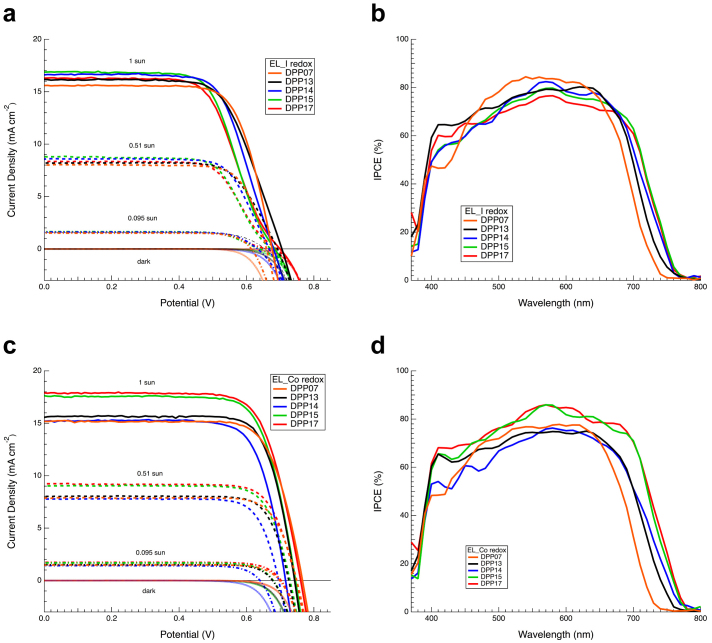
The paradigm shift in dye sensitized solar cells (DSCs) - towards donor- π bridge-acceptor (D-π-A) dyes - increases the performances of DSCs and challenges established design principles. Framed by this shifting landscape, a series of four diketopyrrolopyrrole (DPP)-based sensitizers utilizing the donor-chromophore-anchor (D-C-A) motif were investigated computationally, spectroscopically, and fabricated by systematic evaluation of finished photovoltaic cells. In all cases, the Co(bpy)3 redox-shuttle afforded superior performance compared to I3(-)/I(-). Aesthetically, careful molecular engineering of the DPP chromophore yielded the first example of a high-performance blue DSC - a challenge unmet since the inception of this photovoltaic technology: DPP17 yields over 10% power conversion efficiency (PCE) with the Co(bpy)3 electrolyte at full AM 1.5 G simulated sun light.
染料敏化太阳能电池 (DSCs) 中的范式转变——向供体-π 桥-受体 (D-π-A) 染料转变——提高了 DSCs 的性能,并挑战了既定的设计原则。在这种转变的背景下,我们通过系统地评估成品光伏电池,从理论计算、光谱研究等方面对一系列基于二酮吡咯并吡咯 (DPP) 的敏化剂进行了研究,这些敏化剂利用了供体-发色团-锚定 (D-C-A) 基序。在所有情况下,Co(bpy)3 氧化还原穿梭体的性能均优于 I3(-)/I(-)。从美学角度来看,对 DPP 发色团进行精心的分子工程设计,得到了首例高性能蓝色 DSC 的实例——这是自这项光伏技术诞生以来尚未解决的挑战:DPP17 在全 AM 1.5 G 模拟太阳光下,使用Co(bpy)3电解质,其功率转换效率 (PCE) 超过 10%。