Department of Immunobiology, Yale University School of Medicine, New Haven, CT 06520, USA.
Immunol Rev. 2013 Sep;255(1):165-81. doi: 10.1111/imr.12087.
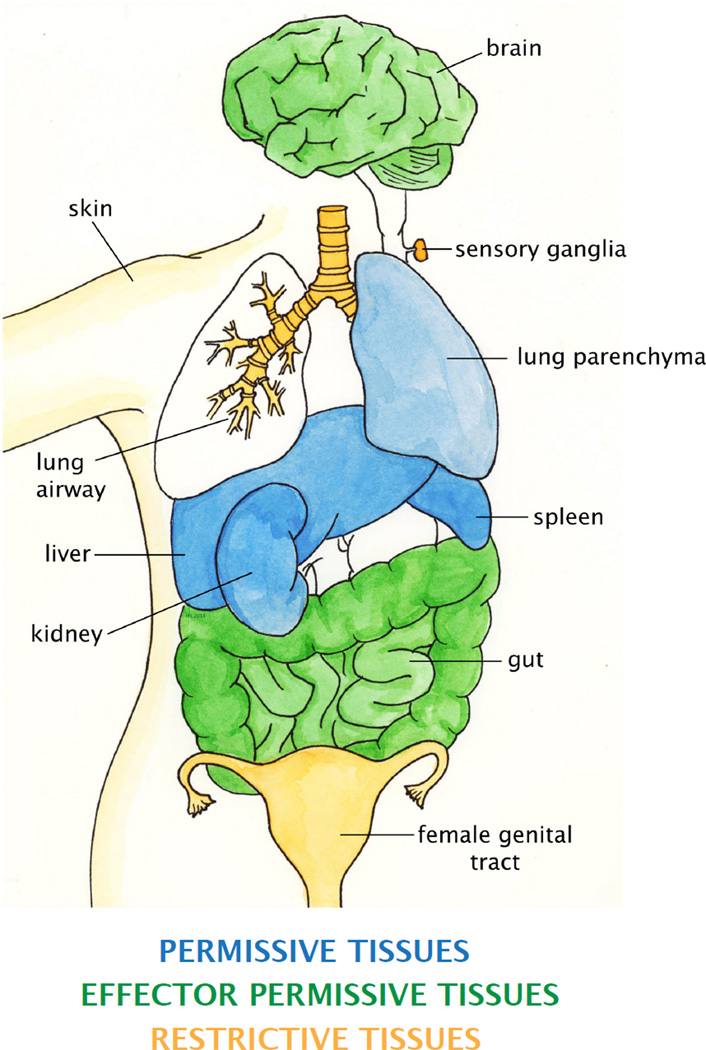
Tissues such as the genital tract, skin, and lung act as barriers against invading pathogens. To protect the host, incoming microbes must be quickly and efficiently controlled by the immune system at the portal of entry. Memory is a hallmark of the adaptive immune system, which confers long-term protection and is the basis for efficacious vaccines. While the majority of existing vaccines rely on circulating antibody for protection, struggles to develop antibody-based vaccines against infections such as herpes simplex virus (HSV) and human immunodeficiency virus (HIV) have underscored the need to generate memory T cells for robust antiviral control. The circulating memory T-cell population is generally divided into two subsets: effector memory (TEM ) and central memory (TCM ). These two subsets can be distinguished by their localization, as TCM home to secondary lymphoid organs and TEM circulate through non-lymphoid tissues. More recently, studies have identified a third subset, called tissue-resident memory (TRM ) cells, based on its migratory properties. This subset is found in peripheral tissues that require expression of specific chemoattractants and homing receptors for T-cell recruitment and retention, including barrier sites such as the skin and genital tract. In this review, we categorize different tissues in the body based on patterns of memory T-cell migration and tissue residency. This review also describes the rules for TRM generation and the properties that distinguish them from circulating TEM and TCM cells. Finally, based on the failure of recent T-cell-based vaccines to provide optimal protection, we also discuss the potential role of TRM cells in vaccine design against microbes that invade through the peripheral tissues and highlight new vaccination strategies that take advantage of this newly described memory T-cell subset.
组织如生殖道、皮肤和肺作为抵御入侵病原体的屏障。为了保护宿主,进入的微生物必须被免疫系统在入侵门户处迅速有效地控制。记忆是适应性免疫系统的标志,它赋予宿主长期保护,并为有效的疫苗提供基础。虽然大多数现有的疫苗依赖循环抗体来提供保护,但开发针对单纯疱疹病毒(HSV)和人类免疫缺陷病毒(HIV)等感染的抗体疫苗的困难突显了需要产生记忆 T 细胞以实现强大的抗病毒控制。循环记忆 T 细胞群体通常分为两个亚群:效应记忆(TEM)和中央记忆(TCM)。这两个亚群可以通过它们的定位来区分,TCM 驻留在次级淋巴器官,而 TEM 循环通过非淋巴组织。最近的研究根据其迁移特性,将第三个亚群称为组织驻留记忆(TRM)细胞。这个亚群存在于需要表达特定趋化因子和归巢受体以招募和保留 T 细胞的外周组织中,包括皮肤和生殖道等屏障部位。在这篇综述中,我们根据记忆 T 细胞迁移和组织驻留的模式对体内不同的组织进行分类。这篇综述还描述了 TRM 产生的规则,以及它们与循环 TEM 和 TCM 细胞的区别特征。最后,鉴于最近基于 T 细胞的疫苗未能提供最佳保护,我们还讨论了 TRM 细胞在针对通过外周组织入侵的微生物的疫苗设计中的潜在作用,并强调了利用这种新描述的记忆 T 细胞亚群的新疫苗接种策略。