Gerhard G S, Styer A M, Strodel W E, Roesch S L, Yavorek A, Carey D J, Wood G C, Petrick A T, Gabrielsen J, Ibele A, Benotti P, Rolston D D, Still C D, Argyropoulos G
1] Weis Center for Research, Danville, PA, USA [2] Department of Biochemistry and Molecular Biology and Department of Pathology and Laboratory Medicine, Pennsylvania State University, Hershey, PA, USA.
Weis Center for Research, Danville, PA, USA.
Int J Obes (Lond). 2014 Mar;38(3):371-8. doi: 10.1038/ijo.2013.152. Epub 2013 Aug 16.
The goal of the present study was to identify differences in gene expression between SAT, VAT and EAT depots in Class III severely obese individuals.
Human subcutaneous (SAT) and visceral (VAT) adipose tissues exhibit differential gene expression profiles. There is little information, however, about the other proximal white adipose tissue, epigastric (EAT), in terms of its function and contribution to metabolism.
Using RNA from adipose biospecimens obtained from Class III severely obese patients undergoing open Roux-en-Y gastric bypass surgery, we compared gene expression profiles between SAT, VAT and EAT, using microarrays validated by real-time quantitative PCR.
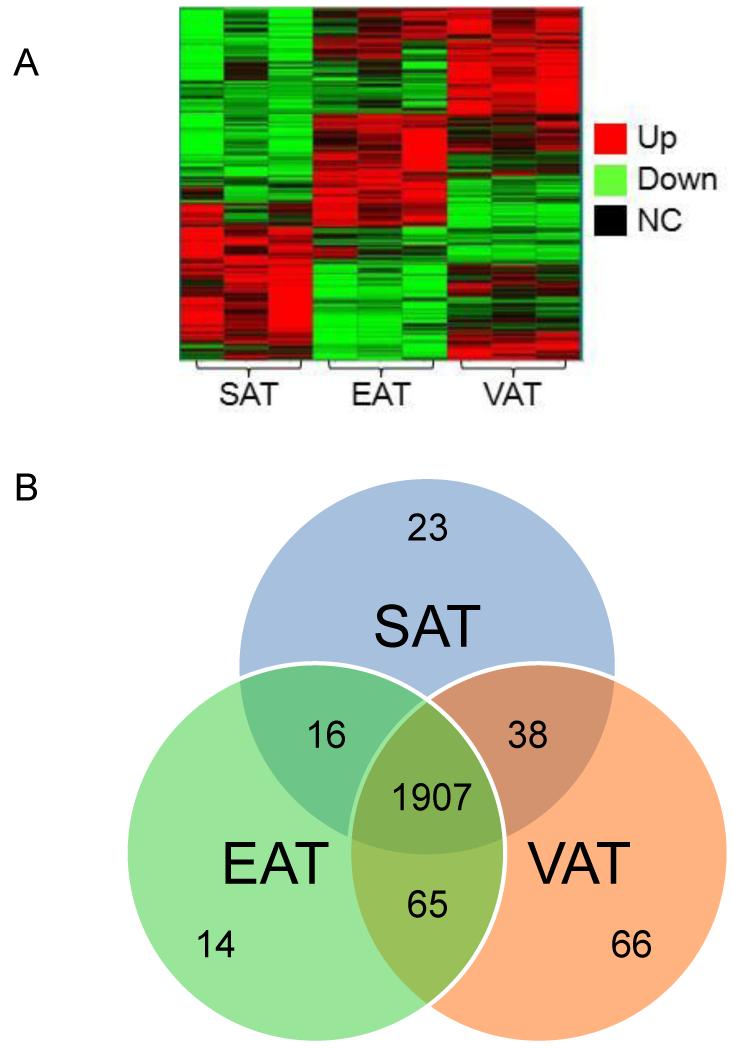
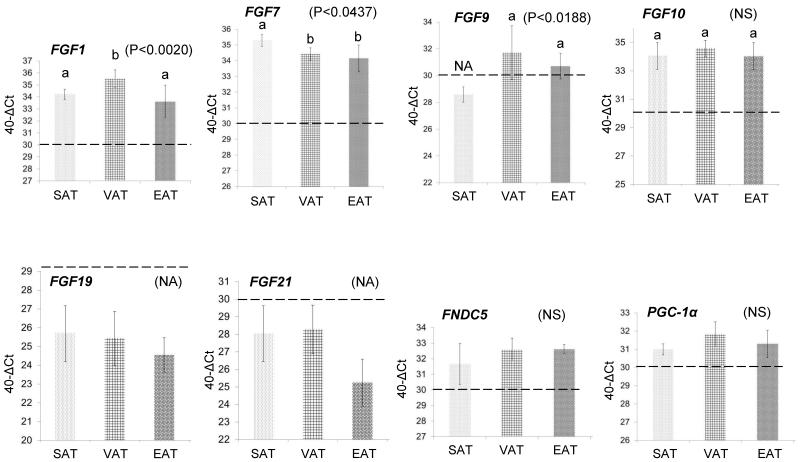
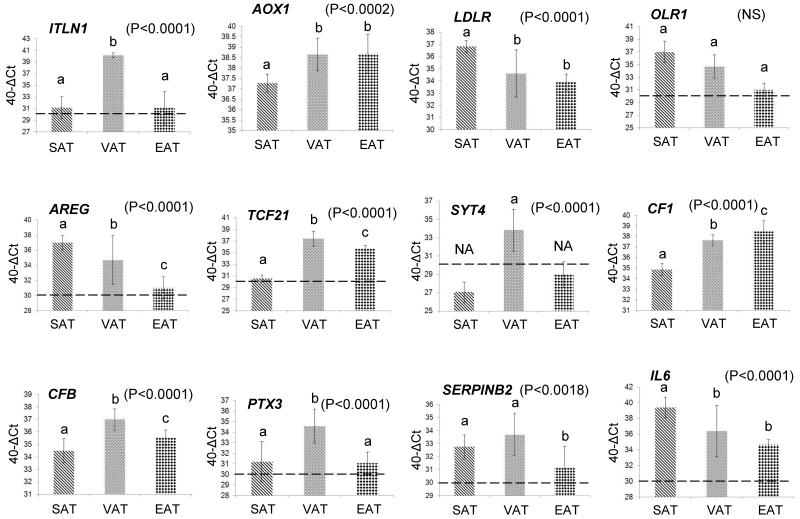
The three depots were found to share 1907 genes. VAT had the greatest number of genes (66) expressed exclusively in this depot, followed by SAT (23), and then EAT (14). Moreover, VAT shared more genes with EAT (65) than with SAT (38). Further analyses using ratios of SAT/EAT, VAT/EAT and SAT/VAT identified specific as well as overlapping networks and pathways of genes representing dermatological diseases, inflammation, cell cycle and growth, cancer and development. Targeted analysis of genes, having a role in adipose tissue development and function, revealed that Peroxisome proliferator-activated receptor Gamma Coactivator 1-alpha (PGC1-α) that regulates the precursor of the hormone Irisin (FNCD5) were abundantly expressed in all three fat depots, along with fibroblast growth factors (FGF) FGF1, FGF7 and FGF10, whereas, FGF19 and FGF21 were undetectable.
These data indicate that EAT has more in common with VAT, suggesting similar metabolic potential. The human epigastric adipose depot could have a significant functional role in metabolic diseases and should be further investigated.
本研究的目的是确定III类严重肥胖个体的皮下脂肪组织(SAT)、内脏脂肪组织(VAT)和上腹部脂肪组织(EAT)之间基因表达的差异。
人类皮下(SAT)和内脏(VAT)脂肪组织表现出不同的基因表达谱。然而,关于另一种近端白色脂肪组织——上腹部(EAT),其功能及其对新陈代谢的贡献,所知甚少。
我们使用来自接受开放式Roux-en-Y胃旁路手术的III类严重肥胖患者的脂肪生物样本中的RNA,通过实时定量PCR验证的微阵列,比较了SAT、VAT和EAT之间的基因表达谱。
发现这三个脂肪库共有1907个基因。VAT拥有最多仅在该脂肪库中表达的基因(66个),其次是SAT(23个),然后是EAT(14个)。此外,VAT与EAT共享的基因(65个)比与SAT共享的基因(38个)更多。使用SAT/EAT、VAT/EAT和SAT/VAT的比率进行的进一步分析确定了代表皮肤病、炎症、细胞周期和生长、癌症和发育的特定以及重叠的基因网络和途径。对在脂肪组织发育和功能中起作用的基因进行的靶向分析表明,调节激素鸢尾素(FNCD5)前体的过氧化物酶体增殖物激活受体γ辅激活因子1-α(PGC1-α)在所有三个脂肪库中均大量表达,同时还有成纤维细胞生长因子(FGF)FGF1、FGF7和FGF10,而FGF19和FGF21未检测到。
这些数据表明EAT与VAT有更多共同之处,提示具有相似的代谢潜力。人类上腹部脂肪库可能在代谢疾病中具有重要的功能作用,应进一步研究。