Dehning Sandra, Gasperi Sarah, Tesfaye Markos, Girma Eshetu, Meyer Sebastian, Krahl Wolfgang, Riedel Michael, Möller Hans-Jürgen, Müller Norbert, Siebeck Matthias
Department of Psychiatry and Psychotherapy, Ludwig Maximilian University, Munich, Germany.
Ethiop J Health Sci. 2013 Jul;23(2):113-22.
This cross-cultural study was designed to examine cultural differences in empathy levels of first-year medical students.
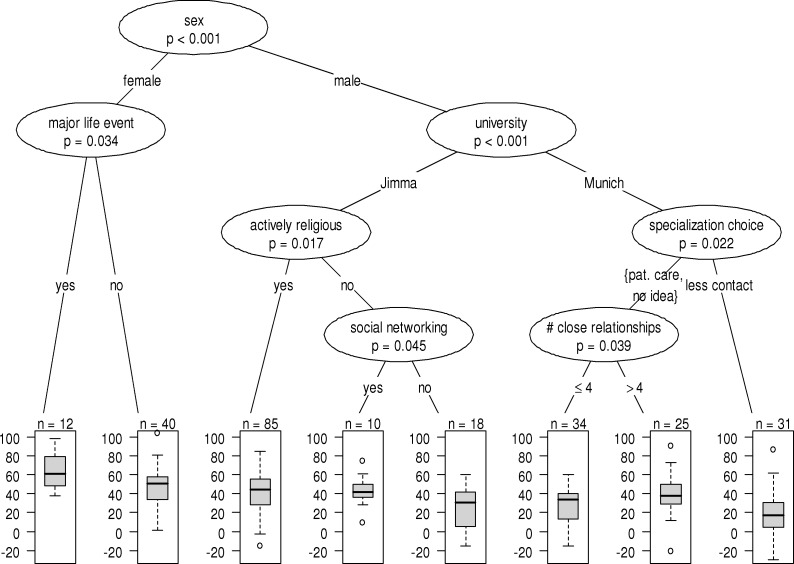
A total of 257 students from the academic year 2010/11, 131 at Jimma University, Ethiopia, and 126 at the Ludwig Maximilian University, Munich, Germany, completed the Balanced Emotional Empathy Scale (BEES), the Reading the Mind in the Eyes (RME-R) test, and a questionnaire on sociodemographic and cultural characteristics. Furthermore, we conducted a qualitative analysis of the students' personal views on the definition of empathy and possible influencing factors. Group comparisons and correlation analyses of empathy scores were performed for the entire cohort and for the Jimma and Munich students separately. We used a regression tree analysis to identify factors influencing the BEES.
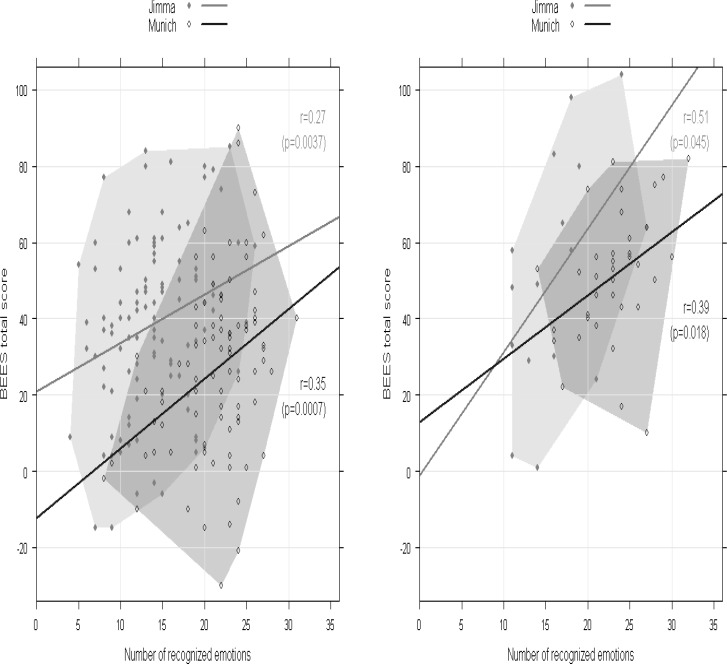
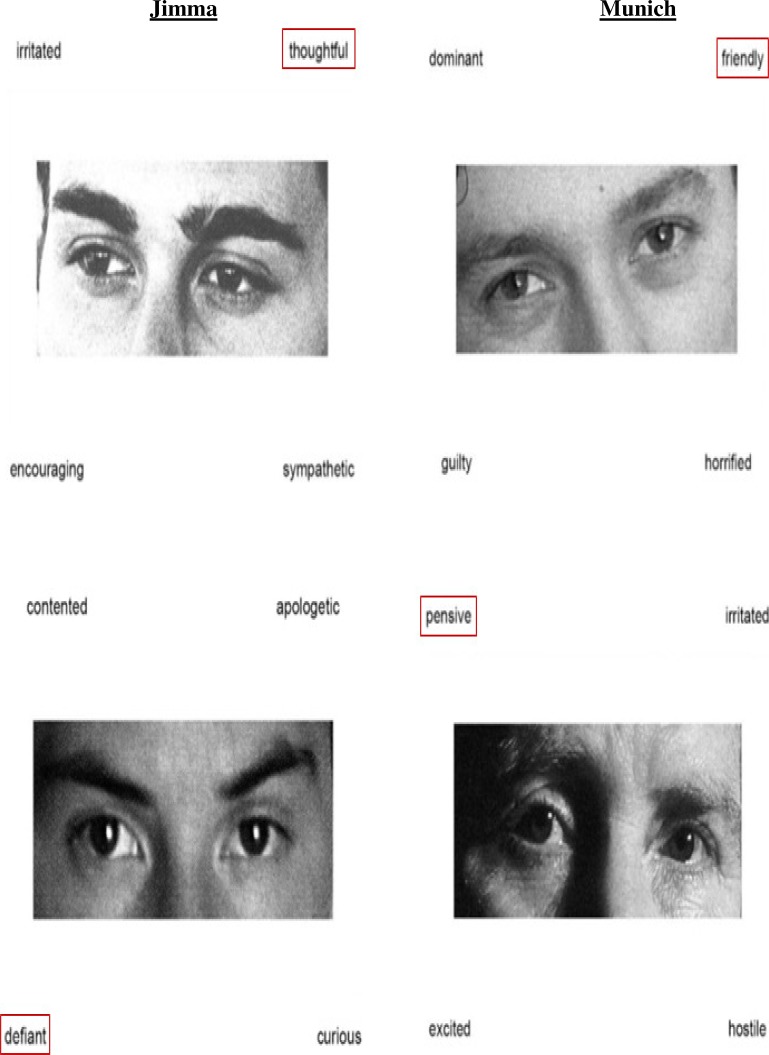
The male students in Jimma (39.1 ± 22.3) scored significantly higher in the BEES than those male students from Munich (27.2 ± 22.6; p = 0.0002). There was no significant difference between the female groups. We found a moderate, positive correlation between the BEES and RME-R test, i.e. between emotional and cognitive empathy, within each university. Nevertheless, the RME-R test, which shows only Caucasian eyes, appears not to be suitable for use in other cultures.
The main findings of our study were the influence of culture, religion, specialization choice, and gender on emotional empathy (assessed with the BEES) and cognitive empathy (assessed with the RME-R test) in first-year medical students. Further research is required into the nature of empathy in worldwide medical curricula.
本跨文化研究旨在考察一年级医学生共情水平的文化差异。
共有来自2010/11学年的257名学生参与研究,其中131名来自埃塞俄比亚的吉姆马大学,126名来自德国慕尼黑的路德维希 - 马克西米利安大学。他们完成了平衡情绪共情量表(BEES)、读心术(RME-R)测试以及一份关于社会人口统计学和文化特征的问卷。此外,我们对学生们关于共情定义及可能影响因素的个人观点进行了定性分析。对整个队列以及分别对吉姆马和慕尼黑的学生进行了共情得分的组间比较和相关性分析。我们使用回归树分析来确定影响BEES的因素。
吉姆马的男学生在BEES上的得分(39.1 ± 22.3)显著高于慕尼黑的男学生(27.2 ± 22.6;p = 0.0002)。女性组之间没有显著差异。在每所大学内部,我们发现BEES与RME-R测试之间存在中度正相关,即情绪共情和认知共情之间存在相关性。然而,仅展示白种人眼睛的RME-R测试似乎不适用于其他文化。
我们研究的主要发现是文化、宗教、专业选择和性别对一年级医学生的情绪共情(用BEES评估)和认知共情(用RME-R测试评估)有影响。需要对全球医学课程中共情的本质进行进一步研究。