Division of Oral Biology, Institute for Behavioral Medicine Research, The Ohio State University, Columbus, OH, USA.
J Inflamm Res. 2013 Jul 4;6:91-8. doi: 10.2147/JIR.S45111. eCollection 2013.
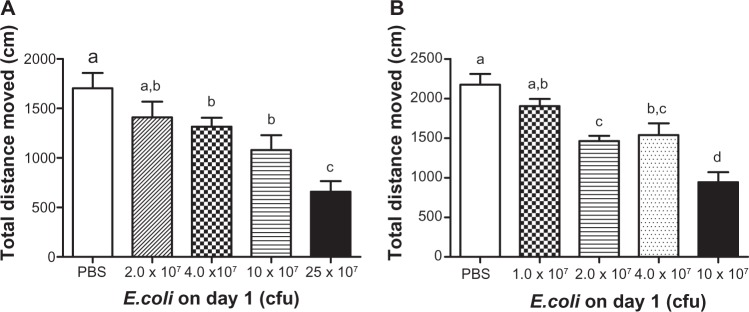
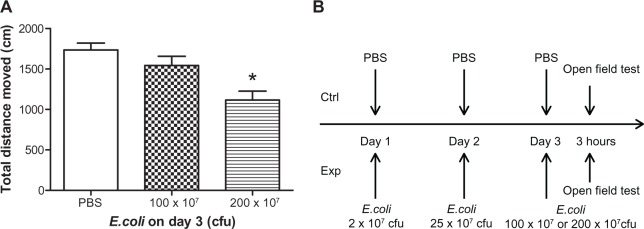
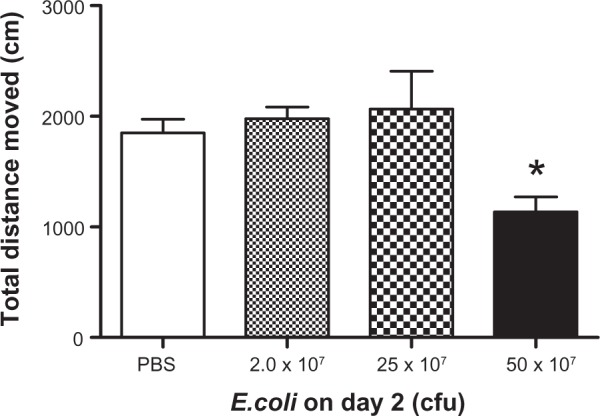
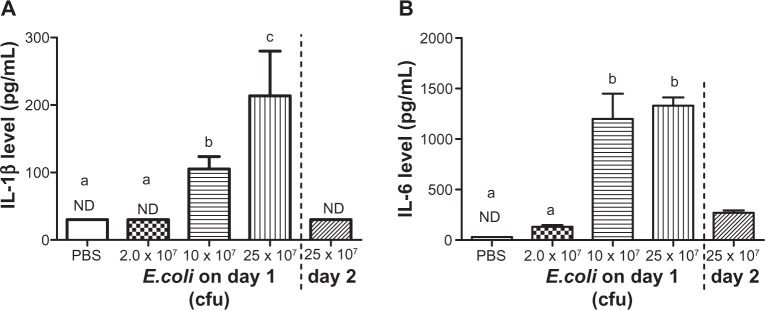
Peripheral immune activation by bacterial mimics or live replicating pathogens is well known to induce central nervous system activation. Sickness behavior alterations are often associated with inflammation-induced increases in peripheral proinflammatory cytokines (eg, interleukin [IL]-1β and IL-6). However, most researchers have used acute high dose endotoxin/bacterial challenges to observe these outcomes. Using this methodology may pose inherent risks in the translational interpretation of the experimental data in these studies. Studies using Escherichia coli have yet to establish the full kinetics of repeated E. coli peripheral injections. Therefore, we sought to examine the effects of repeated low dose E. coli on sickness behavior and local peripheral inflammation in the open field test. Results from the current experiments showed a behavioral dose response, where increased amounts of E. coli resulted in correspondingly increased sickness behavior. Furthermore, animals that received a subthreshold dose (ie, one that did not cause sickness behavior) of E. coli 24 hours prior were able to withstand a larger dose of E. coli on the second day (a dose that would normally cause sickness behavior in mice without prior exposure) without inducing sickness behavior. In addition, animals that received escalating subthreshold doses of E. coli on days 1 and 2 behaviorally tolerated a dose of E. coli 25 times higher than what would normally cause sickness behavior if given acutely. Lastly, increased levels of E. coli caused increased IL-6 and IL-1β protein expression in the peritoneal cavity, and this increase was blocked by administering a subthreshold dose of E. coli 24 hours prior. These data show that progressive challenges with subthreshold levels of E. coli may obviate the induction of sickness behavior and proinflammatory cytokine expression.
众所周知,细菌模拟物或活复制病原体引起的外周免疫激活会导致中枢神经系统激活。疾病行为的改变通常与炎症引起的外周促炎细胞因子(例如白细胞介素[IL]-1β和 IL-6)增加有关。然而,大多数研究人员使用急性高剂量内毒素/细菌挑战来观察这些结果。使用这种方法可能会在这些研究中对实验数据的转化解释带来固有风险。使用大肠杆菌的研究尚未确定重复外周注射大肠杆菌的完整动力学。因此,我们试图在开放场测试中检查重复低剂量大肠杆菌对疾病行为和局部外周炎症的影响。当前实验的结果显示出行为剂量反应,即大肠杆菌的剂量增加会导致相应的疾病行为增加。此外,在第二天接受更大剂量的大肠杆菌(在没有先前暴露的情况下通常会导致小鼠生病的剂量)而不会引起疾病行为的动物,在 24 小时前接受了亚阈值剂量(即不会引起疾病行为的剂量)的大肠杆菌。此外,在第 1 天和第 2 天接受递增亚阈值剂量大肠杆菌的动物在行为上耐受了比急性给予时通常会引起疾病行为的大肠杆菌高 25 倍的剂量。最后,大肠杆菌水平的增加导致腹腔内 IL-6 和 IL-1β 蛋白表达增加,而 24 小时前给予亚阈值剂量的大肠杆菌可阻断这种增加。这些数据表明,逐渐用亚阈值水平的大肠杆菌进行挑战可能会避免疾病行为和促炎细胞因子表达的诱导。