School of Botany, University of Melbourne, Parkville, Victoria, Australia.
PLoS One. 2013 Jun 28;8(6):e68337. doi: 10.1371/journal.pone.0068337. eCollection 2013.
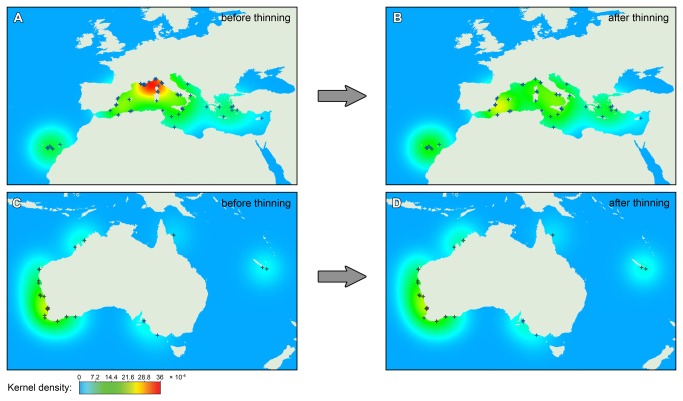
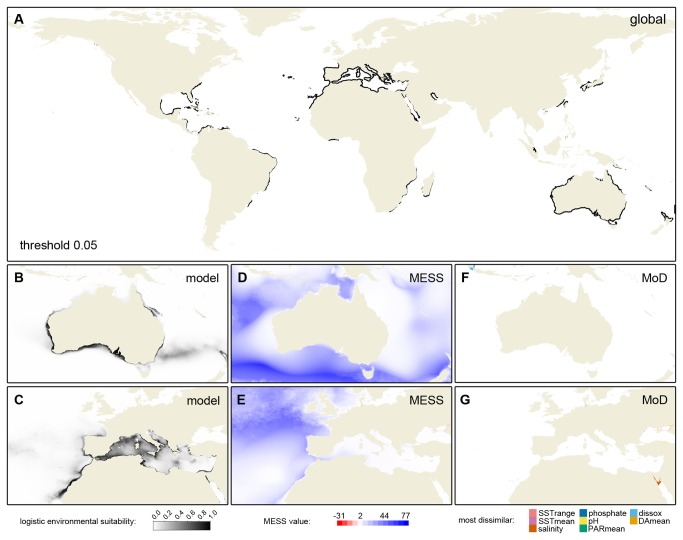
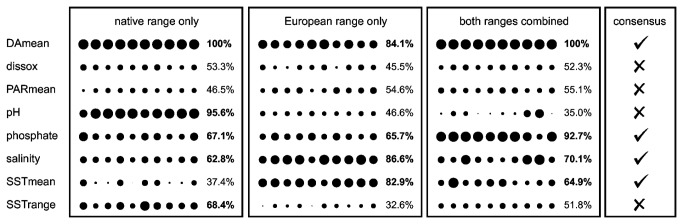
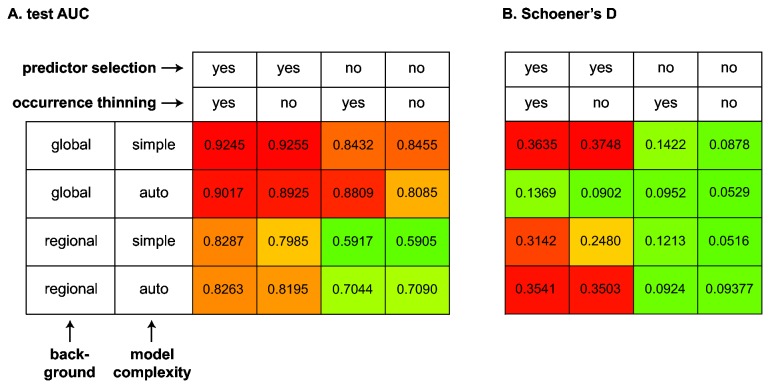
The utility of species distribution models for applications in invasion and global change biology is critically dependent on their transferability between regions or points in time, respectively. We introduce two methods that aim to improve the transferability of presence-only models: density-based occurrence thinning and performance-based predictor selection. We evaluate the effect of these methods along with the impact of the choice of model complexity and geographic background on the transferability of a species distribution model between geographic regions. Our multifactorial experiment focuses on the notorious invasive seaweed Caulerpa cylindracea (previously Caulerpa racemosa var. cylindracea) and uses Maxent, a commonly used presence-only modeling technique. We show that model transferability is markedly improved by appropriate predictor selection, with occurrence thinning, model complexity and background choice having relatively minor effects. The data shows that, if available, occurrence records from the native and invaded regions should be combined as this leads to models with high predictive power while reducing the sensitivity to choices made in the modeling process. The inferred distribution model of Caulerpa cylindracea shows the potential for this species to further spread along the coasts of Western Europe, western Africa and the south coast of Australia.
物种分布模型在入侵和全球变化生物学中的应用的实用性,分别取决于它们在区域或时间点之间的可转移性。我们引入了两种旨在提高存在模型可转移性的方法:基于密度的出现稀疏化和基于性能的预测因子选择。我们评估了这些方法的效果,以及模型复杂度和地理背景选择对物种分布模型在地理区域之间的可转移性的影响。我们的多因素实验集中在臭名昭著的入侵海藻 Caulerpa cylindracea(以前称为 Caulerpa racemosa var. cylindracea)上,并使用了 Maxent,这是一种常用的存在模型技术。我们表明,通过适当的预测因子选择,可以显著提高模型的可转移性,而出现稀疏化、模型复杂度和背景选择的影响相对较小。数据表明,如果有可用的记录,来自原生和入侵地区的出现记录应合并,因为这会导致具有高预测能力的模型,同时减少对建模过程中做出的选择的敏感性。推断的 Caulerpa cylindracea 分布模型表明,该物种有可能沿着西欧、西非和澳大利亚南部海岸进一步扩散。