Engineering Sciences and Applied Mathematics, Northwestern University, Evanston, Illinois, United States of America.
PLoS One. 2013 Aug 7;8(8):e69829. doi: 10.1371/journal.pone.0069829. eCollection 2013.
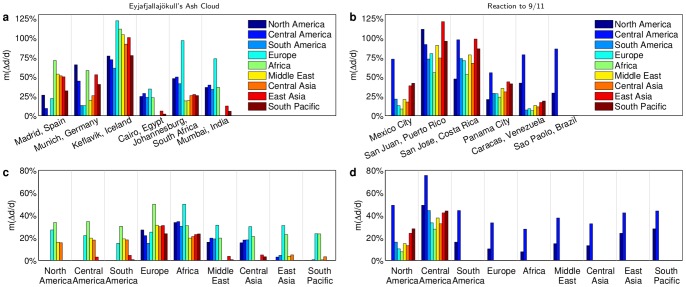
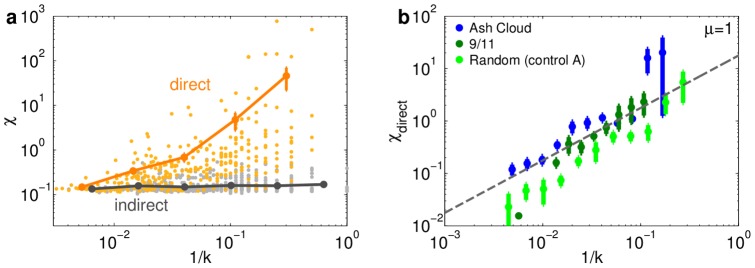
Large-scale disasters that interfere with globalized socio-technical infrastructure, such as mobility and transportation networks, trigger high socio-economic costs. Although the origin of such events is often geographically confined, their impact reverberates through entire networks in ways that are poorly understood, difficult to assess, and even more difficult to predict. We investigate how the eruption of volcano Eyjafjallajökull, the September 11th terrorist attacks, and geographical disruptions in general interfere with worldwide mobility. To do this we track changes in effective distance in the worldwide air transportation network from the perspective of individual airports. We find that universal features exist across these events: airport susceptibilities to regional disruptions follow similar, strongly heterogeneous distributions that lack a scale. On the other hand, airports are more uniformly susceptible to attacks that target the most important hubs in the network, exhibiting a well-defined scale. The statistical behavior of susceptibility can be characterized by a single scaling exponent. Using scaling arguments that capture the interplay between individual airport characteristics and the structural properties of routes we can recover the exponent for all types of disruption. We find that the same mechanisms responsible for efficient passenger flow may also keep the system in a vulnerable state. Our approach can be applied to understand the impact of large, correlated disruptions in financial systems, ecosystems and other systems with a complex interaction structure between heterogeneous components.
大规模灾害会干扰全球化的社会技术基础设施,如移动和交通网络,从而引发高社会经济成本。尽管此类事件的起源通常在地理上受到限制,但它们的影响以人们难以理解、难以评估甚至更难以预测的方式在整个网络中产生共鸣。我们研究了埃亚菲亚德拉冰盖火山爆发、9·11 恐怖袭击以及一般的地理干扰如何影响全球流动性。为此,我们从单个机场的角度跟踪全球航空运输网络中有效距离的变化。我们发现,这些事件之间存在普遍特征:机场对区域干扰的敏感性遵循相似的、强烈异质分布,缺乏规模。另一方面,机场更容易受到针对网络中最重要枢纽的攻击,表现出明确的规模。敏感性的统计行为可以用单个标度指数来描述。使用捕捉个体机场特征和航线结构属性之间相互作用的标度论点,我们可以为所有类型的干扰恢复指数。我们发现,负责有效客流的相同机制也可能使系统处于脆弱状态。我们的方法可以应用于理解金融系统、生态系统和其他具有异质组件之间复杂相互作用结构的系统中大规模相关干扰的影响。