Key Laboratory of Analytical Chemistry for Biology and Medicine, College of Chemistry and Molecular Sciences, State Key Laboratory of Virology, and Wuhan Institute of Biotechnology, Wuhan University, Wuhan, 430072, PR China.
Sci Rep. 2013;3:2462. doi: 10.1038/srep02462.
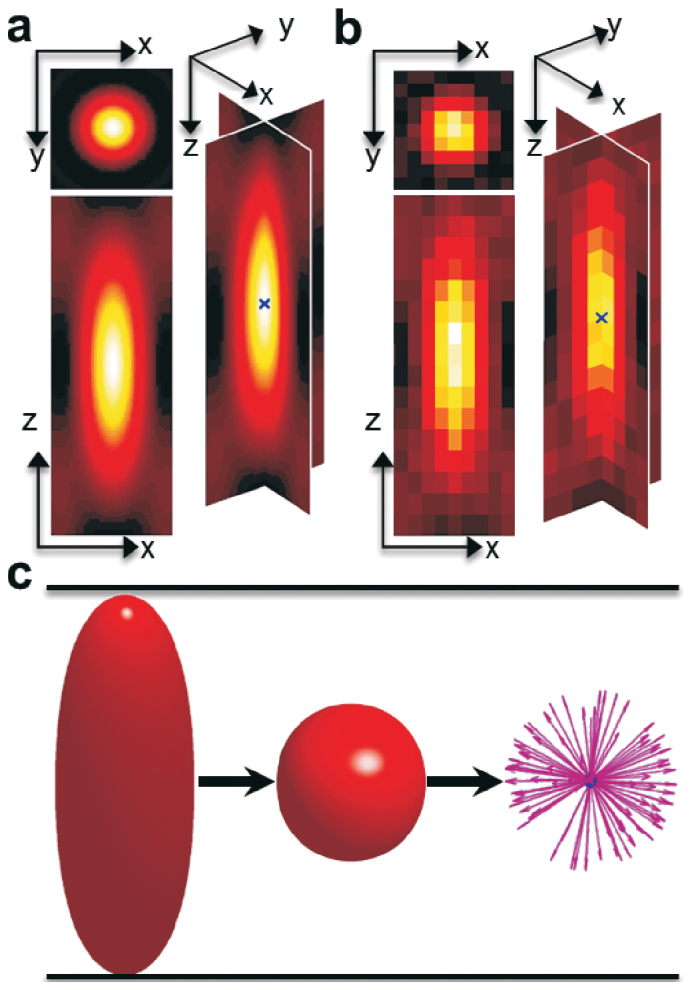
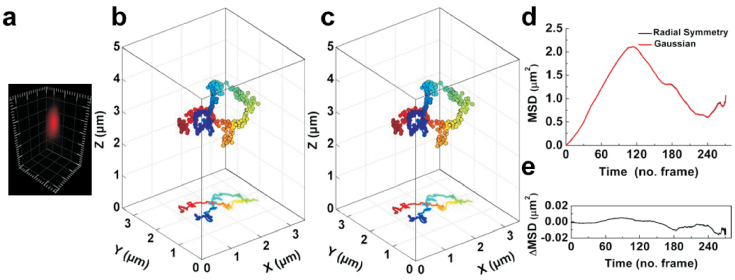
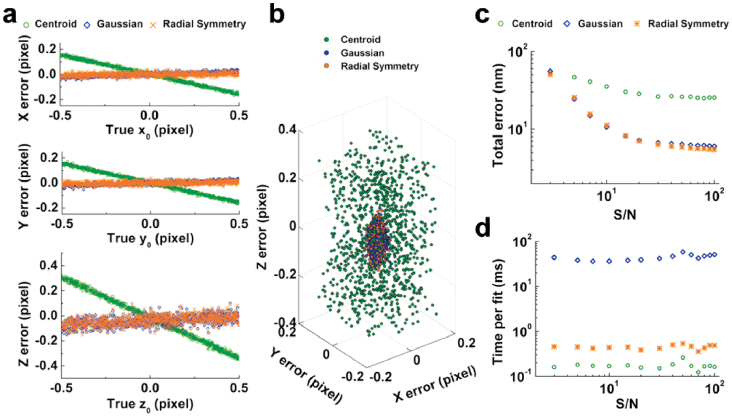
We report a non-iterative localization algorithm that utilizes the scaling of a three-dimensional (3D) image in the axial direction and focuses on evaluating the radial symmetry center of the scaled image to achieve the desired single-particle localization. Using this approach, we analyzed simulated 3D particle images by wide-field microscopy and confocal microscopy respectively, and the 3D trajectory of quantum dots (QDs)-labeled influenza virus in live cells. Both applications indicate that the method can achieve 3D single-particle localization with a sub-pixel precision and sub-millisecond computation time. The precision is almost the same as that of the iterative nonlinear least-squares 3D Gaussian fitting method, but with two orders of magnitude higher computation speed. This approach can reduce considerably the time and costs for processing the large volume data of 3D images for 3D single-particle tracking, which is especially suited for 3D high-precision single-particle tracking, 3D single-molecule imaging and even new microscopy techniques.
我们报告了一种非迭代的定位算法,该算法利用三维(3D)图像在轴向的缩放,并专注于评估缩放图像的径向对称中心,以实现所需的单粒子定位。使用这种方法,我们分别通过宽场显微镜和共焦显微镜分析了模拟的 3D 粒子图像,以及活细胞中量子点(QD)标记的流感病毒的 3D 轨迹。这两种应用都表明,该方法可以实现具有亚像素精度和亚毫秒计算时间的 3D 单粒子定位。该精度几乎与迭代非线性最小二乘 3D 高斯拟合方法相同,但计算速度要高两个数量级。这种方法可以大大减少处理用于 3D 单粒子跟踪的 3D 图像大体积数据的时间和成本,特别适合于 3D 高精度单粒子跟踪、3D 单分子成像,甚至是新的显微镜技术。