Rosaline Hannah, Kandaswamy D, Gogulnath D, Rubin Mi
Department of Conservative Dentistry and Endodontics, Sri Ramachandra University, Porur, Tamil Nadu, India.
J Conserv Dent. 2013 Jul;16(4):352-5. doi: 10.4103/0972-0707.114365.
The aim of this study was to assess the antibacterial efficacy of three different herbal irrigants against Enterococcus faecalis.
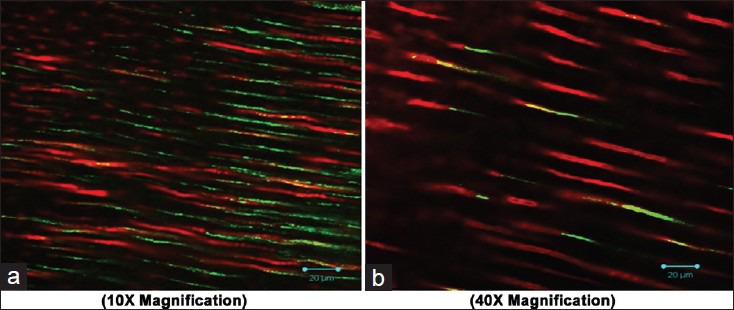
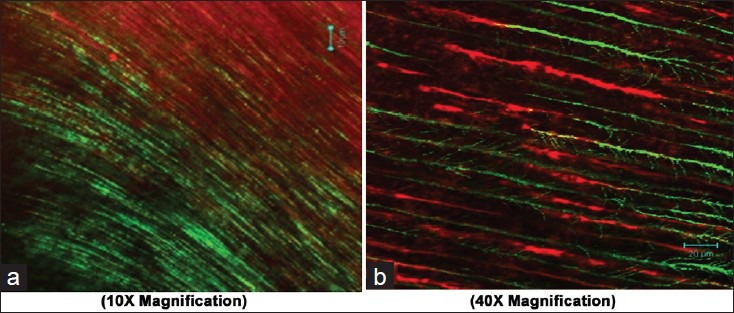
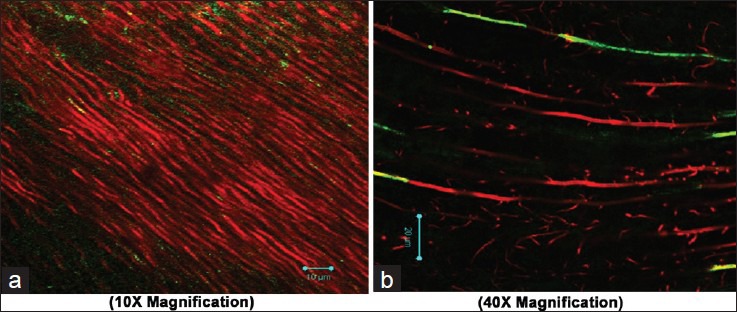
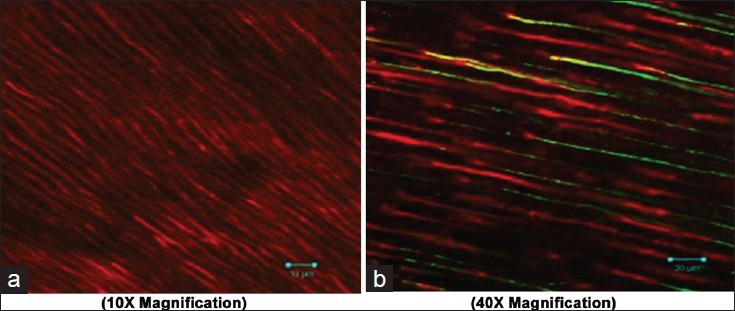
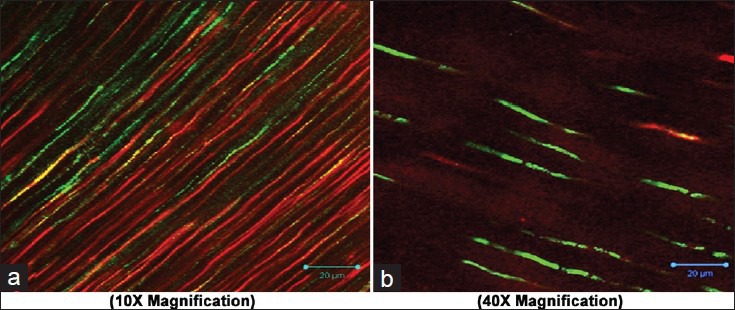
Single rooted teeth were extracted due to orthodontic and periodontal reasons. The teeth were then inoculated with E. faecalis. The teeth were randomly divided into three experimental groups and two control groups of six samples each. Group 1 specimens were treated with 5.2% sodium hypochlorite (NaOCL) for 30 min followed by 5 mmol/L Ethylenediaminetetraacetic acid (EDTA) for 5 min and saline as final irrigant. Group 2 specimens were treated with and 5.2% NaOCl for 30 min as final irrigant. Group 3 were treated with Morinda citrifolia (MC) for 30 min as final irrigant. Group 4 were treated with Azadiracta indica (AI) as final irrigant. Group 5 were treated with green tea (GT) for 30 min as final irrigant. The dentin specimens were carefully spread onto a microscope slide and stained with BacLight and examined in a confocal laser scanning microscope set to monitor fluorescein isothiocyanate and propidium iodide. A total of nine fields were examined for each treatment and the bacteria presented were counted.
Using the one-way ANOVA with multiple comparison, significantly less bacteria were found adhering to the samples treated with Neem followed by NaOCL, GT, MC, Saline.
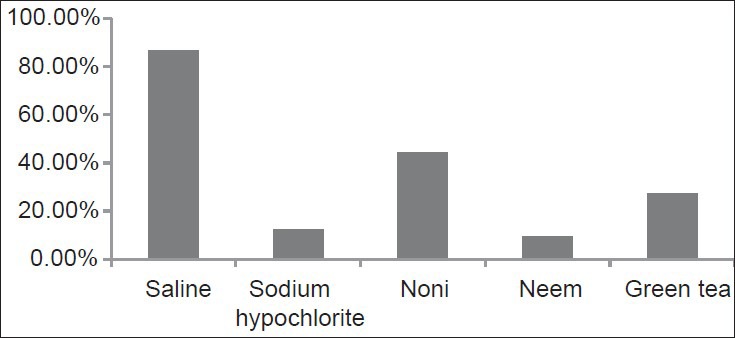
AI treatment produced the maximum reduction in adherence of E. faecalis to dentin (9.30%) followed by NaOCl (12.50%), GT (27.30%), MC (44.20%) and saline (86.70%).
Neem is effective in preventing adhesion of E. faecalis to dentin.
本研究旨在评估三种不同的草药冲洗剂对粪肠球菌的抗菌效果。
因正畸和牙周原因拔除单根牙。然后将牙齿接种粪肠球菌。将牙齿随机分为三个实验组和两个对照组,每组六个样本。第1组样本先用5.2%次氯酸钠(NaOCL)处理30分钟,再用5 mmol/L乙二胺四乙酸(EDTA)处理5分钟,最后用生理盐水冲洗。第2组样本用5.2% NaOCl处理30分钟作为最终冲洗剂。第3组用巴戟天(MC)处理30分钟作为最终冲洗剂。第4组用印楝(AI)作为最终冲洗剂。第5组用绿茶(GT)处理30分钟作为最终冲洗剂。将牙本质样本小心地铺在显微镜载玻片上,用BacLight染色,并在共聚焦激光扫描显微镜下检查,以监测异硫氰酸荧光素和碘化丙啶。每种处理共检查九个视野,并对出现的细菌进行计数。
采用单因素方差分析和多重比较,发现用印楝处理的样本上附着的细菌明显少于用NaOCL、GT、MC、生理盐水处理的样本。
AI处理使粪肠球菌在牙本质上的附着减少最多(9.30%),其次是NaOCl(12.50%)、GT(27.30%)、MC(44.20%)和生理盐水(86.70%)。
印楝能有效防止粪肠球菌附着于牙本质。