Gutierrez Jeydith A, Hannoush Zeina C, Vargas Luis G, Momany Allison, Garcia Carmen C, Murray Jeffrey C, Dunnwald Martine
Internal Medicine Department, Carver College of Medicine. University of Iowa, Iowa City, Iowa, USA.
Mol Genet Genomic Med. 2013 Jul 1;1(2):108-112. doi: 10.1002/mgg3.6.
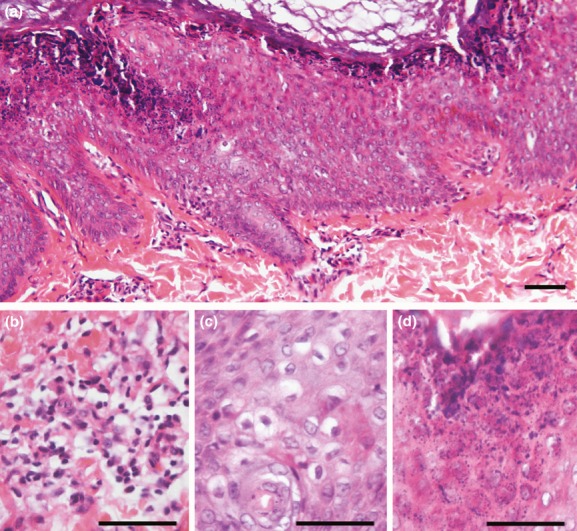
Epidermolytic ichthyosis (EI) is a rare skin disorder characterized by generalized erythroderma and cutaneous blistering at birth, which is substituted by hyperkeratosis later in life. It is caused by autosomal dominant mutations in highly conserved regions of and . To date, only 4 mutations with autosomal recessive inheritance of EI have been described in consanguineous families. All of them affect the 2B domain of . In the present study we describe four patients with EI (including one lethal case) born from unaffected parents in a consanguineous family of a native Venezuelan community. The objective of this study was to characterize the clinical, genetic and morphological aspects of the disease in this family, as well as understand its functional implications. Genomic DNA was sequenced for KRT10 and KRT1. Immunofluoresence for keratin expression was performed on cutaneous biopsies. After examination of cutaneous biopsies histology, our results showed hyperkeratosis and acantholysis with an expanded granular layer. Sequencing of demonstrated a non-sense mutation (p.Tyr282Ter.) corresponding to the 1B domain of the protein in patients and a heterozygous pattern in other family members, resulting in complete absence of K10. The loss of K10 was compensated by upregulation of K14 and K17. In conclusion, this novel mutation in is the first recessive genetic variation that is not located in the so called "hot spot" for recessive EI, suggesting that other areas of the gene are also susceptible for such mutations.
表皮松解性鱼鳞病(EI)是一种罕见的皮肤疾病,其特征为出生时全身性红皮病和皮肤水疱,随后在生命后期被角化过度所取代。它由 和 高度保守区域的常染色体显性突变引起。迄今为止,在近亲家庭中仅描述了4种具有EI常染色体隐性遗传的突变。所有这些突变都影响 的2B结构域。在本研究中,我们描述了委内瑞拉一个本地社区近亲家庭中4例EI患者(包括1例致死病例),其父母均未患病。本研究的目的是描述该家庭中该疾病的临床、遗传和形态学特征,以及了解其功能意义。对KRT10和KRT1进行了基因组DNA测序。对皮肤活检组织进行了角蛋白表达的免疫荧光检测。在检查皮肤活检组织的组织学后,我们的结果显示角化过度和棘层松解,颗粒层增厚。 的测序显示患者中存在与该蛋白1B结构域相对应的无义突变(p.Tyr282Ter.),其他家庭成员为杂合模式,导致K10完全缺失。K10的缺失通过K14和K17的上调得到补偿。总之, 中的这种新突变是第一个不在隐性EI所谓“热点”区域的隐性遗传变异,表明该基因的其他区域也易发生此类突变。