Liakath-Ali Kifayathullah, Vancollie Valerie E, Heath Emma, Smedley Damian P, Estabel Jeanne, Sunter David, Ditommaso Tia, White Jacqueline K, Ramirez-Solis Ramiro, Smyth Ian, Steel Karen P, Watt Fiona M
1] Centre for Stem Cells and Regenerative Medicine, King's College London, Guy's Hospital, London SE1 9RT, UK [2] Department of Biochemistry, University of Cambridge, Tennis Court Road, Cambridge CB2 1QW, UK [3] Wellcome Trust-Medical Research Council Stem Cell Institute, University of Cambridge, Tennis Court Road, Cambridge CB2 1QR, UK.
Wellcome Trust Sanger Institute, Genome Campus, Hinxton, Cambridge CB10 1SA, UK.
Nat Commun. 2014 Apr 11;5:3540. doi: 10.1038/ncomms4540.
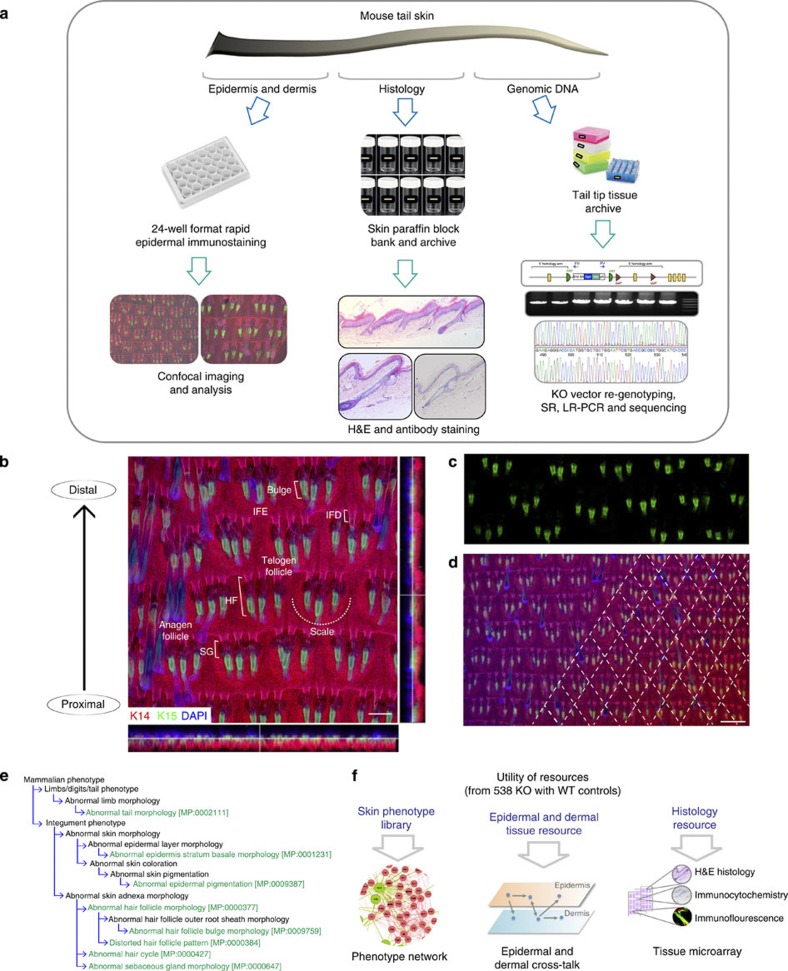
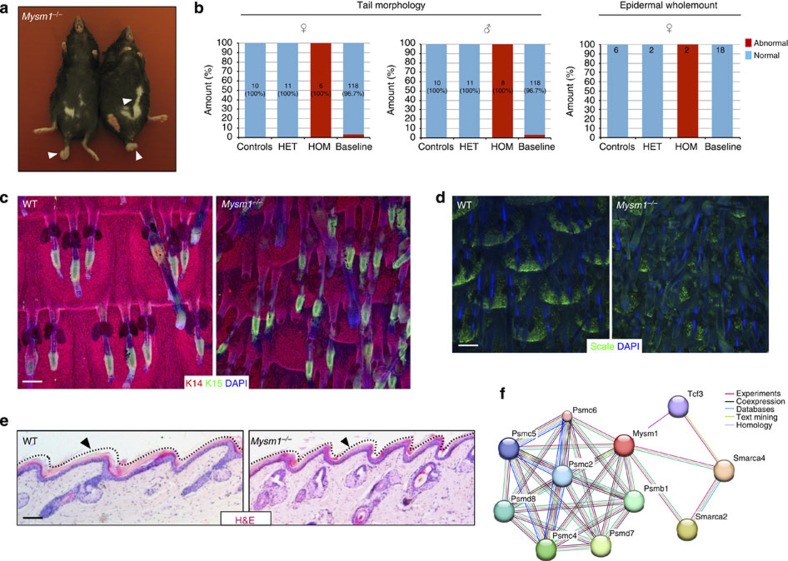
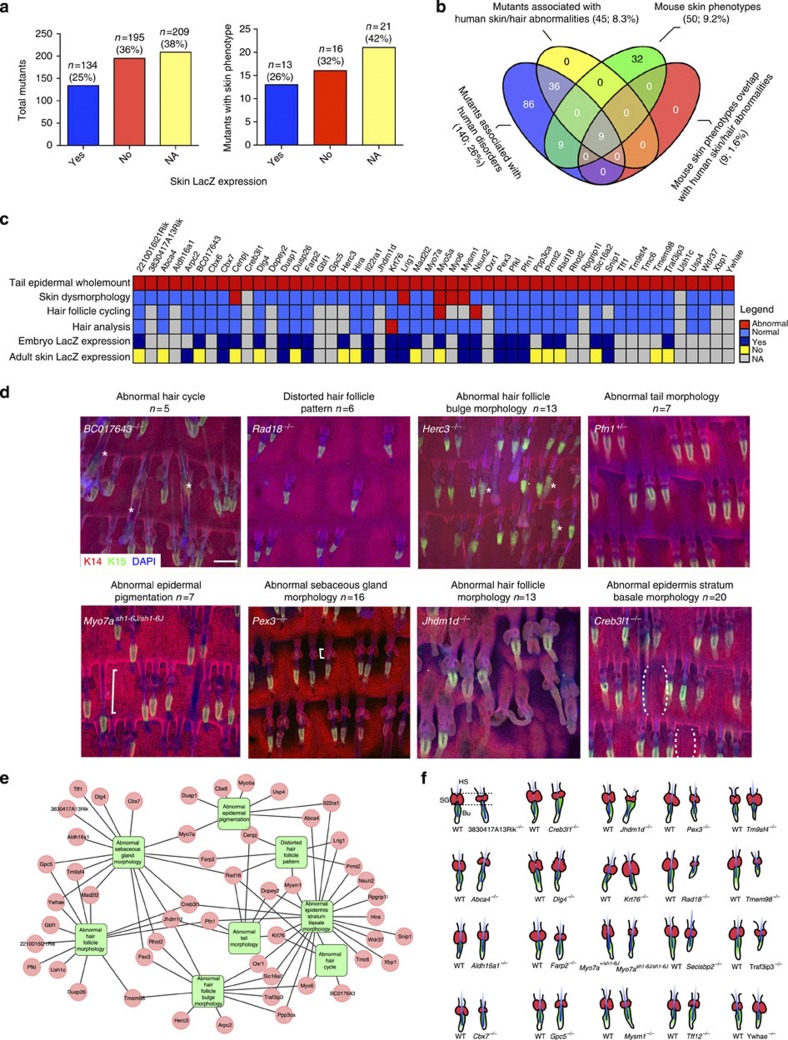
Permanent stop-and-shop large-scale mouse mutant resources provide an excellent platform to decipher tissue phenogenomics. Here we analyse skin from 538 knockout mouse mutants generated by the Sanger Institute Mouse Genetics Project. We optimize immunolabelling of tail epidermal wholemounts to allow systematic annotation of hair follicle, sebaceous gland and interfollicular epidermal abnormalities using ontology terms from the Mammalian Phenotype Ontology. Of the 50 mutants with an epidermal phenotype, 9 map to human genetic conditions with skin abnormalities. Some mutant genes are expressed in the skin, whereas others are not, indicating systemic effects. One phenotype is affected by diet and several are incompletely penetrant. In-depth analysis of three mutants, Krt76, Myo5a (a model of human Griscelli syndrome) and Mysm1, provides validation of the screen. Our study is the first large-scale genome-wide tissue phenotype screen from the International Knockout Mouse Consortium and provides an open access resource for the scientific community.
永久性的一站式大规模小鼠突变体资源为解析组织表型基因组学提供了一个绝佳的平台。在此,我们分析了由桑格研究所小鼠遗传学项目产生的538个基因敲除小鼠突变体的皮肤。我们优化了尾部表皮整装片的免疫标记,以便使用哺乳动物表型本体论中的本体术语对毛囊、皮脂腺和毛囊间表皮异常进行系统注释。在50个具有表皮表型的突变体中,有9个与人类皮肤异常的遗传病症相关。一些突变基因在皮肤中表达,而另一些则不表达,这表明存在系统性影响。一种表型受饮食影响,还有几种表型具有不完全外显率。对三个突变体Krt76、Myo5a(人类格里塞利综合征模型)和Mysm1的深入分析验证了该筛选方法。我们的研究是国际基因敲除小鼠联盟首次进行的大规模全基因组组织表型筛选,并为科学界提供了一个开放获取的资源。