Higgins Torrance J, Middleton Kathryn R, Winner Larry, Janelle Christopher M
Department of Applied Physiology and Kinesiology.
Department of Clinical & Health Psychology.
Health Psychol. 2014 Aug;33(8):891-903. doi: 10.1037/a0033864. Epub 2013 Aug 19.
Researchers have yet to establish how interventions to increase physical activity influence specific self-efficacy beliefs. The current study sought to quantify the effect of interventions to increase physical activity among healthy adults on exercise task (EXSE) and barrier self-efficacy (BSE) via meta-analysis. Intervention characteristics associated with self-efficacy and physical activity changes were also identified.
A systematic database search and manual searches through reference lists of related publications were conducted for articles on randomized, controlled physical activity interventions. Published intervention studies reporting changes in physical activity behavior and either EXSE or BSE in healthy adults were eligible for inclusion.
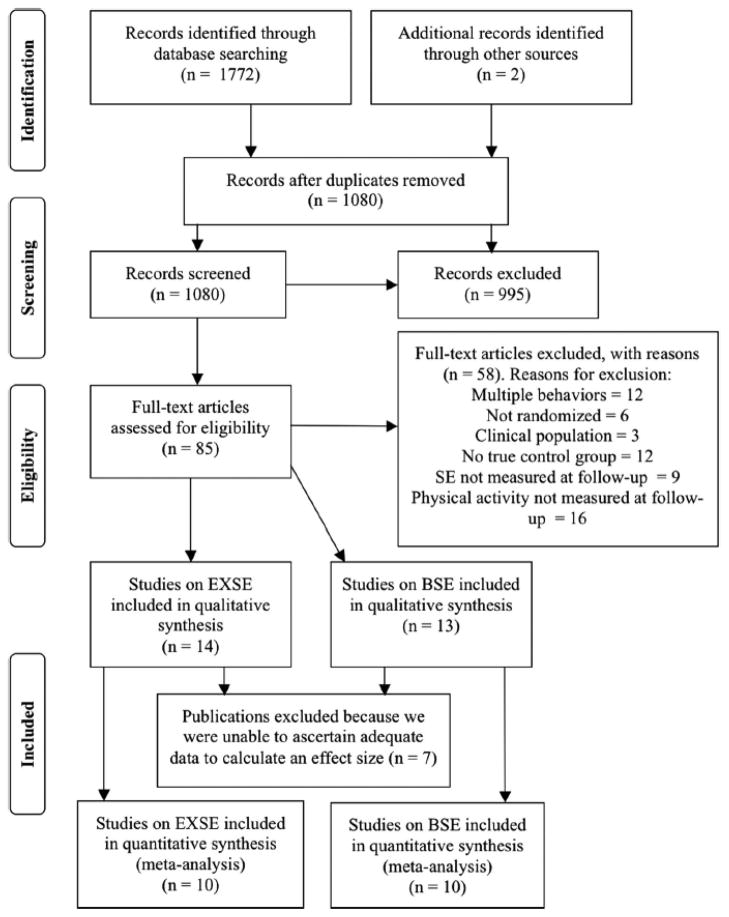
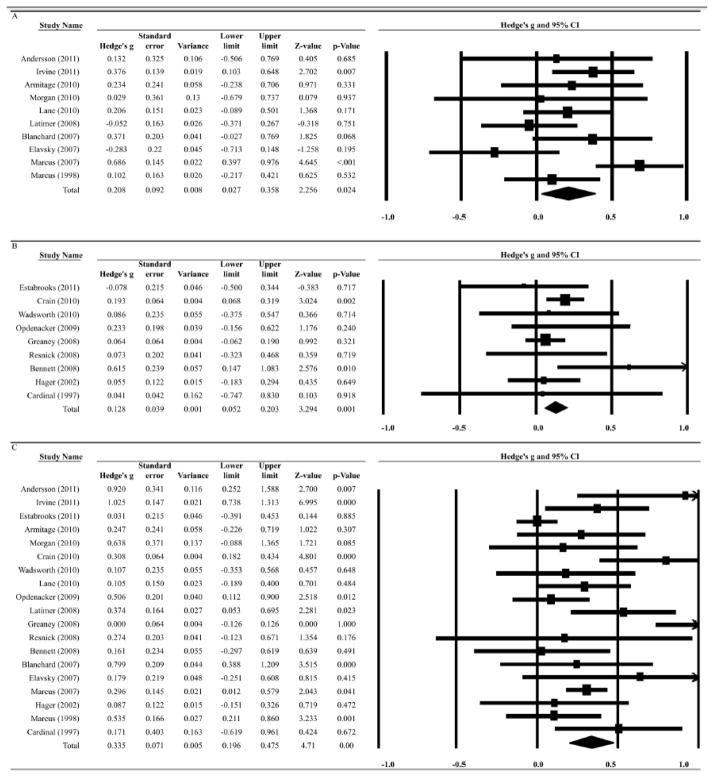
Of the 1,080 studies identified, 20 were included in the meta-analyses. Interventions had a significant effect of g = 0.208, 95% confidence interval (CI) [0.027, 0.388], p < .05, on EXSE; g = 0.128, 95% CI [0.05, 0.20], p < .05 on BSE; and g = 0.335 95% CI [0.196, 0.475], p < .001, on physical activity. Moderator analyses indicated shorter interventions that did not include structured exercise sessions effectively increased EXSE and physical activity, whereas long interventions improved BSE. Interventions that did not provide support increased BSE and physical activity levels. Further, interventions that did not require the use of daily exercise logs improved EXSE and physical activity behavior.
Interventions designed to increase physical activity differentially influenced EXSE and BSE. EXSE appeared to play a more significant role during exercise adoption, whereas BSE was involved in the maintenance of exercise behavior. Recommendations are offered for the design of future interventions.
研究人员尚未确定增加身体活动的干预措施如何影响特定的自我效能信念。本研究旨在通过荟萃分析量化增加健康成年人身体活动的干预措施对运动任务自我效能(EXSE)和障碍自我效能(BSE)的影响。还确定了与自我效能和身体活动变化相关的干预特征。
通过系统的数据库搜索以及对相关出版物参考文献列表的手动搜索,查找关于随机对照身体活动干预的文章。已发表的干预研究报告了健康成年人身体活动行为以及EXSE或BSE的变化,符合纳入标准。
在识别出的1080项研究中,有20项纳入了荟萃分析。干预措施对EXSE有显著影响,g = 0.208,95%置信区间(CI)[0.027, 0.388],p <.05;对BSE的影响为g = 0.128,95% CI [0.05, 0.20],p <.05;对身体活动的影响为g = 0.335,95% CI [0.196, 0.475],p <.001。调节因素分析表明,不包括结构化锻炼课程的较短干预措施有效地提高了EXSE和身体活动,而较长的干预措施改善了BSE。不提供支持的干预措施提高了BSE和身体活动水平。此外,不需要使用每日运动日志的干预措施改善了EXSE和身体活动行为。
旨在增加身体活动的干预措施对EXSE和BSE有不同的影响。EXSE在开始运动期间似乎发挥了更重要的作用,而BSE则参与运动行为的维持。为未来干预措施的设计提供了建议。