Department of Psychology, Chemnitz University of Technology Chemnitz, Germany.
Front Psychol. 2013 Aug 6;4:508. doi: 10.3389/fpsyg.2013.00508. eCollection 2013.
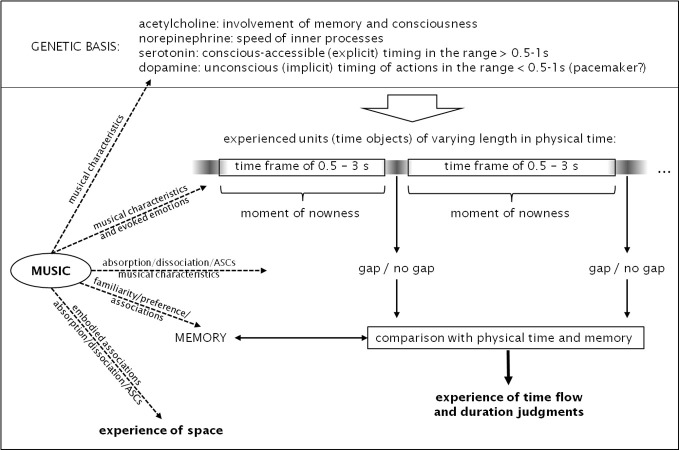
Music is known to alter people's ordinary experience of space and time. Not only does this challenge the concept of invariant space and time tacitly assumed in psychology but it may also help us understand how music works and how music can be understood as an embodied experience. Yet research about these alterations is in its infancy. This review is intended to delineate a future research agenda. We review experimental evidence and subjective reports of the influence of music on the representation of space and time and present prominent approaches to explaining these effects. We discuss the role of absorption and altered states of consciousness and their associated changes in attention and neurophysiological processes, as well as prominent models of human time processing and time experience. After integrating the reviewed research, we conclude that research on the influence of music on the representation of space and time is still quite inconclusive but that integrating the different approaches could lead to a better understanding of the observed effects. We also provide a working model that integrates a large part of the evidence and theories. Several suggestions for further research in both music psychology and cognitive psychology are outlined.
音乐可以改变人们对空间和时间的常规体验。这不仅挑战了心理学中隐含的不变空间和时间的概念,还有助于我们理解音乐的作用机制以及音乐如何被理解为一种具身体验。然而,关于这些变化的研究还处于起步阶段。本文旨在为未来的研究制定一个议程。我们回顾了关于音乐对空间和时间的表现的影响的实验证据和主观报告,并介绍了解释这些效应的主要方法。我们讨论了吸收和意识改变状态及其对注意力和神经生理过程的影响,以及人类时间处理和时间体验的主要模型。在整合了已审查的研究后,我们得出结论,关于音乐对空间和时间表现的影响的研究仍然非常不一致,但整合不同的方法可能会更好地理解观察到的效果。我们还提供了一个工作模型,该模型整合了大部分证据和理论。为音乐心理学和认知心理学中的进一步研究提出了一些建议。