Institut Cochin, Université Paris Descartes, CNRS (UMR8104) , Paris , France ; INSERM, U1016 , Paris , France.
Front Endocrinol (Lausanne). 2013 Aug 12;4:99. doi: 10.3389/fendo.2013.00099. eCollection 2013.
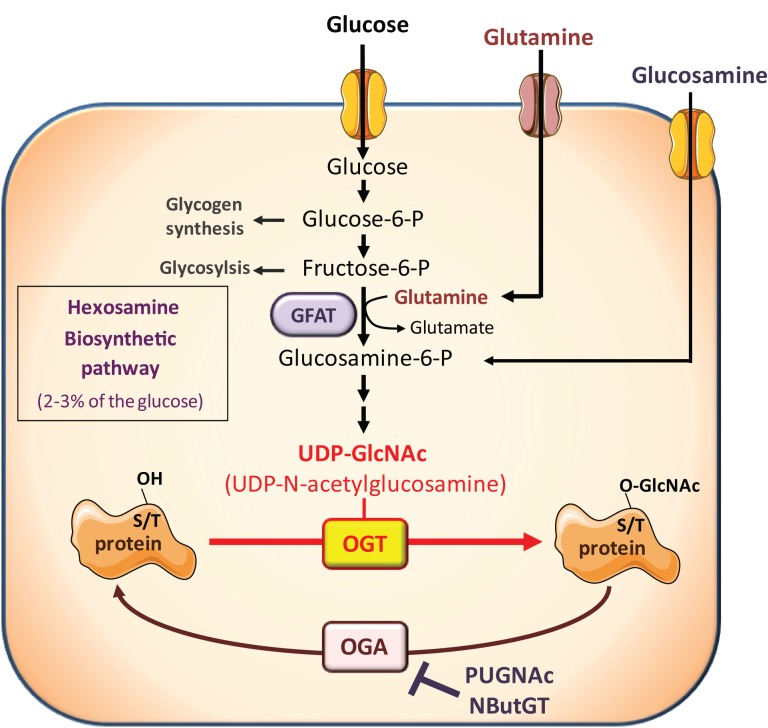
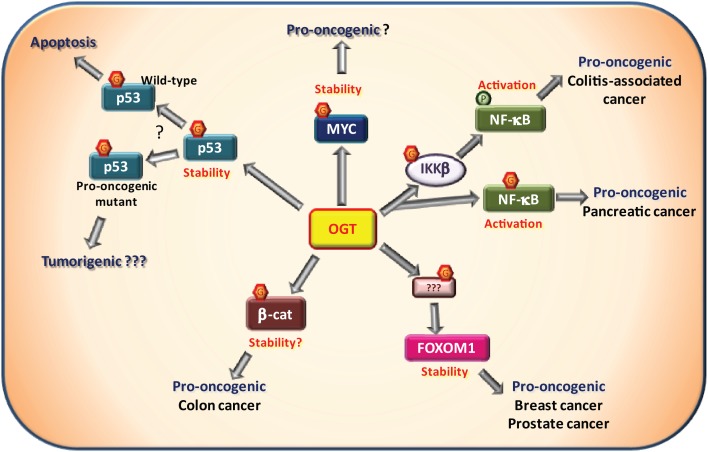
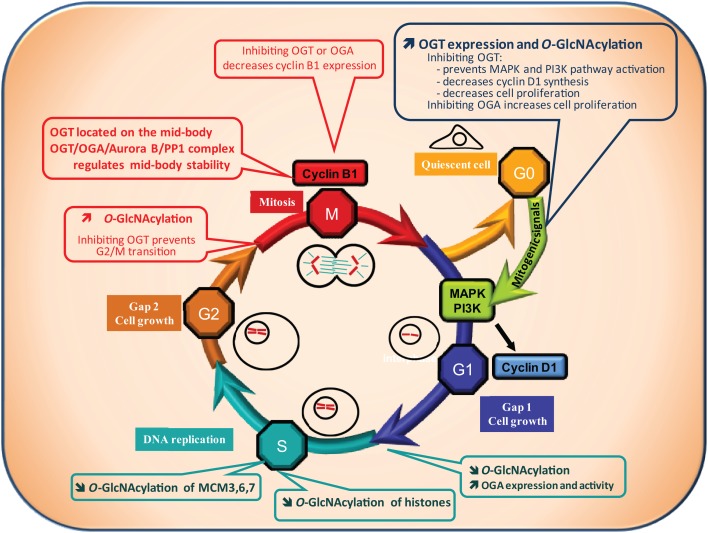
O-linked N-acetylglucosaminylation (O-GlcNAcylation) is a reversible post-translational modification consisting in the addition of a sugar moiety to serine/threonine residues of cytosolic or nuclear proteins. Catalyzed by O-GlcNAc-transferase (OGT) and removed by O-GlcNAcase, this dynamic modification is dependent on environmental glucose concentration. O-GlcNAcylation regulates the activities of a wide panel of proteins involved in almost all aspects of cell biology. As a nutrient sensor, O-GlcNAcylation can relay the effects of excessive nutritional intake, an important cancer risk factor, on protein activities and cellular functions. Indeed, O-GlcNAcylation has been shown to play a significant role in cancer development through different mechanisms. O-GlcNAcylation and OGT levels are increased in different cancers (breast, prostate, colon…) and vary during cell cycle progression. Modulating their expression or activity can alter cancer cell proliferation and/or invasion. Interestingly, major oncogenic factors have been shown to be directly O-GlcNAcylated (p53, MYC, NFκB, β-catenin…). Furthermore, chromatin dynamics is modulated by O-GlcNAc. DNA methylation enzymes of the Tet family, involved epigenetic alterations associated with cancer, were recently found to interact with and target OGT to multi-molecular chromatin-remodeling complexes. Consistently, histones are subjected to O-GlcNAc modifications which regulate their function. Increasing number of evidences point out the central involvement of O-GlcNAcylation in tumorigenesis, justifying the attention received as a potential new approach for cancer treatment. However, comprehension of the underlying mechanism remains at its beginnings. Future challenge will be to address directly the role of O-GlcNAc-modified residues in oncogenic-related proteins to eventually propose novel strategies to alter cancer development and/or progression.
O-连接的 N-乙酰氨基葡萄糖基化 (O-GlcNAcylation) 是一种可逆的翻译后修饰,它由细胞质或核蛋白丝氨酸/苏氨酸残基上糖基的添加组成。该动态修饰由 O-GlcNAc 转移酶 (OGT) 催化,由 O-GlcNAcase 去除,依赖于环境葡萄糖浓度。O-GlcNAcylation 调节广泛的蛋白质活性,这些蛋白质参与细胞生物学的几乎所有方面。作为一种营养传感器,O-GlcNAcylation 可以将过量营养摄入(癌症的一个重要风险因素)对蛋白质活性和细胞功能的影响传递下去。事实上,O-GlcNAcylation 已被证明通过不同的机制在癌症发展中发挥重要作用。O-GlcNAcylation 和 OGT 水平在不同的癌症(乳腺癌、前列腺癌、结肠癌……)中增加,并在细胞周期进展中变化。调节它们的表达或活性可以改变癌细胞的增殖和/或侵袭。有趣的是,主要的致癌因子已被证明可直接被 O-GlcNAc 修饰(p53、MYC、NFκB、β-catenin……)。此外,染色质动力学受 O-GlcNAc 调节。Tet 家族的 DNA 甲基化酶,参与与癌症相关的表观遗传改变,最近被发现与 OGT 相互作用,并将其靶向到多分子染色质重塑复合物。一致地,组蛋白受到 O-GlcNAc 修饰的调节,这些修饰调节它们的功能。越来越多的证据表明 O-GlcNAcylation 在内源性肿瘤发生中起着核心作用,这证明了作为癌症治疗新方法的关注是合理的。然而,对潜在机制的理解仍处于起步阶段。未来的挑战将是直接解决与致癌相关蛋白的 O-GlcNAc 修饰残基的作用,最终提出改变癌症发展和/或进展的新策略。