Department of Biochemistry and Molecular Biology, Eberly College of Science, the Pennsylvania State University, 219 Wartik Lab, University Park, PA 16802, USA.
Int J Mol Sci. 2013 Aug 7;14(8):16386-401. doi: 10.3390/ijms140816386.
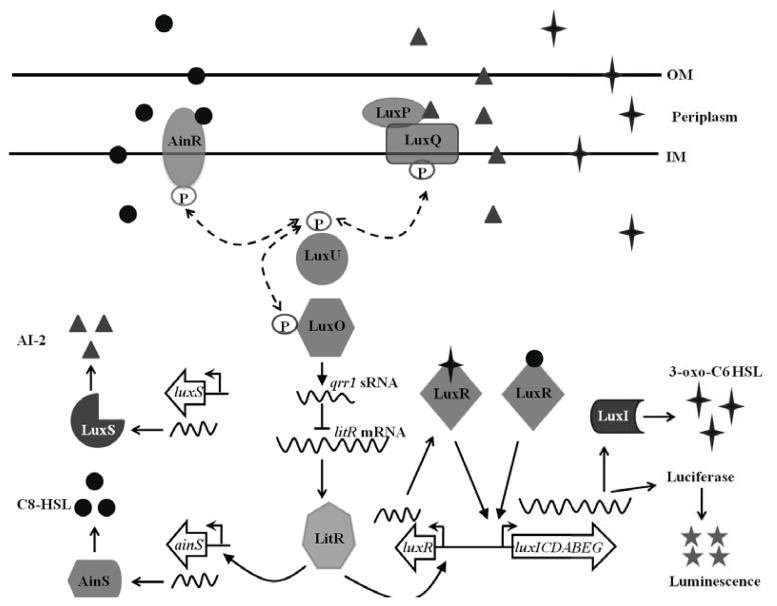
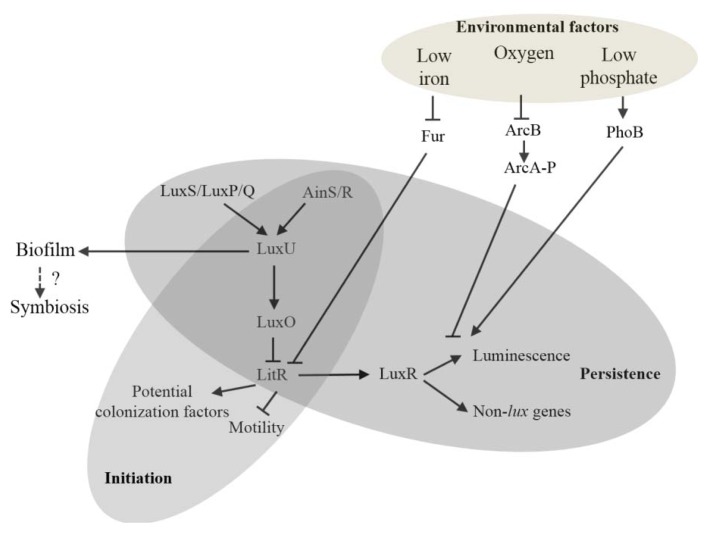
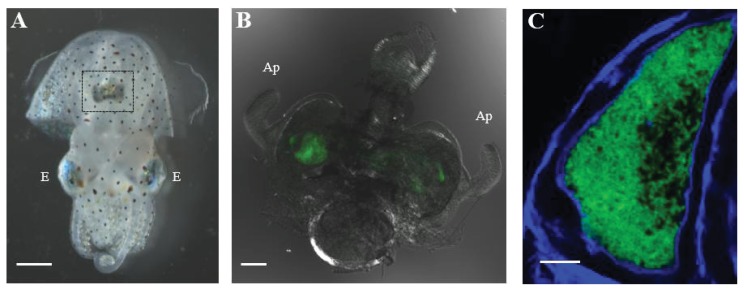
Quorum sensing is an intercellular form of communication that bacteria use to coordinate group behaviors such as biofilm formation and the production of antibiotics and virulence factors. The term quorum sensing was originally coined to describe the mechanism underlying the onset of luminescence production in cultures of the marine bacterium Vibrio fischeri. Luminescence and, more generally, quorum sensing are important for V. fischeri to form a mutualistic symbiosis with the Hawaiian bobtail squid, Euprymna scolopes. The symbiosis is established when V. fischeri cells migrate via flagella-based motility from the surrounding seawater into a specialized structure injuvenile squid called the light organ. The cells grow to high cell densities within the light organ where the infection persists over the lifetime of the animal. A hallmark of a successful symbiosis is the luminescence produced by V. fischeri that camouflages the squid at night by eliminating its shadow within the water column. While the regulatory networks governing quorum sensing are critical for properly regulating V. fischeri luminescence within the squid light organ, they also regulate luminescence-independent processes during symbiosis. In this review, we discuss the quorum-sensing network of V. fischeri and highlight its impact at various stages during host colonization.
群体感应是细菌用于协调群体行为(如生物膜形成以及抗生素和毒力因子的产生)的一种细胞间通讯形式。群体感应一词最初是为了描述海洋细菌发光杆菌培养物中发光产生的机制而创造的。发光,更广泛地说,群体感应对于发光杆菌与夏威夷短尾乌贼(Euprymna scolopes)形成互利共生关系非常重要。当发光杆菌细胞通过鞭毛运动从周围海水中迁移到乌贼的一个专门结构——光器中时,共生关系就建立了。细胞在光器内生长到高细胞密度,感染持续到动物的整个生命周期。共生关系成功的一个标志是发光杆菌产生的发光,通过在水柱中消除乌贼的阴影来使乌贼在夜间隐形。虽然调控群体感应的调控网络对于在鱿鱼光器内正确调控发光杆菌的发光至关重要,但它们也在共生期间调控发光不依赖的过程。在这篇综述中,我们讨论了发光杆菌的群体感应网络,并强调了它在宿主定植的各个阶段的影响。