Immunology Section, Department of Experimental Medical Science, Lund University, Lund, Sweden.
Eur J Immunol. 2013 Dec;43(12):3098-107. doi: 10.1002/eji.201343740. Epub 2013 Aug 21.
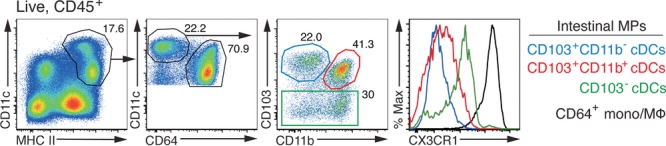
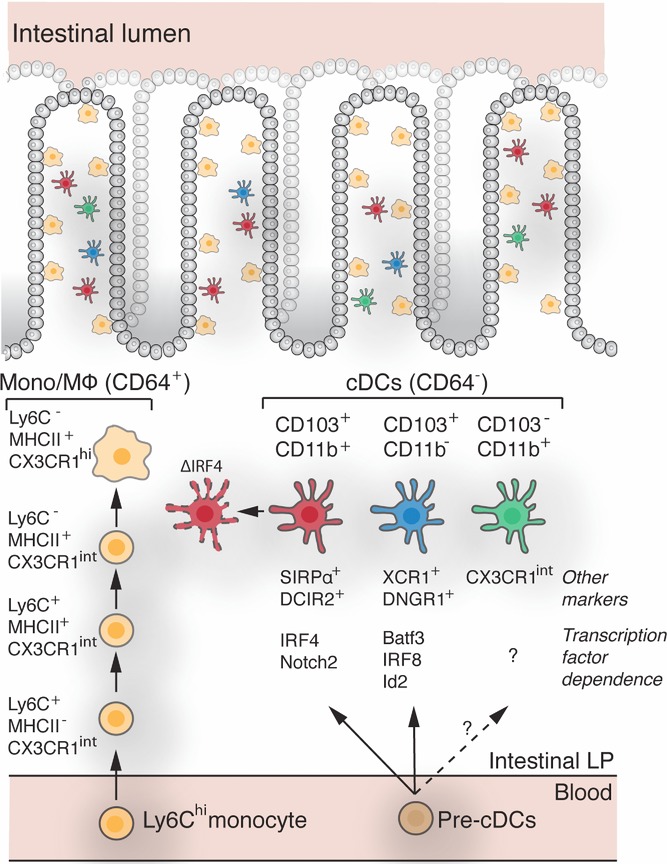
The intestinal mucosa is exposed to large amounts of foreign antigen (Ag) derived from commensal bacteria, dietary Ags, and intestinal pathogens. Dendritic cells (DCs) are believed to be involved in the induction of tolerance to harmless Ags and in mounting protective immune responses to pathogens and, as such, to play key roles in regulating intestinal immune homeostasis. The characterization of classical DCs (cDCs) in the intestinal lamina propria has been under intense investigation in recent years but the use of markers (including CD11c, CD11b, MHC class II), which are also expressed by intestinal MΦs, has led to some controversy regarding their definition. Here we review recent studies that help to distinguish cDCs subsets from monocyte-derived cells in the intestinal mucosa. We address the phenotype and ontogeny of these cDC subsets and highlight recent findings indicating that these subsets play distinct roles in the regulation of mucosal immune responses in vivo.
肠黏膜暴露于大量源自共生细菌、饮食抗原和肠道病原体的外源抗原 (Ag)。树突状细胞 (DC) 被认为参与诱导对无害抗原的耐受,并对病原体产生保护性免疫反应,因此在调节肠道免疫稳态方面发挥着关键作用。近年来,人们对肠道固有层中经典 DC (cDC) 的特征进行了深入研究,但由于使用了也表达于肠道巨噬细胞的标记物(包括 CD11c、CD11b、MHC Ⅱ类),因此关于其定义存在一些争议。在这里,我们回顾了有助于区分肠道黏膜中 cDC 亚群和单核细胞衍生细胞的最新研究。我们讨论了这些 cDC 亚群的表型和发生,并强调了最近的研究结果,表明这些亚群在体内调节黏膜免疫反应方面发挥着不同的作用。