Department of Psychiatry, University of California San Francisco, San Francisco, CA, USA.
Front Hum Neurosci. 2013 Aug 7;7:452. doi: 10.3389/fnhum.2013.00452. eCollection 2013.
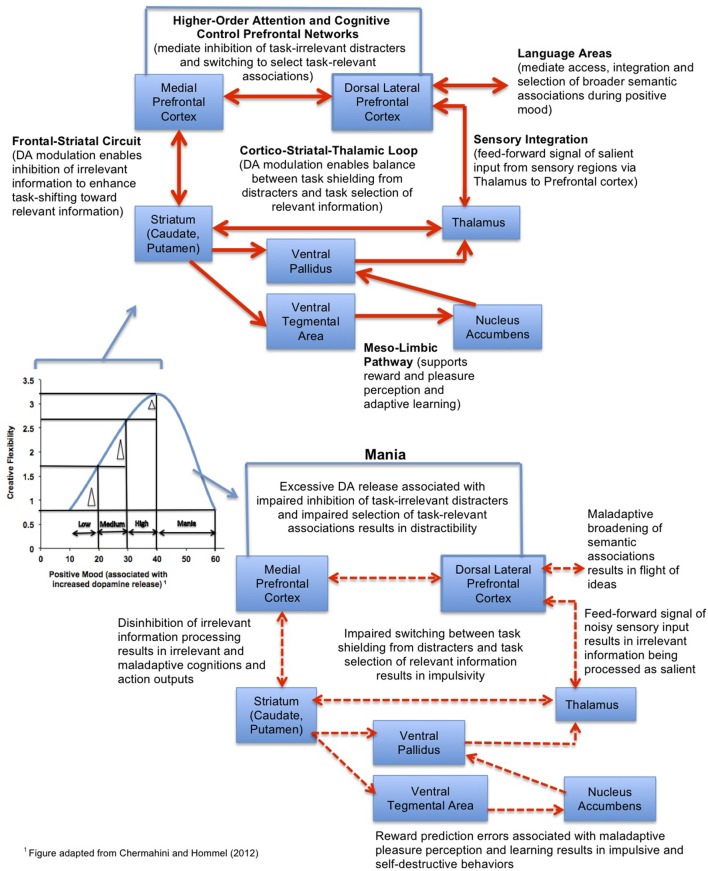
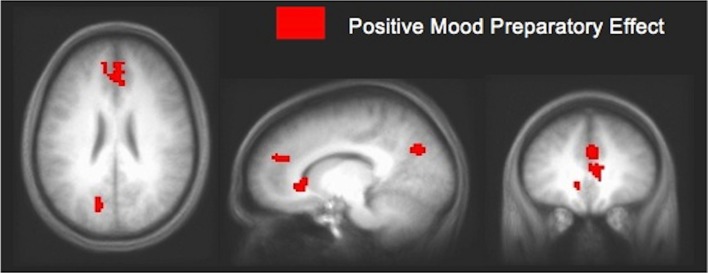
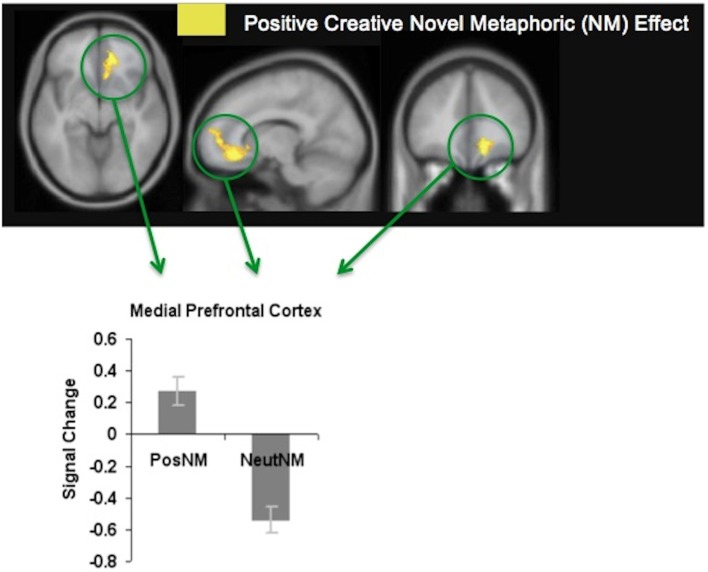
This paper reviews evidence on the neural basis of how positive mood states can modulate cognition, particularly during creative problem-solving. Studies performed over the past few decades demonstrate that individuals in a positive mood engage in a broader scope of attention, enhancing their access to distant and unusual semantic associations, and increasing task-shifting and problem-solving capacities. In this review, we summarize these behavioral studies; we then present recent findings on the changes in brain activation patterns that are induced by a positive mood when participants engage in problem-solving tasks and show how these relate to task performance. Additionally, we integrate findings on the neuromodulatory influence of positive mood on cognition as mediated by dopaminergic signaling in the prefrontal cortex and we describe how this system can go awry during pathological states of elevated mood as in mania. Finally, we describe current and future research directions using psychotherapeutic and real-time fMRI neurofeedback approaches to up-regulate positive mood and facilitate optimal creative cognitive performance. We conclude with some speculations on the clinical implications of this emerging area of research.
本文回顾了积极情绪状态如何调节认知的神经基础的证据,特别是在创造性问题解决过程中。过去几十年进行的研究表明,积极情绪状态下的个体注意力范围更广,能够更好地接触到遥远和不寻常的语义联想,从而提高任务转换和问题解决能力。在这篇综述中,我们总结了这些行为研究;然后介绍了最近关于积极情绪在个体参与解决问题任务时引起的大脑激活模式变化的发现,并展示了这些发现如何与任务表现相关。此外,我们整合了积极情绪对认知的神经调节影响的研究结果,该影响是通过前额叶皮层中的多巴胺能信号介导的,我们还描述了在躁狂等病理性升高情绪状态下,该系统如何出现异常。最后,我们描述了使用心理治疗和实时 fMRI 神经反馈方法来调节积极情绪并促进最佳创造性认知表现的当前和未来研究方向。我们对这一新兴研究领域的临床意义进行了一些推测。