Plewnia Christian, Schroeder Philipp A, Kunze Roland, Faehling Florian, Wolkenstein Larissa
Department of Psychiatry and Psychotherapy, Neurophysiology & Interventional Neuropsychiatry, University of Tübingen, Calwerstrasse 14, 72076 Tübingen, Germany; Werner Reichardt Centre for Integrative Neuroscience, University of Tübingen, Otfried-Müller-Str. 25, 72076 Tübingen, Germany.
Department of Psychiatry and Psychotherapy, Neurophysiology & Interventional Neuropsychiatry, University of Tübingen, Calwerstrasse 14, 72076 Tübingen, Germany.
PLoS One. 2015 Apr 2;10(4):e0122578. doi: 10.1371/journal.pone.0122578. eCollection 2015.
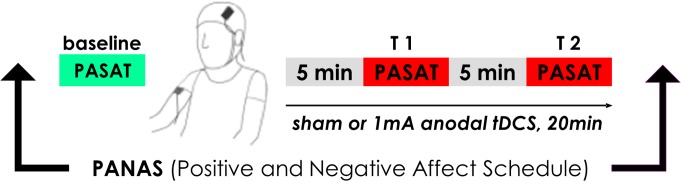
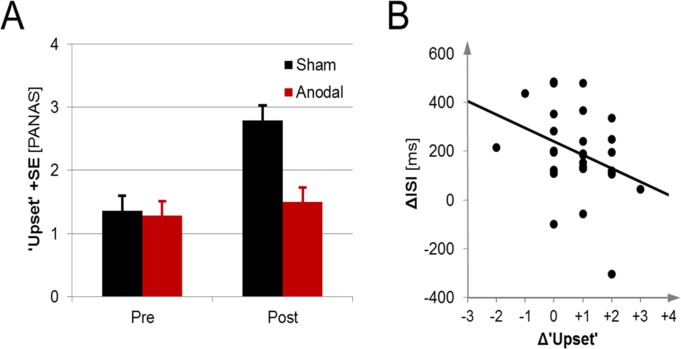
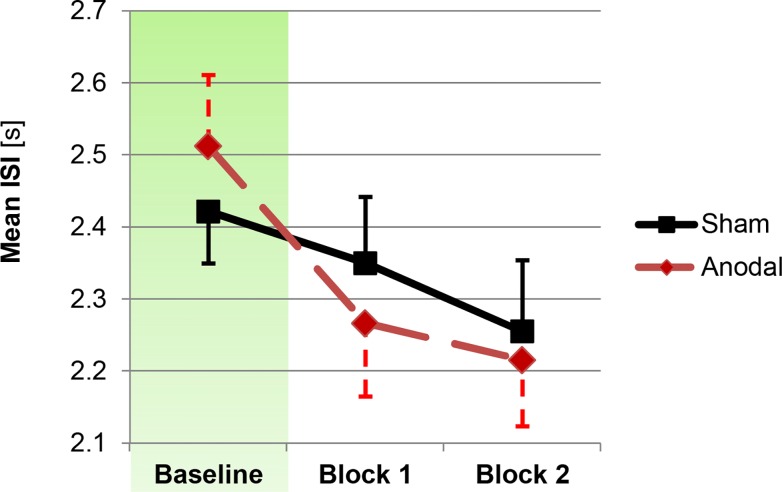
Cognitive control (CC) of attention is a major prerequisite for effective information processing. Emotional distractors can bias and impair goal-directed deployment of attentional resources. Frustration-induced negative affect and cognition can act as internal distractors with negative impact on task performance. Consolidation of CC may thus support task-oriented behavior under challenging conditions. Recently, transcranial direct current stimulation (tDCS) has been put forward as an effective tool to modulate CC. Particularly, anodal, activity enhancing tDCS to the left dorsolateral prefrontal cortex (dlPFC) can increase insufficient CC in depression as indicated by a reduction of attentional biases induced by emotionally salient stimuli. With this study, we provide first evidence that, compared to sham stimulation, tDCS to the left dlPFC enhances processing speed measured by an adaptive version of the Paced Auditory Serial Addition Task (PASAT) that is typically thwarted by frustration. Notably, despite an even larger amount of error-related negative feedback, the task-induced upset was suppressed in the group receiving anodal tDCS. Moreover, inhibition of task-related negative affect was correlated with performance gains, suggesting a close link between enhanced processing speed and consolidation of CC by tDCS. Together, these data provide first evidence that activity enhancing anodal tDCS to the left dlPFC can support focused cognitive processing particularly when challenged by frustration-induced negative affect.
注意力的认知控制(CC)是有效信息处理的主要前提。情绪干扰因素会使注意力资源的目标导向性分配产生偏差并造成损害。挫折诱导的负面影响和认知会成为内部干扰因素,对任务表现产生负面影响。因此,巩固认知控制可能有助于在具有挑战性的条件下支持面向任务的行为。最近,经颅直流电刺激(tDCS)已被提出作为调节认知控制的有效工具。特别是,对左侧背外侧前额叶皮层(dlPFC)进行阳极、增强活动的tDCS可以减少情绪显著刺激引起的注意力偏差,从而增加抑郁症患者不足的认知控制。在本研究中,我们首次证明,与假刺激相比,对左侧dlPFC进行tDCS可提高通过适应性版本的听觉序列加法任务(PASAT)测量的处理速度,该任务通常会因挫折而受阻。值得注意的是,尽管接受阳极tDCS的组中与错误相关的负面反馈更多,但任务诱发的不安情绪得到了抑制。此外,对与任务相关的负面影响的抑制与表现提升相关,这表明处理速度的提高与tDCS巩固认知控制之间存在密切联系。总之,这些数据首次证明,对左侧dlPFC进行增强活动的阳极tDCS可以支持专注的认知处理,特别是在受到挫折诱导的负面影响挑战时。